A new analysis by European clean transport organisation T&E has revealed that electric vehicles (EVs) retain their value better than the leasing industry claims, which could have significant implications for the industry as a whole.
According to T&E, the leasing industry commonly relies on used-car transaction estimates for leasing and financing deals. But by ignoring several key variables from these calculations, the industry gets it wrong, and then uses that information to lobby against more ambitious electric car policies.
T&E analysed 2025 data on standard residual value from leased cars in the four largest markets across the European Union – Germany, France, Italy, and Spain – which showed that used car transactions shows a 12.9 percentage point depreciation gap between combustion and EVs.
However, when the key variables are taken into consideration, the gap closes to just 2.6 percentage points.
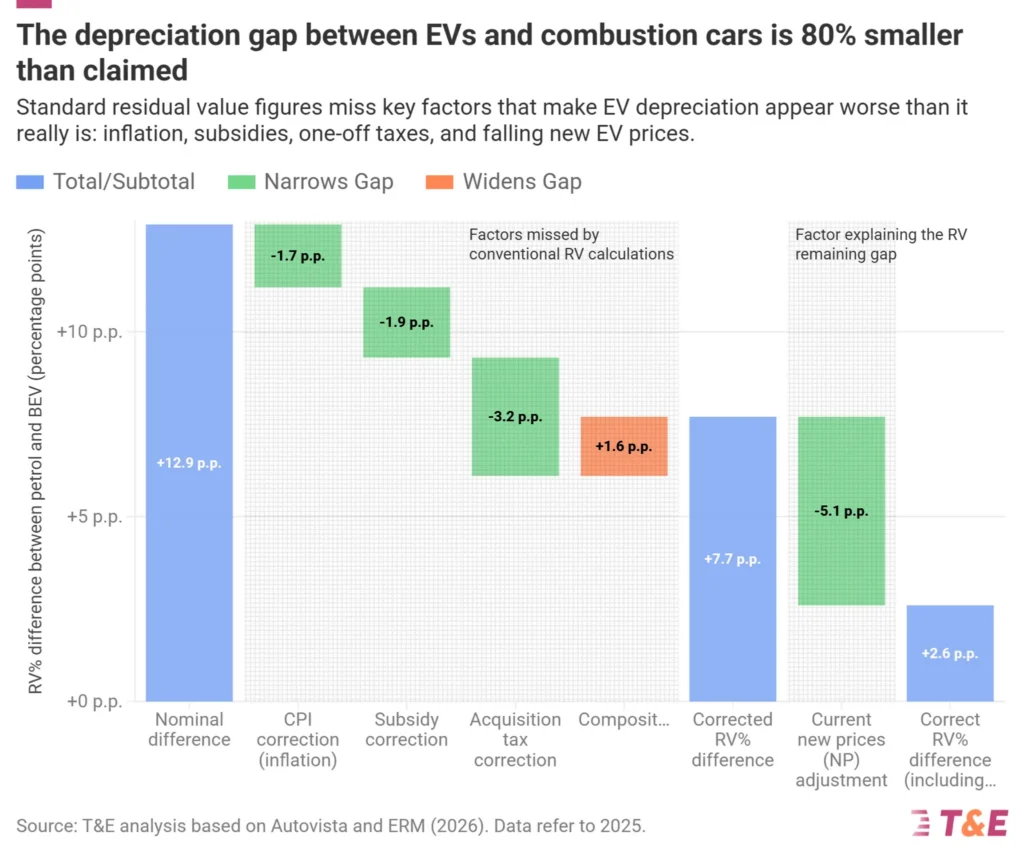
For example, according to T&E, the European leasing industry overlooks the fact that lower subsidies lower EV purchase prices, while acquisition taxes raise the purchase price for fossil-fuel cars.
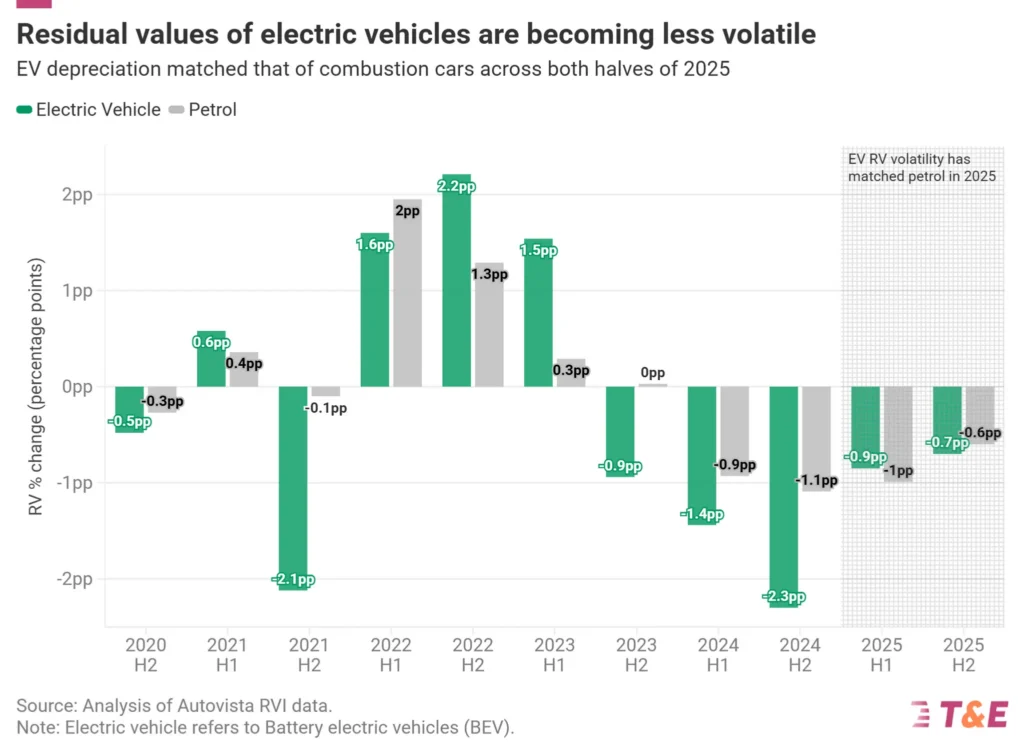
Inflation and compositional corrections also close the gap between EVs and internal combustion engine (ICE) vehicles. This has also seen the residual value of EVs become less volatile over time, and in fact matched that of ICE vehicles in both halves of 2025.
These four variables cut the original 12.9 per centage point gap by 5.2 points, while falling new EV prices are expected to bring down the average depreciation of EVs by a further 5.1 percentage points.
Even though these may sound like small discrepancies and technicalities, their impact on the overall shift to electric vehicles could be significant. According to T&E, by better addressing the retained value of EVs, not only are potential buyers of second-hand cars and leasing deals affected, but pressure increases on leasing companies, carmakers, and governments to accelerate the shift to EVs.
“The industry is painting an overly simplistic picture of EV depreciation to justify opposing EU fleet electrification targets,” said Stef Cornelis, director of the electric fleets and freight programs at T&E.
“In reality, binding targets create market predictability, allowing leasing companies to manage depreciation with greater certainty. Furthermore, targets will incentivise Member States with outdated car tax systems to adopt progressive reforms, which will ultimately reduce the real depreciation gap between powertrains over time.”