A new analysis of European vehicle emissions data has revealed that carbon dioxide emissions from plug-in hybrid (PHEV) cars are six times higher, on average, than official tests suggest.
The research group Transport & Environment (T&E) looked at emissions data for cars registered in 2024 compiled by the European Environment Agency, and found that the gap between real-world CO₂ pollution and lab-based test results has actually widened every year since real world emission measurements started in 2021.
All new cars and small vans that run on liquid fuels that are sold across the European Union have been required since 2021 to be fitted with an approved on-board fuel consumption monitoring (OBFCM) device, which provides real-world emissions data.
The first data from a sample of 600,000 cars fitted with OBFCM devices published in early 2024 revealed that the real-world CO2 emissions from plug-in hybrid electric vehicles were on average 3.5 times higher than official values from WLTP laboratory testing, where driving is tightly controlled.
Since then, data for PHEVs registered in 2021 have solidified, confirming the initial conclusions. Of a total of 360,307 PHEVs registered in 2021, the average grams of CO₂ per km (gCO2/km) was 137.05, compared to the 39.76 CO2/km expected from WLTP testing.
This gap has only increased in subsequent years: real-world emissions of 137.39 gCO2/km compared to a WLTP value of 33.08 gCO2/km in 2022; 138.45 gCO2/km compared to 28.31 gCO2/km in 2023; and 145.27 gCO2/km compared to 24.2 gCO2/km in 2024 – a 500 per cent discrepancy.
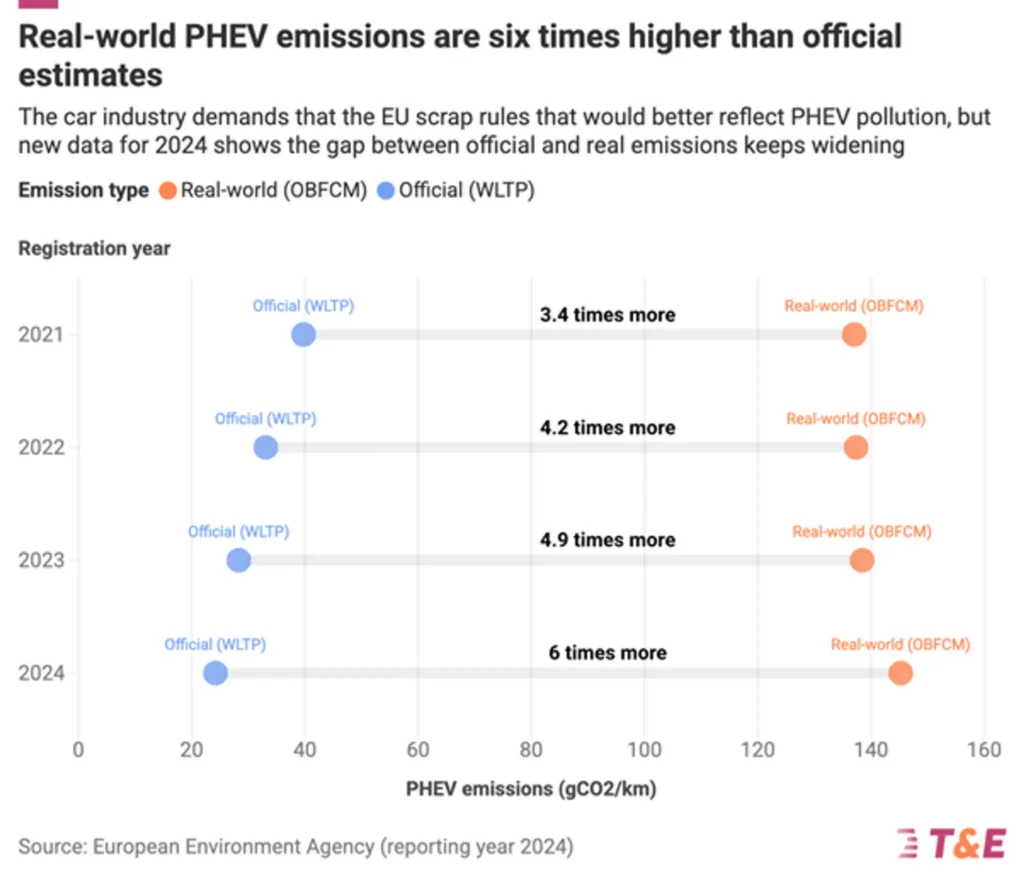
The data also shows that real-world PHEV emissions have increased by 5 per cent between 2023 and 2024, while at the same time the official WLTP emissions average reduced by 15 per cent, from 28 to 24 gCO2/km, and carmakers continued to claim that PHEV performance had improved since 2023.
This also means that PHEVs emit only 14 per cent less CO2 than conventional internal combustion engine (ICE) vehicles, which average 169 gCO2/km.
“Plug-in hybrids are one of the auto industry’s greatest greenwashing stunts – marketed as a green solution, yet delivering a heavy environmental toll in practice,” said Lucien Mathieu, cars director at T&E.
“They are also a major rip-off for consumers, who end up paying far more for fuel than expected.”
The analysis comes as the European car lobby is encouraging the EU to scrap or weaken rules that would better reflect actual PHEV pollution.
WLTP laboratory testing is based on a so-called “utility factor” which estimates the amount of time a PHEV driver spends driving solely off the battery. The European Union has intended to update its utility factors to better represent the reality that drivers often do not drive solely off a PHEVs battery.
However, carmakers across Europe, represented by their industry group, the ACEA, are clamouring for European lawmakers to abandon these revisions, which would likely force PHEVs out of the market.
“Carmakers are demanding that the EU turn a blind eye so it can delay investing in fully electric cars,” said Mathieu.
“Utility factors were designed to make official emission match with real-world; they are evidence-based policy making. If Europe wants to keep a chance to compete with China in the global EV race, it must resist any attempt to weaken the utility factors.”
Sign up for The Driven’s free daily newsletter and get the latest EV news and analysis delivered straight to your inbox.