Australia’s second-hand battery-electric vehicle (BEV) market is starting to hit its straps. From week to week now, the major car sales websites and auction house listings are showing a steady growth in both the variety and number of available BEVs.
Carsales.com.au, for instance, has recently seen BEV listings pass the 11,000 mark, 6,500-ish of which are shown as used or demo. (Just pre-Covid, I remember that number being in the low hundreds!).
Even at 11,000, this may seem small-beer compared to the current total of over 160,000 used and demo models overall on that same site – but at 4%, it has become a viable segment to start looking for a recent second-hand BEV.
That hasn’t always been the case: Australian sales of full-battery EVs (BEVs) started very slowly. In 2011 (the first year Australian BEV stats were collected), a mere 49 were sold. Even by the end of the first decade (2011-2020) the cumulative total was still only just shy of 17,000.
However, just as happened previously in many other countries (until recently, Australia had been a BEV uptake laggard), 2021 saw the long-expected acceleration with another 17,000 added in just 12 months.
Currently (as at September 30, 2026), Australia’s cumulative BEV sales have reached around 525,000 – most of which are likely still in use as almost 500,000 of them have hit the road since the end of 2021.
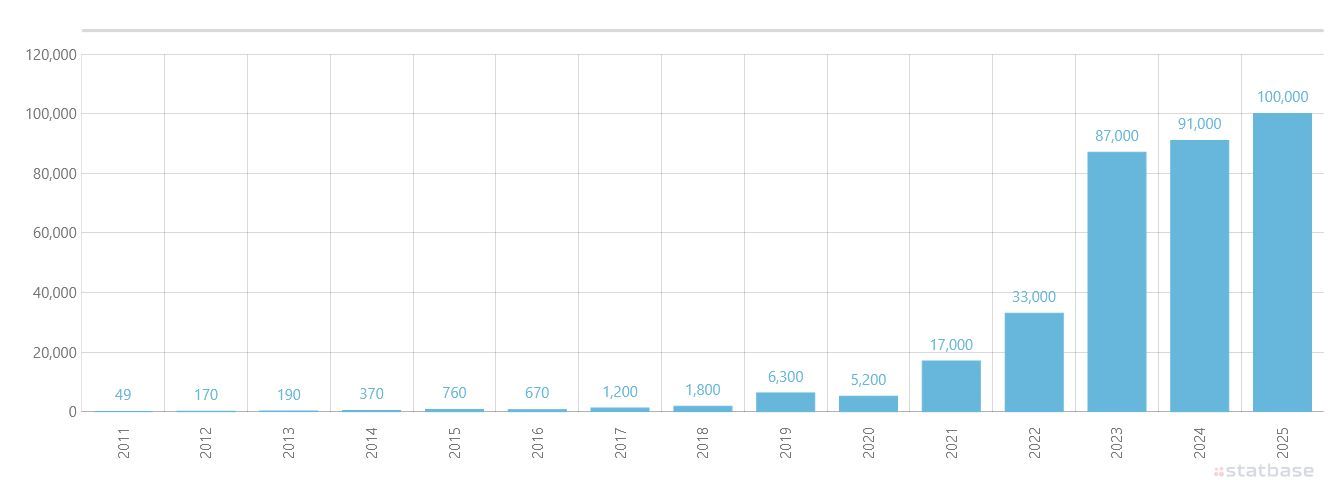
Sources: Statbase.org/aus-bev-sales and IEA Global EV Outlook reports
As a result, the first decade of second-hand BEV sales market was very thin. Prices were less a measure of a ‘market value’ and more one that reflected enthusiasts swapping treasured possessions.
Model options were also few. For instance, in 2012 there were only three: the Mitsubishi iMiEV, Nissan Leaf and Tesla Roadster. Even by the end of 2017 (when the AEVA Fact Sheets started) there were still only 7 BEV models (six passenger and one light commercial) available.
By early 2024 it appeared the second-hand market was about to mature into something near a normal ‘supply and demand’ market reflecting consumer interest – albeit with the proviso that the occasional offloading of a Nissan Leaf, Tesla Model 3 or Polestar 2 fleet was enough to flood the market and depress values of that model for a while.
As a result, I started a provisional Fact Sheet listing of second-hand BEVs available in Australia. Starting with an initial list of 19, its latest quarterly iteration now includes 46 passenger and 6 light-commercial BEVs.
Now that even new BEVs start under $20,000 on-the-road, it would seem that the second-hand market is now a viable place to buy an EV, given most are less than five years old and contain much the same EV and battery tech available in new models. (Albeit with perhaps less annoying Advanced Driver Assist System/ADAS features).
Just be sure to research the model options etc of your intended purchase before buying – some have had a number of significant upgrades over their model run here. (Oh, and the odd downgrade). To help in that research, AEVA also have a page listing individual second-hand model sheets that give many of the changes made to a model throughout its production run.
Full disclosure: Bryce is the writer of the BEV Fact Sheet suite available at the AEVA website.