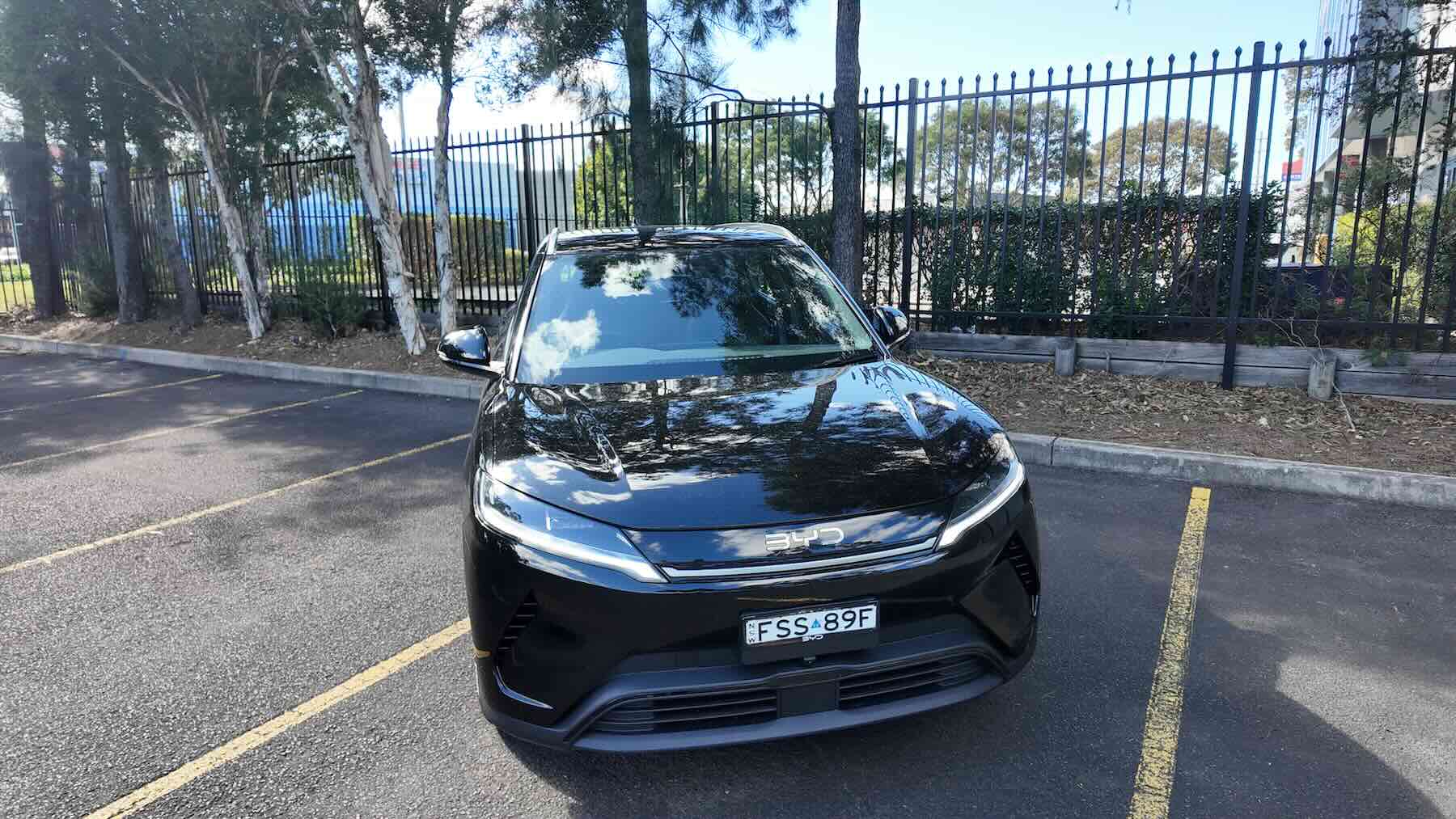
When the BYD Atto 2 arrived in Australia towards the end of 2025, its $31,990 before on-road costs starting price looked like another fairly brutal demonstration of how quickly Chinese manufacturers were rewriting the rules of the local car market.
Here was a proper five-seat electric SUV, from an established EV brand, for barely more than $30,000.
Less than a year later, the Atto 2 is exactly the same car, but the problem for BYD is that Australia’s electric vehicle market is anything but the same.
New models and even entire brands have arrived at a remarkable pace, while prices have continued to tumble. What felt bordering on extraordinary eight or nine months ago now feels (and this says quite a lot about how far the market has moved) fairly normal.
As an example, The GWM Ora 5 has since arrived from $33,990 drive-away, bringing a larger 58.3 kWh battery and as much as 435km of range.
Now the Atto 2 is being outsold by other new entrants, including the Jaecoo J5 EV, which is currently being offered at $36,990 drive-away with 402km of WLTP range, powered and ventilated seats, a 360-degree camera and a powered tailgate.
The Geely EX2 has also burst onto the scene, and outsold the Atto 2 in August, with even lower prices that are pushing price ranges towards territory that not long ago was occupied almost exclusively by petrol hatchbacks. The EX2 now starts at $26,490 before on-road costs, with its longer-range 345km Inspire costing $30,990.
See Australian electric vehicle sales by month in 2026 – by model and by brand
All of which raises a slightly different question from the one we might have asked when the Atto 2 was initially launched.
It less about whether the Atto 2 is a good cheap EV. It’s whether it is still particularly remarkable. I had the Atto 2 as my daily driver for a week to find out more.
At 4.31 metres long, the Atto 2 is genuinely compact, which is rather useful for a vehicle primarily aimed at city buyers. It’s like a Tardis, small on the outside but surprisingly roomy inside.
It has a fairly conventional upright SUV shape, rather than being a hatchback wearing black wheelarch cladding and hoping nobody asks too many questions. There are slim headlights, a full-width rear light bar and, naturally, sufficient dark plastic around the lower body to satisfy the international legal definition of “SUV”.
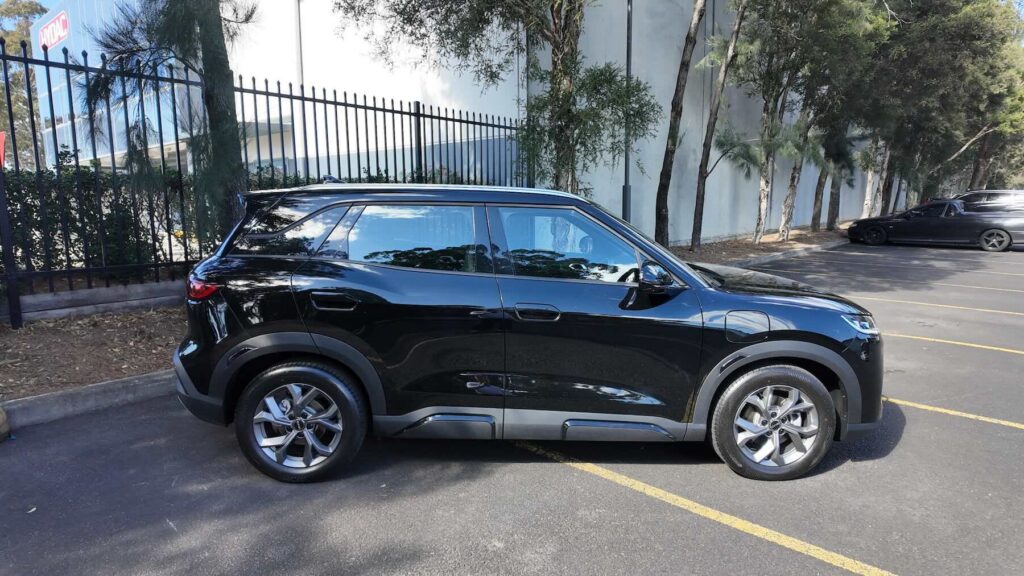
It isn’t especially adventurous, but that is unlikely to bother its intended buyer. If anything, the restrained design should age reasonably well.
The same applies inside. BYD has toned things down considerably from the original Atto 3, whose interior famously included guitar-string door pockets and various gym-inspired design flourishes. The Atto 2 is cleaner, simpler and, to my eyes at least, better for it.
You’ll also find the welcome addition of some physical buttons on the centre console for functions including the drive modes, volume and auto hold.
Both variants get synthetic leather upholstery, wireless Apple CarPlay and Android Auto, and BYD’s familiar rotating touchscreen. The entry-level Dynamic gets a 10.1-inch central display, while the Premium tested here gets a larger 12.8-inch version.
The Premium also brings electrically adjustable, heated and ventilated front seats, a panoramic glass roof, eight-speaker audio, wireless phone charging and a 360-degree camera. The Dynamic misses all of those items.
So while the Dynamic is $31,990 before on-road costs and the Premium $35,990, yet there is absolutely no difference in battery, motor, range or performance. You are paying $4,000 entirely for cabin equipment, which is an arguably significant sum for an entry-level EV.
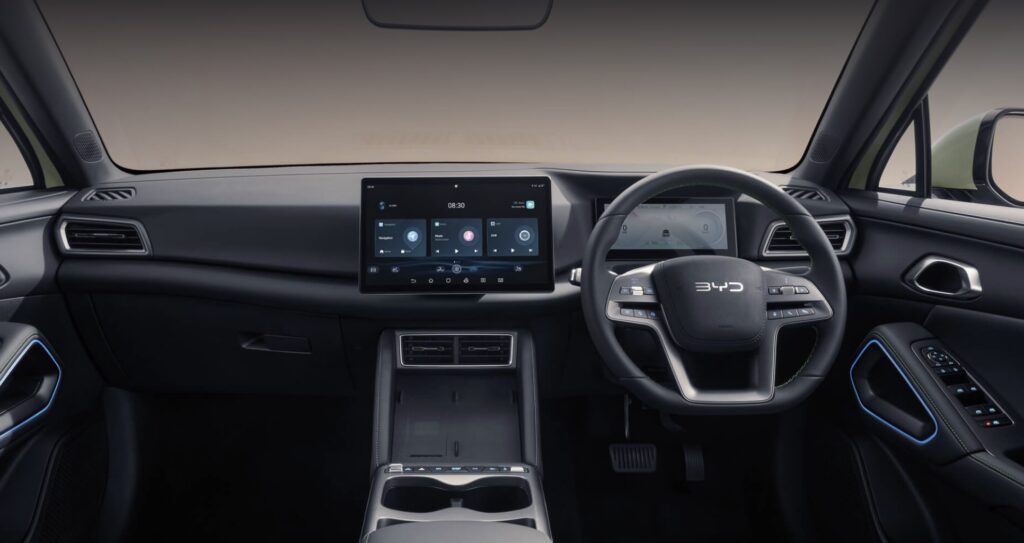
Some of the Premium extras are potentially worthwhile considering paying the premium for. I would particularly miss the presence of a 360-degree camera and wireless charger, but then once the Atto 2 gets close to $36,000 before on-roads, today’s competition starts looking considerably more serious.
BYD seems conscious of that. At the time of publication it is offering Premium buyers a temporary $2,000 “Your Way” incentive, which can be taken as cashback or put towards selected products and services, for eligible orders placed before September 30.
Both Atto 2s use a 51.13kWh BYD Blade battery feeding a single front-mounted motor producing 130kW and 290Nm. BYD claims 0-100km/h in 7.9 seconds and 345km of range on the WLTP cycle. The specifications remain unchanged from launch.
That range makes sense for the sort of car this is. For commuting, school runs and suburban errands (which is what I primarily used it for in the week I had it), 345km was more than adequate, particularly with the ability to charge at home. Efficiency over the week was good with an average of 14kWh/100km.
Unsurprisingly, the Atto 2 begins to look less convincing for long distance travel. AC charging is limited to 7kW and DC charging tops out at around 82kW. In a market where 11kW AC and triple-digit DC charging rates are becoming increasingly common, those figures already look dated despite the car itself being less than a year old.
Vehicle-to-load is standard on both grades, with up to 3.3kW available through the supplied external adaptor. There is no frunk. Given the amount of unused-looking space under the bonnet, it does feel like something of a missed opportunity.
One area where the Atto 2 punches above its physical dimensions is passenger space. At 195cm tall, I could sit comfortably in the back, helped considerably by the tall roofline. Two child seats should fit comfortably, and rear passengers also get an air vent plus USB-A and USB-C charging.
The same synthetic leather is used across both grades and the rear cabin doesn’t immediately advertise the fact that you bought one of Australia’s least expensive electric SUVs.
Boot space is 380 litres, growing to 1,320 litres with the rear seats folded. It’s adequate for shopping, luggage or a smaller pram, although anyone contemplating a fortnight away with multiple small children may want to investigate either a larger car or the ancient art of packing very, very lightly.
There is useful storage beneath the boot floor, although no powered tailgate, even on the Premium.
So what’s it like to actually drive? The Atto 2 makes the most sense when driven in exactly the environment its dimensions suggest: around town.
The accelerator response is smooth, the steering is light and it has enough of the instant shove familiar to EV drivers to feel responsive in suburban traffic. With 130kW it’s not slow, and you still get that instant torque as you get from all electric motors, but it’s also not the kind of EV that will give you the opportunity to turn every green light into an unsolicited demonstration of acceleration.
And that’s perfectly fine.
The Atto 2 is an uncomplicated urban commuter, and in that role it works well.
The suspension is generally comfortable, although larger bumps can make themselves known, and there is noticeable body movement if you attack a roundabout too aggressively.
At motorway speeds there is also more tyre and wind noise than in some newer or more expensive EVs, and the modest motor feels less muscular once speeds rise.
You could quite happily take it from Sydney to Canberra, but you probably wouldn’t buy one because you regularly drive Sydney to Canberra.

There are just two regenerative braking settings and even the stronger setting remains relatively mild. Proper one-pedal driving isn’t available, something that will frustrate some seasoned EV owners who want one-pedal driving.
If there is one part of the Atto 2 that makes its rapid ageing most obvious, it is the driver’s display and software.
The 8.8-inch instrument cluster is busy, cluttered and not particularly easy to read at a glance. That would be mildly annoying in any car, it feels particularly odd in an EV launched only months ago.
During my time with the car, the built-in navigation also returned a server error rendering it unusable, although wireless Apple CarPlay meant there was an easy escape route.
More frustrating was the speed-limit assistance. At various points the car correctly displayed an 80km/h speed sign on one side of the instrument panel while simultaneously warning me that I was exceeding a 60km/h limit.
One imagines the two halves of the computer may eventually meet and discuss the matter.
The broader driver-assistance package isn’t among the most intrusive I’ve experienced, but those sorts of errors undermine confidence fairly quickly.
On safety, the Atto 2 comes pretty well equipped, with AEB, adaptive cruise, blind-spot monitoring, rear cross-traffic braking, lane-keeping assistance and six airbags. The one caveat is that it still doesn’t have an independent ANCAP rating.
The Atto 2 is still a reasonable car, but the pace of the electric vehicle market (lead primarily by BYD), almost ironically puts the Atto 2 in an unusual position of looking slightly outdated less than a year into its release.
It is comfortable, spacious for its size, pleasant to drive around town, reasonably practical and offers enough range for the everyday use its buyers are likely to throw at it.
The Dynamic still has a convincing argument at $31,990 before on-road costs because it gives you exactly the same 130kW motor, 51.13kWh battery and 345km range as the Premium, but it lacks some basic cabin features that I think should come standard.
I’m less sure on the $35,990 Premium. The extras are good, and BYD’s current $2,000 promotion improves the equation, but the moment you move into the mid-$30,000s the Atto 2 finds itself surrounded by increasingly capable alternatives.
For BYD, The Atto 2 may end up a victim of its own success. Eight months ago it helped push the affordable EV market forward. Now the market has simply caught up, and in a few places, overtaken it. It’s worth pointing out that despite this, the Atto 2 remains the 6th most popular EV in Australia this year to date, with 6,615 vehicles delivered. You can find all the 2026 EV sales data here.
Whether it can maintain a position in the top 10 vehicles in Australia will be an interesting watch.
In most corners of the car market, a model less than a year old would still feel pretty fresh. In the Australian EV market, eight months can feel like a generation.
| Atto 2 Dynamic | Atto 2 Premium (as tested) | |
|---|---|---|
| Price before on-roads | $31,990 | $35,990 |
| Battery | 51.13kWh LFP Blade | 51.13kWh LFP Blade |
| Motor | Front, single motor | Front, single motor |
| Power / torque | 130kW / 290Nm | 130kW / 290Nm |
| WLTP range | 345km | 345km |
| 0–100km/h | 7.9 sec | 7.9 sec |
| AC charging | 7kW | 7kW |
| DC charging | Up to 82kW | Up to 82kW |
| V2L | 3.3kW | 3.3kW |
| Boot | 380L / 1,320L seats folded | 380L / 1,320L seats folded |
| Wheels | 16-inch | 17-inch |
| Centre screen | 10.1-inch | 12.8-inch |
For a full rundown of all available EV models in Australia, please go to our Compare EVs page here.
And you can sign up for The Driven’s free daily newsletter and get the latest EV news and analysis delivered straight to your inbox.