The Australian electric car market has become increasingly crowded, but there is one type of vehicle that remains surprisingly uncommon: the humble sedan.
Kia is hoping there are still plenty of buyers who would rather sit lower to the ground than climb into yet another electric SUV, with the EV4 competing as a direct rival to the Tesla Model 3 and BYD Seal.
I had the mid-spec EV4 Earth as my daily driver for a week, and I’ve come away rather fond of it. It’s comfortable, surprisingly practical, very efficient and, with more than 600km of claimed range, unlikely to have most owners thinking about charging very often at all.
It isn’t perfect. Kia has been a bit stingy with some of the standard equipment, particularly given the price of the Earth, and its DC charging speed is respectable rather than remarkable. But after spending a week in the EV4, I’m also wondering whether quite so many of us actually need an SUV.
There are three EV4 variants in Australia: Air, Earth and GT-Line. The Air gets the range started at $49,990 before on-road costs, while the Earth tested here is offered at $59,990 before on-roads. Above that sits the GT-Line at 64,690-plus on-roads.
The Air gets the smaller pack and range in the 400km bracket, while the Earth and GT-Line get the larger battery and more than 600km of WLTP range. There’s no extra performance in the GT-Line. Both it and the Earth use the same 150kW front-wheel-drive powertrain. The additional money gets you things such as a sunroof, 360-degree camera and ventilated seats.
That makes the Earth look like the obvious sweet spot on paper: the big battery without paying for the top trim. I’m less convinced about the value equation once you start looking at what Kia has left out, but we’ll get to that.
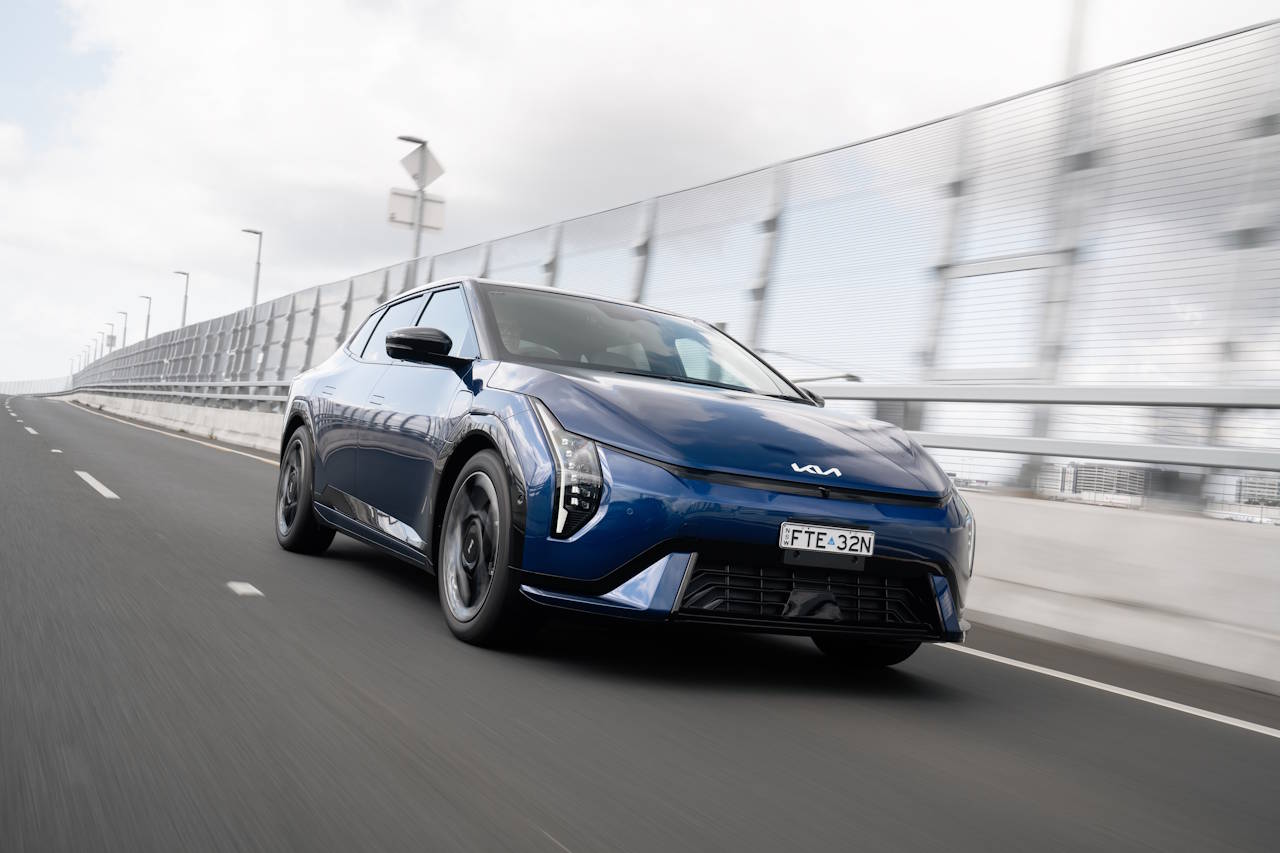
Aesthetically, the EV4 is definitely not boring. Beauty is obviously subjective, but I really like it. There’s something about the proportions and the almost square-looking wheels that reminds me of the sort of futuristic car I imagined as a kid.
The vertical lights front and rear help, as does the low, sleek body. Then there’s the back tail which extends quite a long way and gives the EV4 what I described in my video review, with considerable technical precision, as a bit of a big bum. I still like it.
Kia has developed a fairly distinctive design language across its newer cars and I’d rather manufacturers take a few risks than produce another anonymous blob.
I could do without the flush door handles though. You push one end in and then grab the other. It’s not difficult and it certainly wouldn’t stop me buying the car, but I remain unconvinced that opening a door was a problem requiring further innovation.
Pop the bonnet and there is no front storage compartment. Kia has at least put a plastic cover over most of the electrical hardware, so you’re not greeted by a tangle of cables, but I still think the lack of a frunk is a missed opportunity.
Fortunately, the boot itself is excellent for a sedan. Kia quotes 490 litres, and the thing that struck me was how deep it is. Suitcases, shopping bags and everyday luggage aren’t going to be an issue.
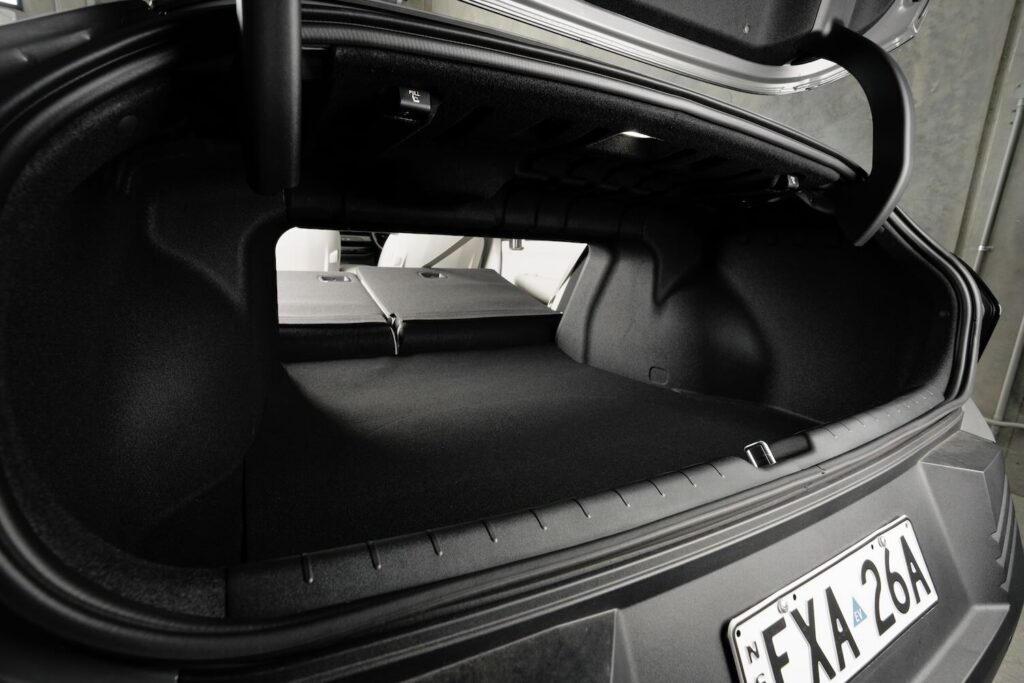
Fold the rear seats and there’s more than 1,400 litres available, while a small underfloor compartment gives you somewhere to put charging cables and a few other bits and pieces.
The catch is the opening. This isn’t a liftback, so the rear window stays where it is. While the litres look great on the specification sheet, getting something tall or awkward through the opening could still be a pain. A bike or particularly bulky pram is where an SUV or hatchback starts to earn its keep. For everything else, though, I was genuinely surprised by how useful the EV4’s boot is.
The cabin gets most things right. At 6’5″, I tend to find out fairly quickly whether a car’s roofline has prioritised styling over people. There were no problems here. I could get comfortable in the driver’s seat without feeling like my head was part of the roof lining.
The seats themselves are good, and the mesh headrests fitted to the Earth and GT-Line are especially comfortable. They feel almost like small pillows behind your head, which suits the generally relaxed nature of the car. The Earth also gets heated front seats.
Material quality is decent rather than luxurious. The parts of the cabin you look at and touch most often feel good, while the centre console gets into harder plastics as you move down. I don’t necassraily have a major problem with that, and it feels appropriate for a mainstream Kia. On the other hand, you can get much more luxurious interiors for the same price elsewhere.
Perhaps more importantly, the layout works. Kia uses a wide arrangement of screens across the dashboard for the instrument cluster, climate display and infotainment, but it hasn’t taken that as permission to delete every button. There are still physical controls for climate, volume and other commonly used functions. I much prefer this approach. The cabin still looks clean and modern, but you don’t need to swipe through three menus because you’ve decided your feet are cold.
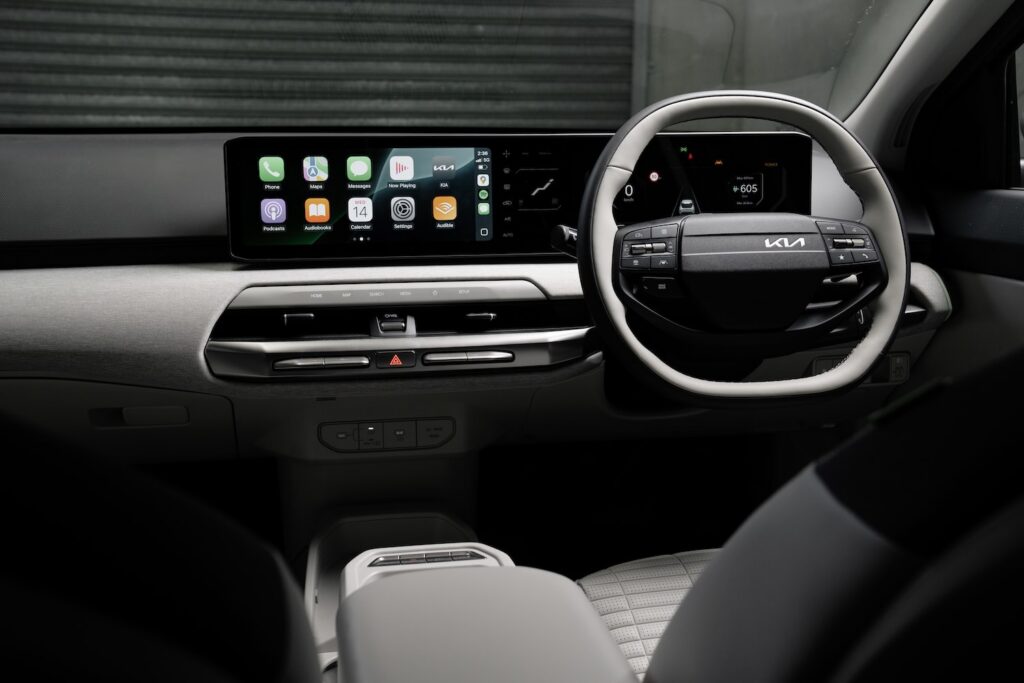
One thing that particularly annoyed me was the lack of a wireless phone charger. During the first couple of days I kept putting my phone in different spots around the centre console, assuming I simply hadn’t found the wireless charging pad. There isn’t one.
The Earth gets wireless Apple CarPlay and Android Auto, USB-C ports and plenty of other technology, but not wireless phone charging. For a car that’s getting close to $60,000 on the road, that feels pretty ordinary. You need the GT-Line for wireless charging. The same applies to the 360-degree camera and ventilated seats.
I can understand Kia needing to differentiate the grades, but wireless phone charging hardly feels like the sort of decadent luxury that should be roped off for top-spec buyers in 2026. I’d also expect a 360-degree camera at this price.
I’ve had two child seats in the back throughout the week and the EV4 has handled family duties without much trouble. There’s obviously less room than in a medium SUV. In an MG S6 I recently tested I could squeeze myself between two child seats; I’m not volunteering to attempt that very often in the EV4.
But two kids fit perfectly well, and rear passengers get air vents and USB-C ports mounted in the backs of the front seats. Where the SUV argument starts to make more sense is when you’ve got very young children and all the accompanying equipment.
Prams seem to expand in size roughly in proportion to how badly you need to get somewhere quickly, and that’s where the narrower sedan boot opening becomes inconvenient. But once you get past the stage of having to take around all the large newborn items, the EV4 is a perfectly viable family car.
The Earth and GT-Line’s big selling point is range. Kia claims more than 600km WLTP, and my week with the car suggests the EV4’s efficiency is genuinely good.
After roughly 180km, mostly around the city with a small amount of highway driving, I was averaging around 16kWh/100km. The battery was still showing 66 per cent, with 413km of predicted range remaining. Of course city driving suits an EV, and I’d expect consumption to rise on a sustained highway run. But it does illustrate what 600km-plus range means in normal use.
Plenty of owners could charge this car once a week. For me, that’s more useful than chasing another enormous power figure or shaving half a second from the 0–100km/h time.
Charging is fine, although hardly a party trick. AC charging is up to 11kW, while DC charging peaks at around 128kW. The EV4 uses a 400-volt architecture rather than the ultra-fast 800V setup found in the EV6 and EV9. That said, 128kW is perfectly serviceable.
And when you already have more than 600km of claimed range, the number of occasions where you’re standing beside a public fast charger wondering why the car isn’t pulling another 100kW is probably fairly limited.
I’d still like to see faster charging, particularly as newer competitors push well beyond this figure. But I don’t think it ruins the car.
The EV4 also supports Vehicle-to-Load, allowing you to draw around 3.5kW from the battery, which is good for camping equipment, power tools, laptops and other appliances.
It’s also V2G-ready. The infrastructure and commercial arrangements around vehicle-to-grid are still developing in Australia, but the important part is that the car itself is designed to participate once the rest of the system catches up.
An 80-odd-kWh battery sitting in your driveway is an enormous energy resource. Eventually, what an EV can do while parked may become nearly as important as what it does on the road.
I’ll be hosting a live episode of The Driven Podcast on the topic of V2G at the upcoming Everything Electric Show in Sydney.

One of the best things about the EV4 is how it drives. It’s just a very soothing car to drive. The 150kW motor provides more than enough performance for everyday driving. It pulls strongly onto a highway, overtaking is easy and you get the instant response you’d expect from an EV. But it’s the smoothness of that acceleration that stood out.
I’ve driven several electric SUVs recently and getting back into a sedan was surprisingly refreshing. The EV4 feels lower, lighter on its feet and more agile. It’s easy to manoeuvre and there’s less of that sense of carrying around a large, tall body that comes with many SUVs. I never found myself wishing it was faster.
There is something faintly ridiculous about reaching the point where a 150kW family sedan can be described as lacking performance, but EVs have distorted our expectations somewhat. It’s quick enough. More importantly, it’s comfortable and enjoyable.
Sedans used to be everywhere in Australia. Now more than 60 per cent of new vehicles sold are SUVs, and the switch to electric hasn’t done much to change that. While we have plenty of electric SUVs electric sedans are considerably less common.
The obvious rivals to the EV4 are the Tesla Model 3 and BYD Seal. You can probably include the Polestar 2 if you’re happy stretching the definition to include a liftback.
So who is a sedan for? Someone who doesn’t regularly need the extra height and cargo flexibility of an SUV, basically.
Couples, smaller families, commuters and people coming out of cars such as a Toyota Camry or Honda Accord are obvious candidates. The EV4 gives you plenty of passenger room and a large boot without the bulk of an SUV. Its lower body helps aerodynamics and range, and it’s more enjoyable to drive as a result. I’m increasingly unconvinced that sitting 150mm higher off the ground is quite as essential as the Australian new-car market suggests.
You can adjust the regenerative braking using the paddles behind the steering wheel. There are three main levels, and I spent most of my time in the strongest setting which I found to be well tuned. Only after I completed my video review did I realise there was a one-pedal option which can be activated by holding the left paddle. I’ve driven several newer Chinese EVs where strong one-pedal driving simply isn’t available, so I appreciate Kia continuing to give drivers the choice.
The EV4’s driver assistance systems are among the less annoying ones I’ve experienced recently. There are still speed warnings and the usual collection of assistance systems, but they’re reasonably restrained and relatively straightforward to switch off. Although a short-cut function like the MG’s MGPilot which allows you to revert to your preferred ADAS settings with just two a swipe and a touch of the screen. would be a welcome addition.
Kia’s software is also pretty good. I’m familiar with Hyundai’s interface from my own driving, and I think Kia currently does the software side slightly better. It’s responsive, easy to understand and doesn’t feel particularly laggy. The built-in navigation is useful, and the screens aren’t being asked to replace every physical control in the car.
It’s a combination that works. You get the big, modern displays buyers now expect, along with knobs and buttons for the things you actually want to adjust while moving. After a few days I stopped thinking about the infotainment system, which is probably about the best outcome possible.
The problem for the EV4 is the price. The EV4 hasn’t exactly set the Australian sales charts alight so far, and I suspect there are two fairly straightforward reasons. The first is that it’s a sedan. The second is price.
The Air starts below $50,000, which is reasonable, but it doesn’t get the long-range battery. Move to the Earth and you’re into the mid-$50,000s before on-road costs and around the $60,000 mark once it’s on the road.
At that point you’re shopping against a Tesla Model 3 and some increasingly competitive Chinese EVs. That’s where things like the missing wireless charger and 360-degree camera start to irritate.
They’re small things, but they can matter when two cars are sitting next to each other on a shortlist and one of them gives you more equipment for less money. I’d like to see the Earth cheaper, better equipped, or ideally both.
Overall, I’ve really enjoyed having the EV4 Earth for the week. The range is excellent, it’s efficient, the cabin is comfortable, the boot is much bigger than I expected and Kia’s software and driver assistance systems are among the better ones I’ve used recently.
More than anything, I like driving it. Getting out of a succession of electric SUVs and into something lower and more agile has been a reminder of why sedans were so popular for so long.
If you’re coming out of something like a Camry or Accord, don’t need the extra height of an SUV, and want to move into an EV without buying a Tesla, the EV4 could make a compelling case.
Kia EV4 Earth key specs
| Specification | EV4 Air | EV4 Earth (as tested) | EV4 GT-Line |
|---|---|---|---|
| Drive-away price* | $52,990 | $62,990 | $68,490 |
| Battery | 58.3kWh | 81.4kWh | 81.4kWh |
| WLTP range | 456km | 612km | 612km |
| Power | 150kW | 150kW | 150kW |
| Torque | 283Nm | 283Nm | 283Nm |
| Drive | Front-wheel drive | Front-wheel drive | Front-wheel drive |
| 0–100km/h | 7.4 sec | 7.8 sec | 7.8 sec |
| AC charging | Up to 11kW | Up to 11kW | Up to 11kW |
| DC charging | Up to 128kW | Up to 128kW | Up to 128kW |
| 10–80% DC charge | Approx. 29 min | Approx. 31 min | Approx. 31 min |
| Boot space | 490L | 490L | 490L |
| Wheels | 17-inch | 19-inch | 19-inch |
| V2L interior | Yes | Yes | Yes |
| V2L exterior adaptor | No | Yes | Yes |
| Braked towing capacity | 500kg | 1,000kg | 1,000kg |