The federal government has announced a $32 million investment to help support a plan to convert forestry waste into Australian-made jet fuel.
The funding, made through the Australian Renewable Energy Agency (ARENA), will be provided to Melbourne based company HAMR Energy as it seeks to develop a series of low-carbon liquid fuels (LCLF) projects using residual forestry biomass.
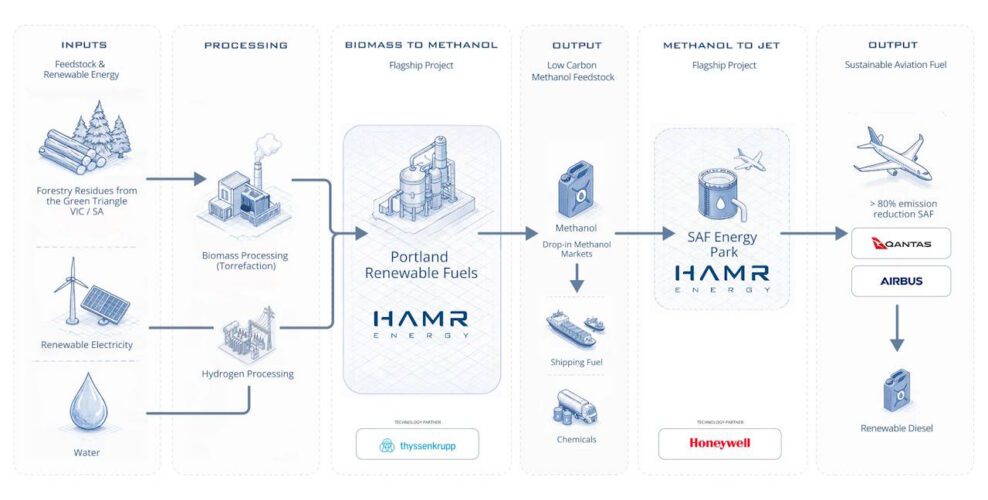
HAMR, founded in 2020, is in developing several sustainable aviation fuel (SAF) projects, including one that uses residual forestry biomass and renewable energy to make low-carbon methanol, which is then converted into low-carbon methanol or other low-carbon liquid fuels.
SAF has emerged as the likely best way to decarbonise hard-to-abate transport industries such as aviation and shipping, which still rely on liquid fuels because batteries do not, and likely will not, be able to meet all their clean power needs.
The company has already secured partnerships and investments from big-name stakeholders including Thyssenkrupp, Honeywell, OneFortyOne, Qantas, and Airbus.
ARENA’s funding will be split into two stages, starting with a $12.5 million grant to be used for an early Front End Engineering Design (FEED) phase. The second $19.5 million will be subject to HAMR Energy securing the necessary co-funding to commence a detailed design phase.
With a total project cost of $92 million, ARENA’s funding will be used specifically to undertake development and design work on three separate facilities which form the links in an eventual sustainable aviation fuel supply chain.
This includes a biomass processing facility located in Victoria which will be capable of handling approximately 600,000 tonnes a year of forestry residues – which includes byproducts and residues such as sawdust, bark, woodchips, thinnings, and other material left over after harvesting and processing has occurred that typically have limited other markets.
Despite the government’s insistence of describing this as “forest waste”, it is better described as “forestry waste”.
The second facility is the proposed Portland Renewable Fuels methanol project located in Portland, Victoria, which would be capable of producing approximately 300,000 tonnes of renewable methanol each year.

Image Credit: HAMR Energy
Methanol produced at the Portland Renewable Fuels facility would then be used at a proposed Methanol to Jet SAF Energy Park set to be built in Gillman, South Australia, which would use the methanol to produce approximately 140 megalitres of sustainable aviation fuel each year.
For comparison, a fully fuelled Boeing 747-8, the largest model of the 747 family, holds approximately 238,600 litres, or 0.2386. For a Boeing 747-8 to fly from Melbourne to Los Angeles it would need around 0.15 megalitres of fuel, meaning 140 megalitres of SAF would be capable of fuelling over 900 flights between Melbourne and Los Angeles.
Liquid fuels currently account for around half of Australia’s national energy use, meaning that replacing fossil fuel-based liquid fuels with cleaner alternatives is capable of delivering a significant reduction in carbon emissions.
“Australia has an abundant supply of forest waste and turning it into fuel for hard-to-abate sectors like aviation would be a win for emissions, Australian industry and regional jobs,” said Chris Bowen, federal minister for climate change and energy.
“Projects like this can help strengthen Australia’s long-term fuel resilience by supporting more domestic fuel production and a more diverse fuel supply, making us more resilient to global energy shocks.”