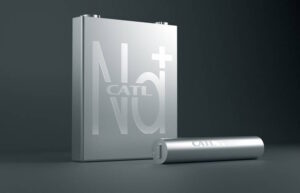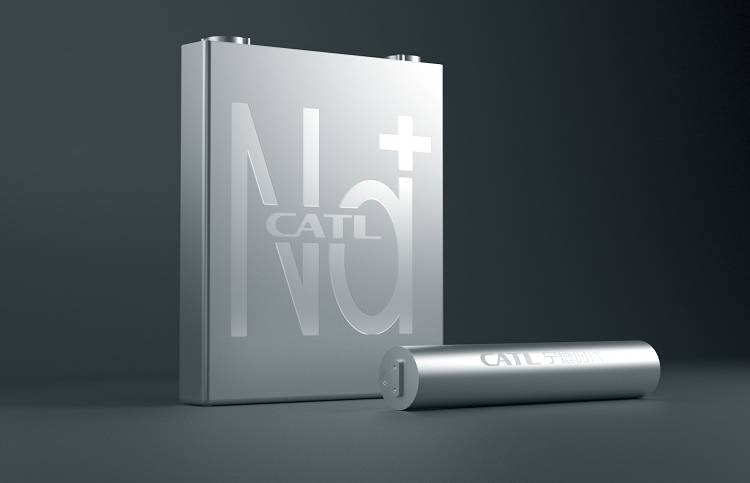
Sodium-ion batteries are entering commercial production with more than 70 GWh of supply agreements, according to Wood Mackenzie. The firm expects leading manufacturers to match lithium iron phosphate (LFP) batteries on cell costs by the end of 2026, with cost parity for modules and complete systems expected after 2030.
In the race to deliver enough battery capacity to supply the duelling demands of stationary battery energy storage systems (BESS) as well as batteries for the automotive sector, battery manufacturers are pushing development of alternative battery chemistries to find the best solution for each sector.
Sodium-ion batteries (SIBs) use sodium in place of lithium. Lithium iron phosphate (LFP) batteries still use lithium, but their cathodes use iron and phosphate in place of the nickel and cobalt found in some other lithium-ion chemistries.
But a new analysis from energy analysts Wood Mackenzie finds that SIB is establishing itself as the most cost-effective emerging alternative to lithium-ion battery storage and is expected to achieve cell-level parity with LFP amongst market leaders by the end of 2026, and module and system level cost parity post-2030.
Sodium carbonate vs lithium carbonate price index comparison
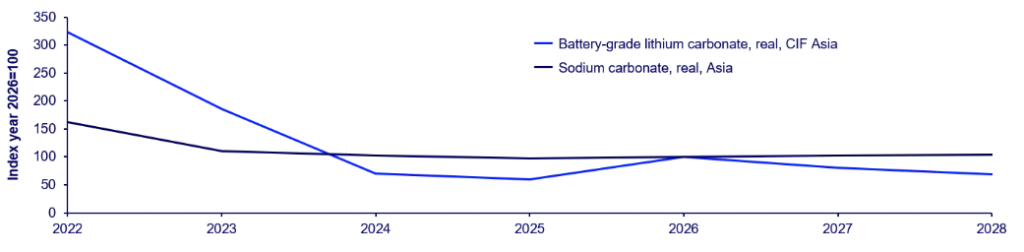
“Sodium-ion batteries (SIBs) wins on supply chain security, cycle life, and wide thermal threshold,” said Ankita Chauhan, director of global supply chain and integrated power and renewables research at Wood Mackenzie.
“Geopolitical supply advantages and superior performance of SIB across temperature ranges drive near-term commercialisation.”
The rise of sodium-ion batteries (SIBs) is backed by significant manufacturing capacity and demand. According to Wood Mackenzie, Chinese carmaker BYD has 30 GWh of planned manufacturing capacity in China, while Chinese battery giant CATL is targeting at least 1 GWh of SIB shipments by end-2026.
Similarly, Wood Mackenzie finds that China, the US, and Europe already have significant offtake agreements, whereas India is only in the early commercial validation stage.
Wood Mackenzie estimates that sodium-ion storage systems cost an average of US$229/kWh upfront, compared with US$200/kWh for lithium iron phosphate (LFP) systems. Over a 20-year project life, however, the firm estimates that sodium-ion systems cost 21 per cent less to own and operate, thanks to lower operating costs and no need to add battery capacity later.
Specifically, according to Wood Mackenzie, system economics “remain stable across 2- to 4-hour durations, though regional supply-chain and trade barriers present near-term headwinds to deployment.”
Despite this, Wood Mackenzie still warns that “China’s export controls, India’s underdeveloped supply chain, slow US gigafactory expansion, and German trade policies risk constraining near-term growth across key markets.”
But policies are weighing heavily on manufacturers’ minds, outpacing cost as the key market driver. China announced changes to its battery consumption tax in July. A 2 per cent levy on lithium-ion batteries, including lithium iron phosphate (LFP), took effect on 1 September 2026 and will rise to 4 per cent on 1 September 2027. Qualifying sodium-ion batteries are exempt through the end of 2028.
Similarly, tariffs of approximately 58 per cent in the United States on Chinese energy storage cells structurally incentivise domestic sodium-ion batteries (SIBs) production, complemented by government backed manufacturing credits.
In Europe, carbon-footprint disclosure requirements under the EU Battery Regulation act are expected by Wood Mackenzie to act as a structural tailwind, while India plans to build local capacity through a $US1.25 billion incentive scheme and duty exemptions on manufacturing equipment.
The fight between battery chemistries won’t properly heat up until the next decade, according to Priya Shrivastava, a senior research analyst of power and renewables and the battery storage supply chain at Wood Mackenzie.
Lithium iron phosphate (LFP) remains the bankable choice storage projects designed to discharge for two to four hours, but moving forward, Wood Mackenzie expects different battery technologies and chemistries to be optimised towards distinct application and duration profiles.