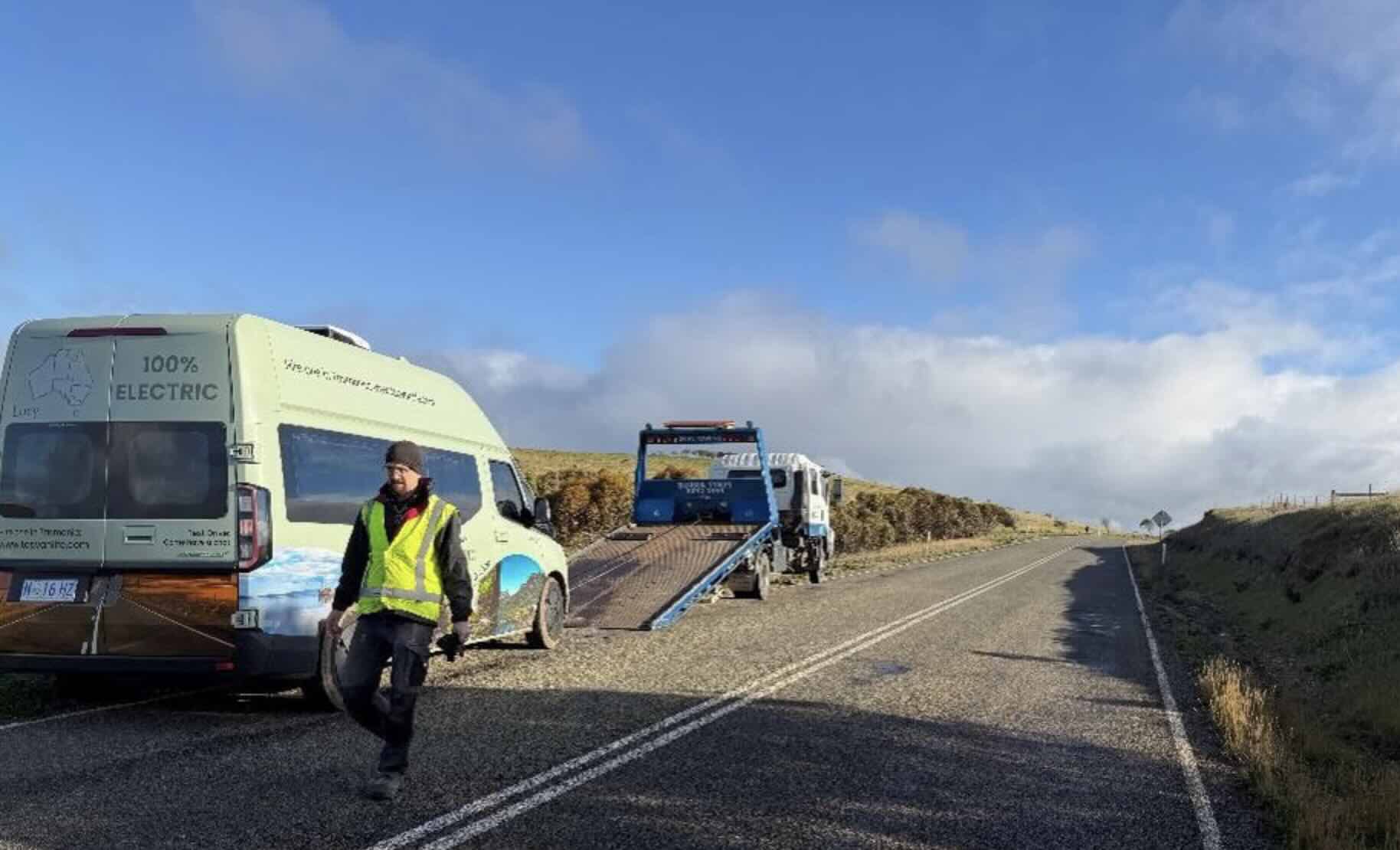
This will be a story that the trolls will delight in. But having spent too much of my youth standing by the Stirling Highway in Perth with an empty jerry can of petrol in my hand, waiting for a lift to the nearest servo, it’s only fair to report that the first electric campervan doing the lap of Australia has also been caught short, and needed a tow to its nearest charger.
My excuse in the 1980s was that I was an impoverished student who couldn’t afford to put more than a couple of dollars of petrol in my Austin Tasman at any one time. So the risk of running out of fossil fuel was always high.
Clive Attwater, on the other hand, failed to follow his own maxim of Always Be Charging (the ABC of EV driving), and found himself out of charge just 200m short of the crest of a hill that would have allowed him to roll into the EV charger less than two kilometres away.
Clive and his partner Anne, as we reported last week, have begun a big lap of Australia, actually a kind of figure 8, in an electric campervan, having converted a Farizon SV cargo van into a comfortable, all electric holiday home on wheels. It is believed to be the first of its type to undertake the big lap, and they have already travelled from Hobart to South Australia.
And, as we reported, Clive and Sue want to spread the word around the benefits of going electric, but that also means providing honest information about the potential pitfalls and challenges, both for the drivers, and the caravan park owners who could one day be hosting dozens of such vans at a time.
It’s estimated that there are between 75,000 and 100,000 grey nomads – retired or semi-retired Australians – who travel for extended periods in RVs, caravans, and motorhomes, and up to 30,000 are on the road at any one time. Add in a some adventurous younger families, and a lot of electric vans on their way, the numbers of green nomads could also jump considerably.
Clive admits to being at fault and not following his own maxim for failing to make it into the town of Burra under the electric camper van’s own steam, so to speak. The couple had planned to charge at Morgan, but Clive decided the van could make it into Burra without that stop. And then they ran into some headwinds.
“Big mistake,” writes Sue on their travel blog. “So second mishap for the day was to completely run out of power about 200m (the photo shows you exactly how far ) from the top of a hill into Burra, and we had to call RAA to tow us into the Burra charger.
“The service was absolutely amazing and we only had to wait about 40 mins for the tow truck to arrive even out in the middle of nowhere.”
Clive knows a thing or two about EVs and EV charging. He and Sue set about their first lap of Australian in an EV in 2021 in a Nissan Leaf, only to be thwarted by Covid, and Clive has helped ensure Tasmania has about the best EV fast-charging network through his work with Electric Highways Tasmania.
And he was frank in his mea culpa: “We could have charged earlier, but I chose not to. Always be charging! It’s interesting a diesel ute driver told me that he tops up his fuel at virtually every servo, so it’s not just EVs.”
Clive says it has taken a while to get the measure of the real range of Lucy, the electric campervan. Overall, they have averaged 242 km of range, but the variations have been considerable – from 170 km to 346 km, depending on different conditions, including altitude gains, headwinds, speed and temperature.
“We have played around with a variety of highway speeds but generally run at 80 – 90 km if there is any doubt about range,” he write.
“While it drives comfortably at 110, even if there is charging available the additional cost and charging time is a trade off against the driving time saved. 90-100 km is the compromise unless extra range is needed. Overall we have averaged 242 km range, but that is 100% to 0% which would not be pretty!”
So far, the EV charging has worked at every site they have visited, and about half had had other users. “Most of those have been in the less remote areas with four bay sites so no worries about queues there. Even when shared there was only one case where the charge rate was slightly diminished – we were getting into the slower charge zone anyway.”
You can read our first story on Clive and Sue’s adventures here. Around Australia in an electric campervan: “We want to show that it can be done”
You can read about other EV road trips here, and you can sign up for The Driven’s free daily newsletter and get the latest EV news and analysis delivered straight to your inbox.