Much has been written about the incredible growth in battery EV (BEV) sales this year, but one landmark that has been missed is an historic turning point that was reached back in February and could only be confirmed now.
The number of vehicles registered in NSW that contain an internal combustion engine (ICE) reached its peak on 27 February at 6,309,403. It is now in decline. This includes all heavy and light trucks, vans, buses, passenger vehicles and motorcycles and also includes hybrids and plug-in hybrids (PHEVs).
And it’s not because a vehicle recession has hit and total fleet numbers are declining. It is because for the first time new BEVs are not only covering all growth in the vehicle fleet, but are causing the permanent exit of fossil fuel vehicles from the fleet.
This is a momentous and historic turning point. Ever since the first motor vehicles were registered in NSW in 1910, total fossil fuel vehicle numbers have increased relentlessly for 116 years. The moment has finally arrived where that is no longer true.
The hard data
Peaks like this cannot be identified at the time because vehicle registration numbers bounce up and down from day to day and week to week. No-one wants to declare an all-time peak only for a new peak to be reached a few weeks later after a shipload of new vehicles is delivered and sold.
But with four additional months of data, we can now be confident the peak was reached on 27 February. The fact that the peak occurred the day before the USA started its war against Iran is either ironic or a ‘wisdom of the crowd’ premonition!
Figure 1 charts the turning points of total ICE vehicle registrations in NSW, the three lower lines representing increasingly expansive definitions as to what an internal combustion engine vehicle is. All three have now peaked. Data comes from the Transport for NSW Registration Snapshot Report.
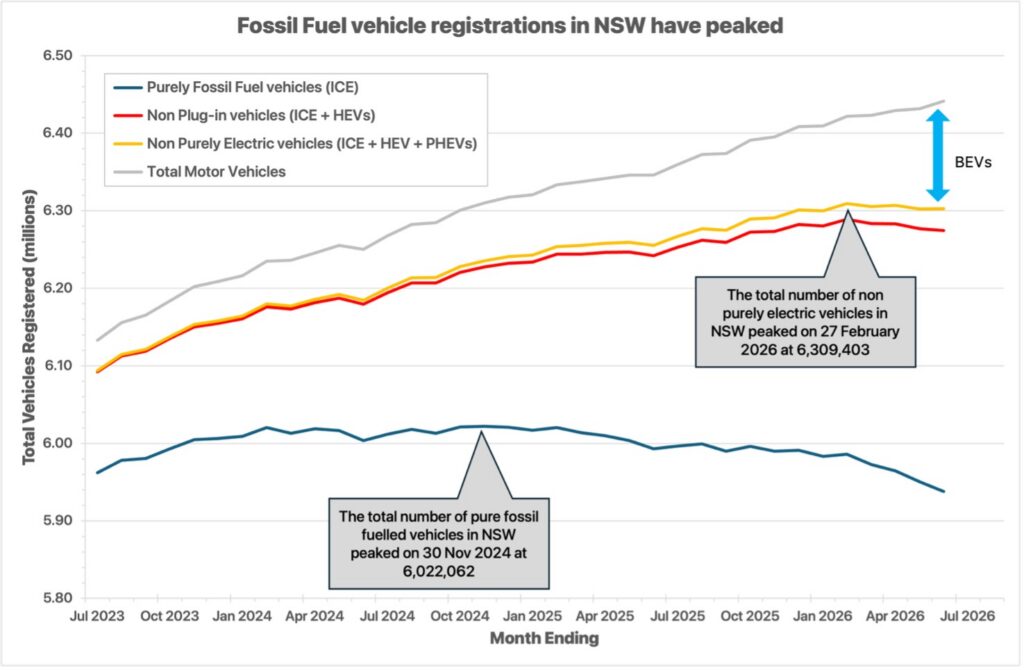
Table 1 shows the peaks for each drivetrain category and how far down we are today from that peak.
| Drivetrain category | Peak reached | Peak | Total at 30 June 2026 | Change from peak |
| Purely fossil fuel (ICE) | 30 Nov 2024 | 6 022 062 | 5 938 066 | -1.39% |
| Non plug-in (ICE+conventional hybrids) | 27 Feb 2026 | 6 289 001 | 6 273 167 | -0.23% |
| Non purely electric (ICE+conventional hybrids+plug-in hybrids) | 27 Feb 2026 | 6 309 403 | 6 302 738 | -0.11% |
Table 1 – ICE peaks in NSW
Reaching peak ICE is momentous, but there is still a very long way to go. A 0.11% reduction in the number of fossil fuelled vehicles on the road, while welcome, is the tiniest step forward in the very big and lengthy job of decarbonising Australia’s vehicle fleet.
It’s taken Norway 15 years and the most pro-EV policies in the world for BEVs to reach one-third of their vehicle fleet. Australia is barely above 2%. Full electrification will take decades.
As to why only NSW data is presented, unfortunately data of this granularity isn’t available in real time from other states. NSW is approximately one-third of the national vehicle fleet so is a strong proxy for what is happening Australia-wide.
The significance for vehicle emissions and fuel sovereignty
The beginning of the end of the ICE age isn’t just some culture war debating point. It has economy-wide significance:
– Total national petrol and diesel consumption should now start to reduce (noting this varies week to week depending on vehicle movements) improving our resilience to oil shocks as every day passes. Every litre of liquid fossil fuel not consumed by a BEV is a litre that is now available for vehicles in the rest of the fleet that, for whatever reason, have yet to make the switch. Meanwhile, BEVs are recharged from homegrown electricity, which is increasingly coming from renewable sources.
– In turn, vehicle emissions should now steadily decline. Not only as a result of BEVs supplanting fossil fuel vehicles, but new PHEVs, hybrids, and even fossil fuel vehicles being more fuel efficient than the vehicles they replaced.
– In May, Federal Climate Change and Energy Minister Chris Bowen announced that total transport emissions declined by 0.6% in 2025 compared to 2024, saying “Australia’s overall transport emissions may have peaked as more motorists choose cleaner, cheaper to run vehicles”. This data should remove any doubt in the ‘may’.
– And transport emissions are not just about CO2. Combustion engines spew out a range of toxic and carcinogenic gases including nitrous oxides, carbon monoxide, sulphur dioxide, benzene and PM2.5 particulate pollution – and these have significant negative public health consequences costing Australia billions every year.
– A Melbourne University study in 2023 estimated that vehicle tailpipe pollution in Australia causes 11,000 premature deaths each year, and is responsible for over 12,000 cardiovascular hospitalisations, almost 7,000 respiratory hospitalisations, and 66,000 active asthma cases per year.
– And there is growing evidence that even a relatively small percentage of BEVs in a vehicle fleet leads to measurable improvements in air quality.
Update on BEV growth in NSW
In October last year NSW hit the 100,000 BEV milestone but the growth since then has been extraordinary. Many new records have been set.
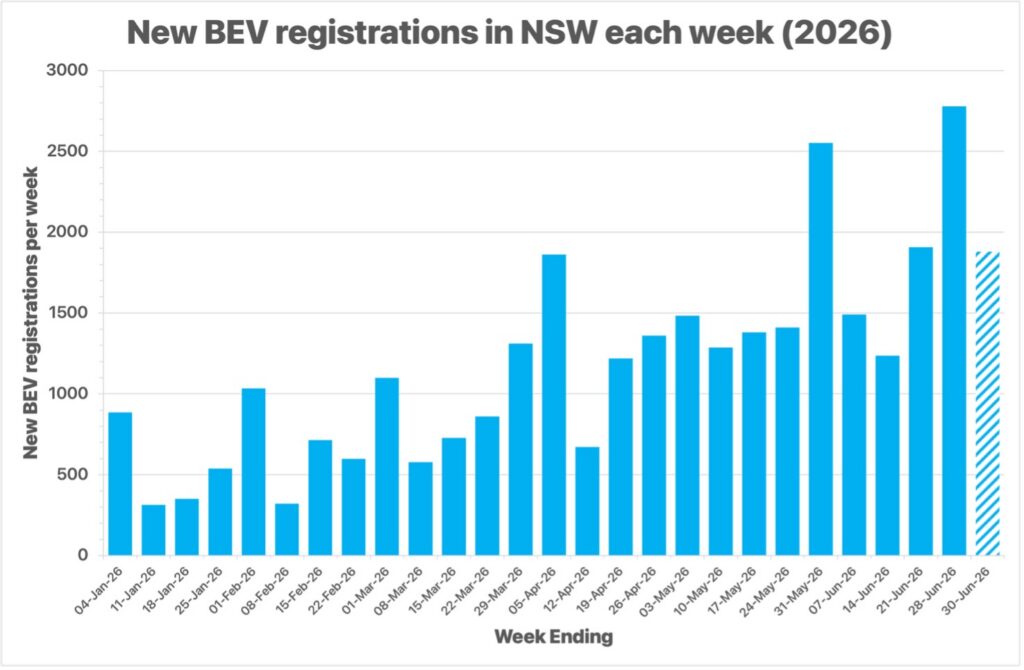
As at 30 June, NSW has 138,580 BEVs registered, nearly 40% growth in just 8 months. Figure 2 shows the number of new BEVs registered in NSW for each week of 2026. The increase driven by the USA-Iran war begins to appear from late March.
Some of the records:
– It took 10 years (from 2011 to 2021) for NSW to reach its first 10,000 BEVs. The next 10,000 took 1 year. The most recent 10,000 increase took just 32 days, the shortest amount of time ever.
– The final full week of June (Monday-Sunday) saw 2780 BEVs registered in NSW – the most ever in a week.
– A new daily record was set on 26 June with 1392 new BEVs registered.
– BEVs now represent 2.15% of the entire motor vehicle fleet in NSW, or 1-in-47 vehicles
– BEV passenger vehicles are now 2.82% of the passenger vehicle fleet, or 1-in-35 passenger vehicles.
NSW represents about 31.3% of the national BEV fleet, implying Australia now has roughly 440,000 BEVs.