Perhaps the final hold-up for rolling out Vehicle to Grid (V2G) at scale in Australia has been the reluctance by vehicle suppliers to warranty their vehicles for use with V2G systems.
It has certainly been a bone-of-contention for potential EV buyers. I field an enormous number of questions on the topic – perhaps more than any other – and the lack of V2G is cited as the major reason many people still hold out on buying their first electric car.
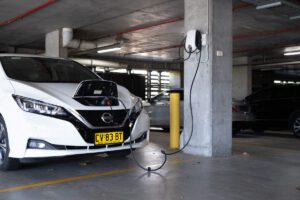
In some ways, this is hardly surprising as it is 14 years since V2G was announced as ‘just around the corner’. Back then, the Japanese developed CHAdeMO plug DC system was designed ‘from day 1’ to be capable of providing power to the grid and the very first Japanese EVs (the Nissan Leaf and Mitsubishi iMiEV) were both V2G capable.
Since then, CHAdeMO lost the Plug War and the CCS system that replaced it in most of the world* was slow to include V2G into the design.
However, things have sped up in the last few years as, one-by-one, the roadblocks have been removed.
V2G capability was added to the CCS system design several years ago, Australian connection standards for V2G were approved in 2024, the first few boxes for interfacing with the switchboard were approved for installation in later 2025 … and the first EV models technically capable of it have already arrived.
The federal government has funded, through ARENA, an expanded pilot of V2G managed by retailer Amber. So far, only BYD has made its Atto 3 available, although the government is keen to add up to four other models to the 50-strong pilot fleet.
One reason cited by vehicle suppliers for the delay is they were not fully happy with the first-generation connection standard was it might override the vehicle battery management system and damage the battery.
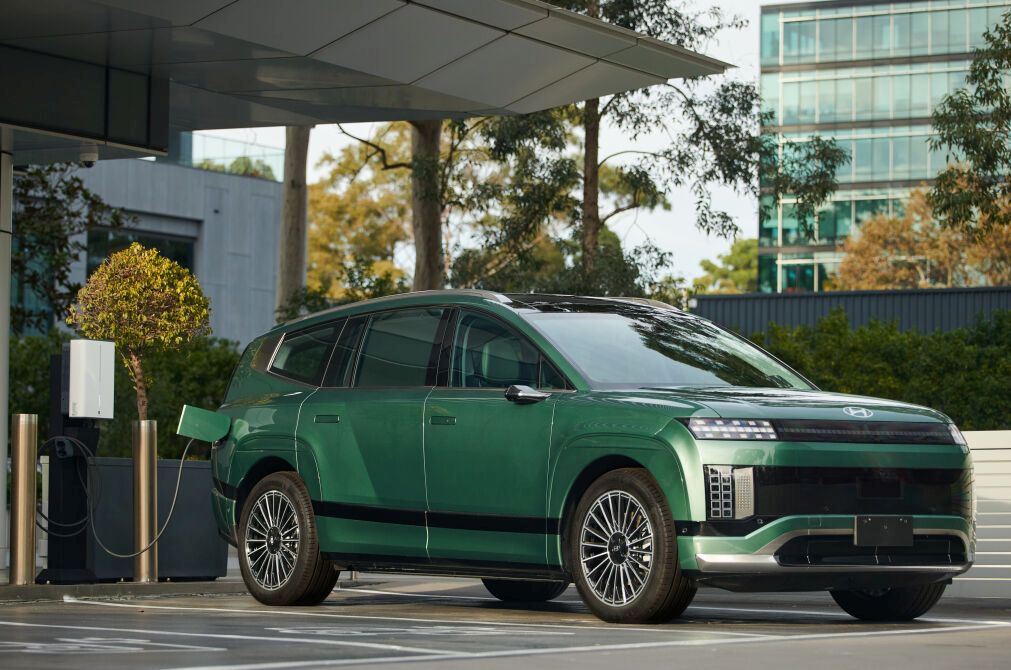
However, Hyundai have just announced that they have now completed Australia’s first V2G discharge using the ISO 15118-20 communication protocol.
Hyundai describe the ISO 15118-20 protocol as “ … the second-generation international standard for bidirectional power transfer between electric vehicles and charging equipment. It provides the secure, interoperable framework required for V2G, Vehicle-to-Home and Vehicle-to-Everything applications.”
The tests were carried out with a Hyundai Ioniq 9, using a StarCharge Halo 7.4 kW bidirectional DC charger – which is Clean Energy Council (CEC) approved and compliant with the AS/NZS 4777.2 home battery standard.
Austin Luo, Director eMobility, StarCharge Energy Oceania, said it was an important milestone for the development of V2G in Australia, and Don Romano, the CEO, of Hyundai Motor Company Australia (HMCA), said of the tests:
“This is the result of sustained technical work by Hyundai’s R&D teams in Korea and Australia. ISO 15118-20 includes all the messages and sequence requirements for bidirectional power transfer. Getting this right is essential because V2G will only scale in Australia if consumers, energy providers and governments can trust the technology.
“Electric cars can do far more than just drive. They can power homes and support the grid. This first V2G discharge using ISO 15118-20 with the Ioniq 9 demonstrates that we are delivering real innovation, not just talking about it.”
Given the Ioniq 9 is built on Hyundai’s 800V Electric-Global Modular Platform (E-GMP), this means that any of the Hyundai/Kia/Genesis could, in theory, soon be announced as capable of V2G.
As to when Hyundai will formally make the feature available, Hyundai at least appear to be inching closer with the statement:
“Hyundai models under evaluation or development for V2G in Australia include the Ioniq 9, Ioniq 5, Ioniq 6 and future Ioniq platforms. Globally, Hyundai Motor Group is advancing V2X capabilities through Korea’s first customer-focused V2G pilot on Jeju Island, commercial V2G services in Europe and V2H services in the United States.
“Australia adopted national V2G and V2H standards in 2024. ARENA forecasts up to 2.6 million Australian homes could adopt V2G by 2040. HMCA encourages all stakeholders to ensure V2G programmes utilise manufacturer-approved technology compliant with ISO 15118-20.”
Going by this, as with any new vehicle feature – don’t assume your existing Ioniq 5, EV6 etc will be immediately V2G capable, or buy one today on the assumption it will be automatically become V2G capable when the feature is announced.
To be sure your do buy a V2G capable BEV, I still recommend waiting the now (hopefully) short time left before the official trigger is pulled. The same by the way also applies to the many other manufacturers in this category: BYD are currently doing trials of a number of their models, plus many of the latest VW stable EVs are supposedly ‘V2G capable’ with a software update.
On the other hand, it isn’t here yet, and the waiting game continues as no date was included in Hyundai announcement. Hopefully though, the successful test outcome does make V2G that little bit closer to available.
Sadly, that should not come as much of a surprise for Australian EV buyers, who by now are well used to delayed EV models and features. (Some things never change!)
* Note: Japan still uses CHAdeMO as their DC charge standard.