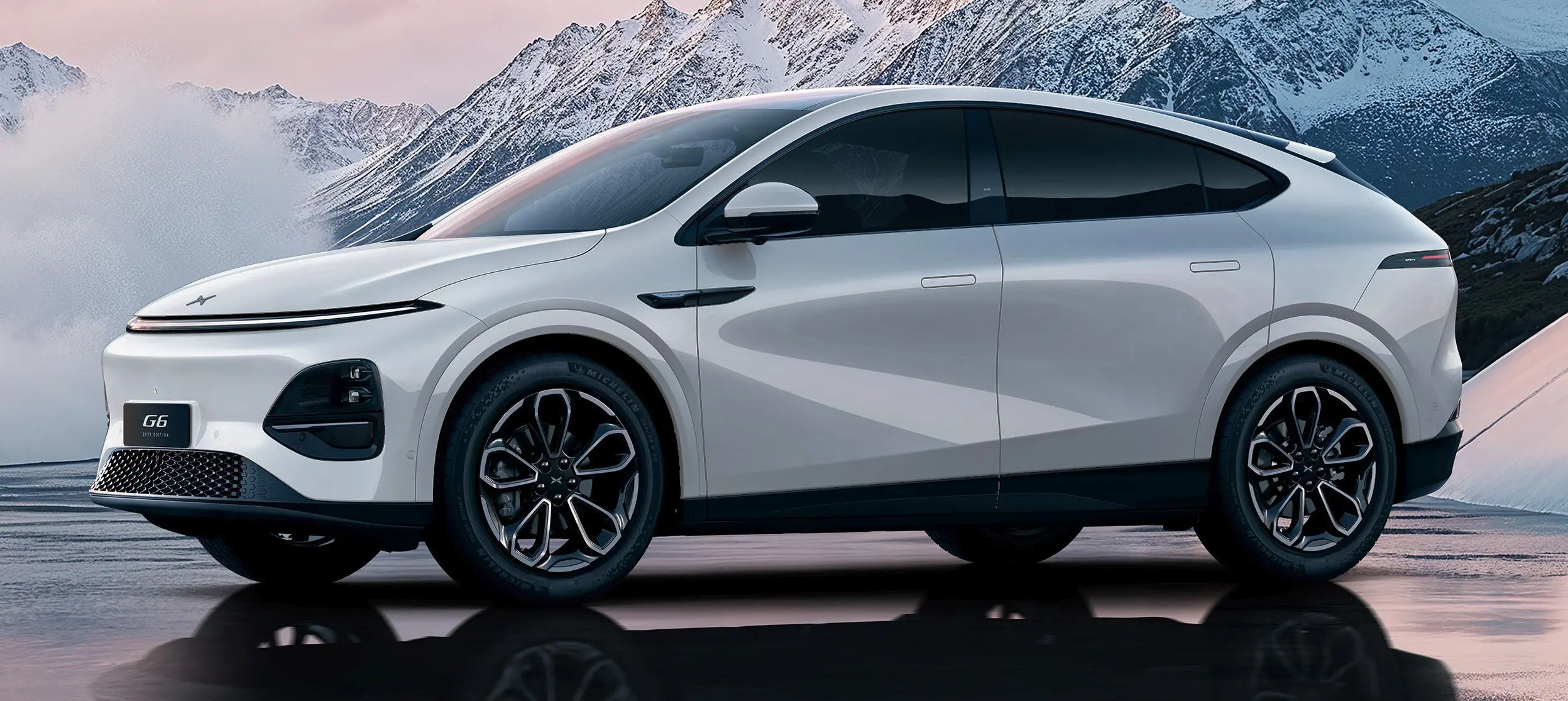
Launched here in late 2024, the Xpeng G6 is currently the brand’s sole vehicle offering in Australia, although this will soon change with the imminent arrival of the G9 Large SUV and X9 People Mover.
The G6 is, in design, reminiscent of the Tesla Model Y in both its external appearance and the reliance on minimalist screen/app based vehicle control interfaces with little to no physical buttons or dials.
As such it has often been described as a direct competitor to the Tesla in both size, capabilities and price. The new G6 is however likely to take the fight even further up to the Tesla with significant upgrades to its power train and sensing systems. It also offers some potentially nice touches in the ‘computer-on-wheels’ machine learning area – which I’ll come back to later.
Externally, the new G6 sports a full-width light bar across the front, along with the Xpeng logo moving up to the lower edge of the bonnet.
The rear is said to have been made more streamlined, although without actually lining the old and the new up side-by-side, I am not sure anyone would easily notice the change! Internally, there have been a couple of tweaks to the look of the dash, but otherwise it’s mostly unchanged.
The biggest changes though are to do with the drivetrain and the software. In terms of the drivetrain, whilst there are still standard and long-range variants, gone is the long-range 87 kWh NMC battery, which has been replaced with an 80.8 kWh gross (80 kWh nett) LFP one.
As a result, the WLTP range for the long-range rear-wheel drive is down 45 km to 525 km (from 570 km). The new long-range battery has however been upgraded to an 800V architecture, offering a significantly faster DC charge rate.
It was no slouch previously at 280 kW – but it now can charge at up to 451 kW, giving a 10 to 80% charge time of just 12 min. This is slightly academic, as there are no chargers yet in Australia above 350kW (and few even at that speed) – but even on the rare 350 kW ones, that still translates to a 13 – 14 min time.
Given you are unlikely to use DC charging unless on a long trip, either time is already barely enough to complete a coffee and/or snack break.
Some of the biggest changes are when it comes to the software (and the computer hardware it runs on). The new G6 sees some significant upgrades over the previous version.
The processor has been updated to the Nvidea Orion-X chip, delivering faster response times and, along with an improved ‘perception system’, is said to offer better driver assistance capabilities, plus allow for adaptive ADAS (Advanced Driver Assistance System) functioning.
This latter Xpeng say will enable the ADAS and other systems to adapt to individual driving styles. Whilst I had only 30 min in the driver’s seat, at first blush I can say the ADAS felt far less intrusive and annoying than many recent vehicle releases. (I will give a more detailed report there once the G6 becomes available for longer term loans).
Other changes include almost doubling the Vehicle to Load output to 6 kW/26 amps and (finally) it being given a tow rating – in this case, a very handy maximum of 1500 kg. The update will also see the addition of a long-range AWD version to the existing standard- and long-range, rear-wheel drive models.
Note: final details of pricing, warranty and delivery of the new G6 will be available in July 1.
Full specifications of the existing G6 can be found in TheDriven’s new models page, as well as the AEVA Fact Sheets page.
See The Driven’s detailed EV sales data here: Australian electric vehicle sales by month in 2026; by model and by brand.
Please sign up for The Driven’s free daily newsletter and get the latest EV news and analysis delivered straight to your inbox.