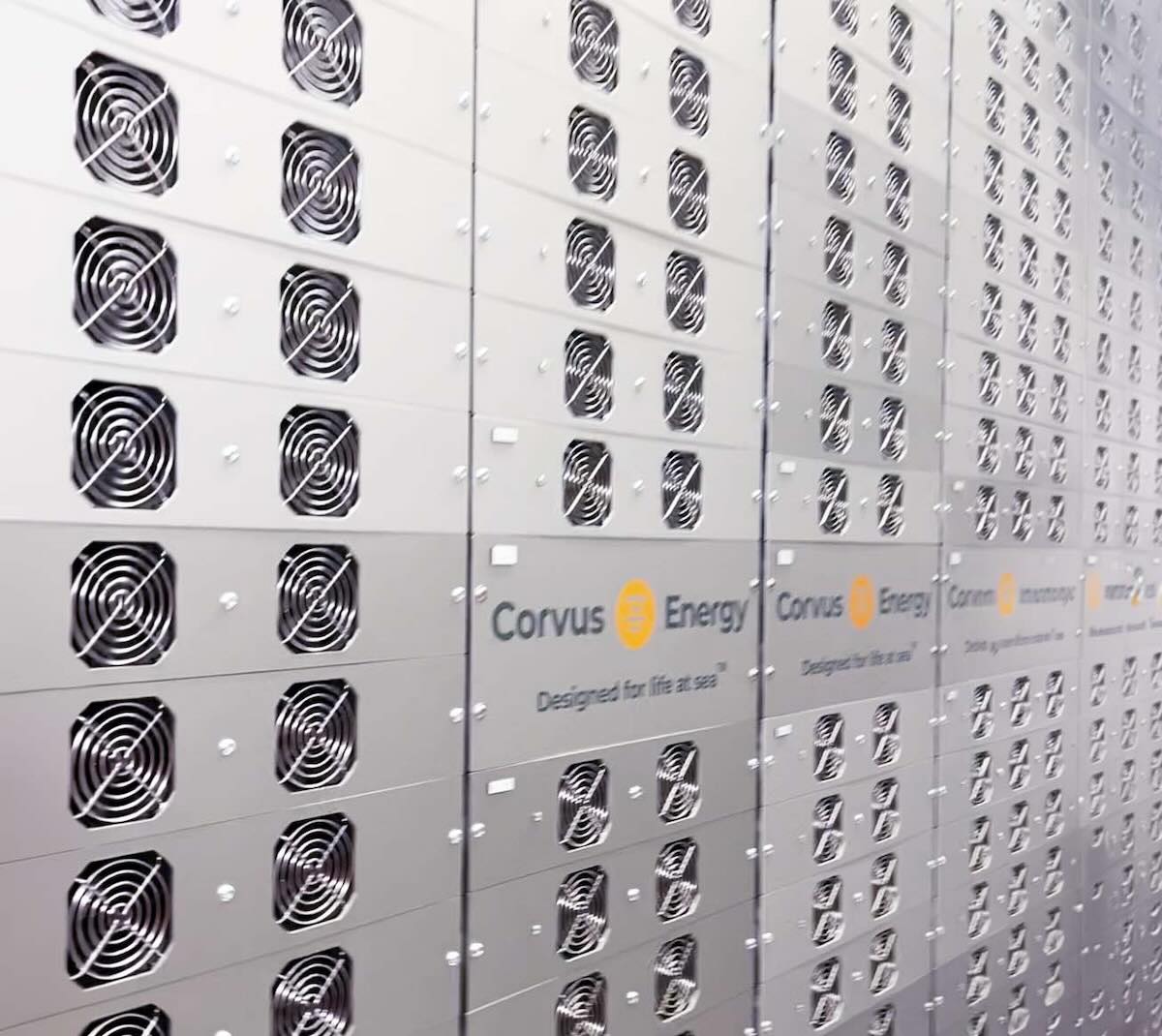

Behind thick insulated walls onboard the 130-metre China Zorrilla sit rows upon rows of lithium-ion batteries – 5,016 individual battery modules, with more than 40 megawatt-hours (MWh) of energy storage capacity weighing 260 tonnes..
The giant ferry, built by Tasmanian shipbuilder Incat, is designed to carry more than 2,000 passengers and 225 vehicles between Argentina and Uruguay entirely on battery power. And the energy storage system needed to make that possible is unlike anything previously installed on a ship.
“The energy storage system is four times larger than any current installation,” says Incat’s Manager Public Relations and Corporate Affairs, Tom Cooper.
Batteries for the China Zorrilla were produced by Corvus Energy, a Norwegian marine battery maker which specialises in battery systems for ships and ferries.
Just how enormous the China Zorrilla project became is reflected in the production effort required to build 5,016 batteries.
“They had to build a new factory just to produce the batteries for this ship,” Cooper says.
In fact, Corvus produced more batteries for the China Zorrilla than it manufactured in its first seven years of operating. And installing that many batteries at Incat’s Hobart shipyard was a logistical challenge.
“We got up to about 150, 160 a day that we were installing,” Cooper says.
The ship’s battery system is split across four dedicated battery rooms, each designed with multiple layers of insulation in the event of a fire.
Large lithium-ion battery systems inevitably raise questions about safety and thermal runaway, the dangerous chain reaction that can occur when a battery overheats and begins generating more heat internally faster than it can cool down. In severe cases, thermal runaway can spread between battery cells and lead to fires or explosions.
Managing that risk is one of the central engineering challenges for large-scale battery systems used in electric vehicles, grid batteries and now ships.
Onboard the China Zorrilla, the battery system is designed with advanced cooling, monitoring and fire mitigation systems specifically intended to prevent or contain thermal runaway events.
“The temperature is constantly monitored from the wheelhouse of the ship,” Cooper says.
If temperatures ever begin rising towards dangerous levels, a staged fire mitigation process activates.
“If the batteries ever exceed 80 degrees, the first of the cooling process starts, including a saltwater drench,” Cooper says.
The enormous scale of the China Zorrilla battery system highlights how rapidly battery technology is evolving and shows how maritime electrification is now being taken seriously.
Only a few years ago, many in the shipping industry thought fully battery-electric vessels of this size would not be commercially or technically possible.
Now, sitting in Hobart’s Derwent River waiting to enter service, the China Zorrilla shows that the electrification of transport is moving beyond cars and trucks.
Read our full report on how Incat is leading a revolution in electric shipping on our sister site Renew Economy here: From fast ferries to electric ships: How a Tasmanian company is helping reshape global shipping
Sign up for The Driven’s free daily newsletter and get the latest EV news and analysis delivered straight to your inbox.