

For a lot of people, the biggest hurdle to going electric has been the price. However, in the last 12 months a quiet revolution in EV pricing has been going on – with ever lower benchmarks being set for the title of ‘cheapest BEV on the Australian market’.
In March 2023, there were only two full battery EVs below $50,000 (the Atto 3 and MG ZS EV). Now there are ten price at $40,000 and below (on-the-road pricing/OTR) BEVs – with one of them well under $30,000! There is even a rumour that the first sub-$20,000 BEV (before on-roads) may arrive before the end of this year.
Interestingly, until recently there were eleven options in this category. Leapmotor have just increased the B10 price to start at $43,630 OTR. Hopefully this is not the start of a trend to cash in on the recent fuel-security related spike in BEV interest.
So what BEVs can you get on the road for $40,000 or under? And how do they compare for size, features and range?
The Cheapest EVs:
The cheapest BEV today is the Essential version of the BYD Atto 1. At $27,122 OTR (in Victoria) it is the one-and-only BEV in Australia so far to properly break the $30k barrier.
However, at 220 km WLTP driving range, it is also by a mile (or more accurately, almost 100 km) the shortest-range new BEV on the Australian market. For those wanting a new BEV just to do the shopping and school drop-off, it does offer a cheap entry to electric driving.
On the other hand, there are a number of second-hand BEVs in the high teens to low $20,000’s with equal or greater WLTP driving range. (Such as the MG ZE EV, MG4, Hyundai Ioniq and Renault Zoe).
Depending on your vehicle size and feature needs, you could be better off with one of these instead – although the recent spike in second-hand BEV prices may see this price advantage starting to erode.
To go up to an Atto 1 with something matching the driving range of the other new BEVs in this price segment, you’ll need spend just over $30k ($31,290 OTR in Victoria to be precise) for the larger battery Atto 1 ‘Premium’ that offers 330km WLTP range. Next is the GAC Aion UT at the current limited time offer of $30,990 OTR, closely followed by the new MG4 EV Urban at $31,990 OTR.
Cheapest over 400km WLTP range:
The biggest determinant of BEV prices is battery size. More range means a bigger battery, which equals more dollars. Once the domain of the over (and often well over) $60k bracket, you can now get 400 km range BEVs for under $40k. In fact, you even get a selection of BEVs with a 400+ km range for under $40k!
At $30,990 on the road and 430km WLTP, the new Aion UT comfortably takes the prize here. Next up is the GWM Ora at $33,990 and 400 km WLTP. (Mind-you, I did find during my week with an Ora that the 400 km test figure seemed a tad optimistic). Close behind, at $34,990 OTR and 405km WLTP is the new MG4 EV Urban. The Jaecoo J5 is next at $36,990 OTR and 402 km WLTP.
And yes, whilst many of the other offerings in the under $40k bracket do offer bigger battery options for longer ranges, they all require you to spend noticeably more than $40k to do so. (See table below for pricing).
By the way, an ‘honourable mention’ goes to the Chery E5 here. It offers 430km WLTP range, but has until recently been priced just over $40k OTR. At the moment though it is on a limited time (to April 30) price of $38,990.
Another vehicle to note here is the outgoing version of the MG4. This car is now on run-out and pricing is likely to become variable as stock options disappear. It may be worth keeping an eye out for potential bargains for the 51kWh/450km range version.
Best tow rated under $40k:
A long-standing myth has been that ‘BEVs can’t tow’. However, this was never really true and was more a case of ‘BEV manufacturers can’t be bothered tow rating their cars’.
This has changed in recent years and many BEVs now offer tow ratings – even some of the smallest come with useful ratings beyond that needed for a bicycle rack. half of the ten listed here are tow rated, with the best tow rating in this price bracket being 750kg. (BYD Atto 2, Jaecoo J5 and the Chery E5).
Full list of $40k and under BEVs in Australia:
(Please note that pricing can vary at any time. Prices as of 2.4.2026).
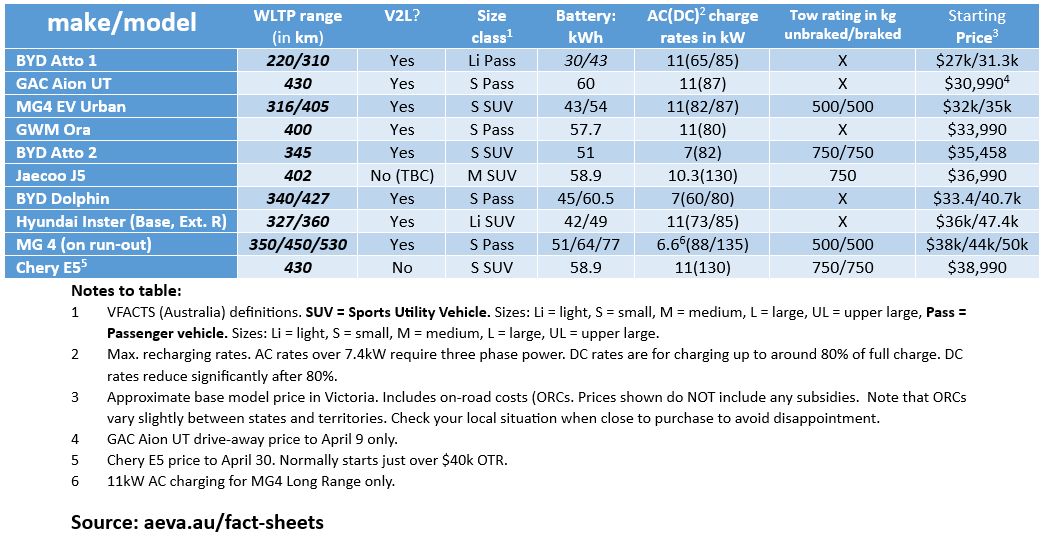
Coming cheapest BEVs?
It is fairly safe to say the Nio Firefly will be comfortably under $40k, perhaps closer to $30k. The Honda Super One is also expected to squeak in under $40k, in fact it will have to do better than that if Honda expect to sell many.
As for any others – we will have to see as pricing for upcoming new models is always a closely guarded secret until the official launch.
Mind-you, at around 13% to 14% of new car sales in Australia now being BEVs, this heralds the entry of the price-conscious ‘early majority’ buyer. As such, it is likely the budget end of the BEV market is likely to see increased competition this year as more models in this price bracket arrive.
We may not see too much further lowering of the BEV entry price until fossil fuel prices stabilise. With the recent increase in BEV enquiries and sales due to the goings-on in the Middle East, BEV manufacturers will have little incentive to cut their margins to bring in more sales!
Check out all available models at our EV Models page here.
And also check out the recent sales data for either model and electric brand here: Australian electric vehicle sales by month in 2026 – by model and by brand