Image: Toyota Australia
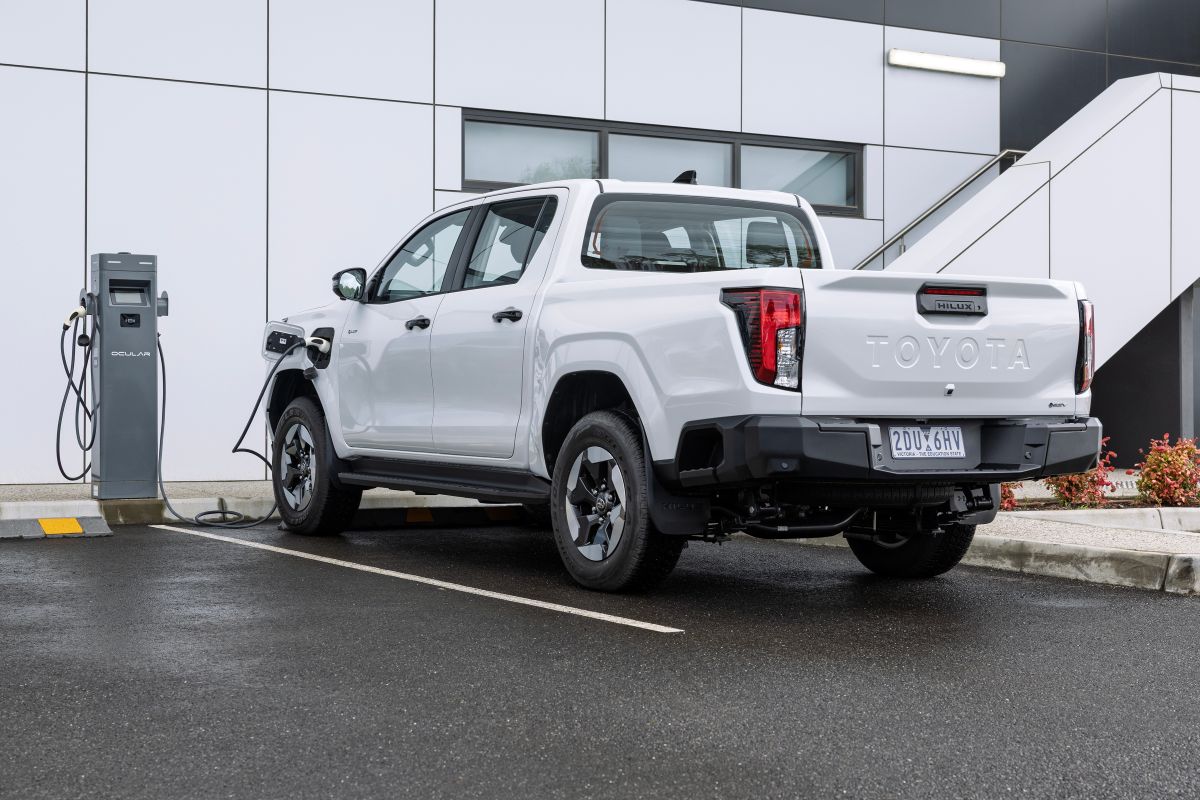
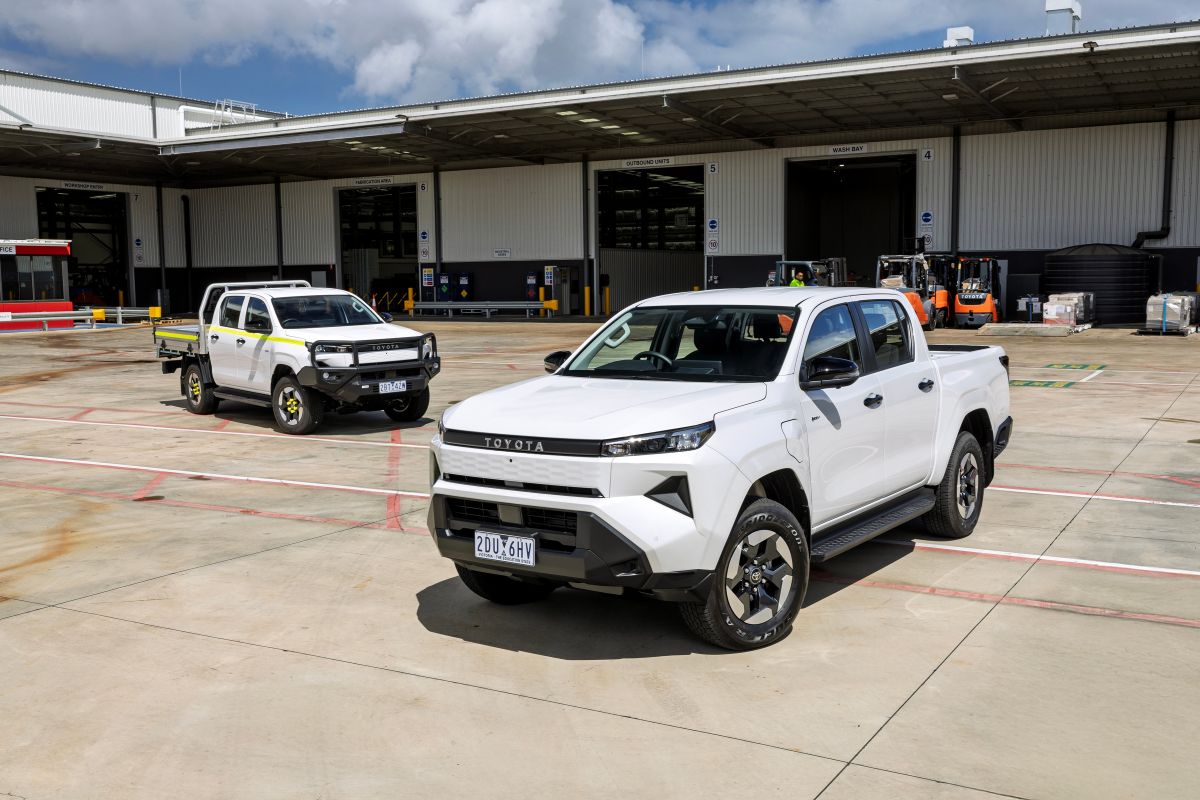
Toyota has finally confirmed the Hilux electric ute for Australia, almost three years after the company conducted an engineering evaluation, and will offer the landmark package in two variants but limited range..
Prices for the SR dual-cab chassis will start at $74,990 before on-roads, and for those wanting the dual-cab pick-up, the $1,500 option extra can be added to that price, bringing it up to $76,490. The flagship electric ute with SR5 badge comes in a $82,990 before on-roads.
The Hilux electrics will be powered by a 59.2 kWh battery pack, which will deliver a limited range of up to 315 km – under the NEDC calculation (so a lot less on the WLTP range commonly used in Australia – while the SR cab-chassis will get just 245 km NEDC.
For this reason, Toyota is targeting mining fleets and those operating within metropolitan areas, or not needing to drive great distances.
Toyota Australia VP of sales, marketing and franchise operations John Pappas shared that the Hilux BEV was an important addition to the local line-up and will offering both Australian businesses and private buyers the choice of a HiLux with zero tailpipe emissions.
“This is a crucial step forward in providing consumers the right powertrain for the right application, at the right time,” he said in a statement.
“This is an exciting time for Toyota; bringing in an electric version of the much-loved HiLux pick-up finally gives businesses and fleets the option of low-emission motoring mixed with Toyota’s extensive parts and servicing network.”
“In fact, Toyota has already been testing the HiLux BEV for months on mine sites in temperatures nearing 50°C, ensuring the performance of this new powertrain matches the tried-and-tested HiLux diesel.
“Private buyers looking to make the switch to an electric pick-up now have the backing of Toyota quality, durability and reliability.”
Powering the Hilux BEV is a dual-motor powertrain with a combined power output of 144 kW and 468 Nm of torque. That’s from a front motor which can produce up to 82 kW, while the rear has a peak output of 129 kW.
To help with charging, Toyota will be offering a 7 kW AC charger with every Hilux BEV it sells to private customers, helping them with home charging.
Inside, there is a 12.3-inch infotainment screen with four speakers and compatibility with Apple Carplay and Android Auto.
The SR5 spec adds LED headlamps with auto-levelling, auto-retracting and heated exterior mirrors, LED foglamps and tail-lights, rear privacy glass and painted hood moulding and radiator lower grille.
There is also leather-accented upholstery, heated front seats with powered driver’s adjustment and two-way lumbar support, heated steering wheel, carpeted floor, electrochromatic rearview mirror, soft, lidded instrument panel, silver door handles, eight-speaker audio system and wireless phone charger are all on offer too.
The company aims to launch the Hilux electric in three colours, including two white tones and Ash slate. According to Toyota, the Hilux BEV ute will be available to order from May in Australia, adding to its current best-selling Hilux ute range.
Riz is the founder of carloop based in Melbourne, specialising in Australian EV data, insight reports and trends. He is a mechanical engineer who spent the first 7 years of his career building transport infrastructure before starting carloop. He has a passion for cars, particularly EVs and wants to help reduce transport emissions in Australia. He currently drives a red Tesla Model 3.
Volvo cuts prices on its existing EX30 and EX40 electric offerings in preparation of the…
What sort of EV can you buy for less than $30,000, or less than $40,000?…
Chinese automotive group Chery unveils its next generation ‘Rhino’ battery which boasts ultra-fast charging and…
Tesla promises to ramp up supply as first official data for March reveals sharp lift…
The Department of Pedalling and Perspiration suggests cyclists should be paid $1 per kilometre and…
A detailed early look at the 2026 refreshed Zeekr X.
*chefs kiss*
Toyota, you really know how to deliver a joke on April 1st.
The range is pretty much garbage but in terms of actually doing the job, maybe it doesn't matter. It's not like metro tradies are driving 400km/day. We'll see if this gets any traction. Otherwise v2 in 2 years time might be a lot more attractive, much like the BZ4X.
Toyota will need a massive recruitment of those with 'tickets'.
A toe in the water might create more hastles than benefit for some years ?
Not taking the transition seriously for so long leaves them vulnerable to GWM, BYD etc. They must be squirming.
"This is a crucial step forward in providing consumers the right powertrain for the right application, at the right time"??? What a joke !
The "wrong" powertrain, he meant to say, as hardly anyone, not even the rusted on Toyota fans will want that thing. Look at Mazda, they've done the same thing and now, three years after it has been gathering dust in showrooms, they are supposedly coming up with something real.
They just don't get it, do they?
Is this another attempt to “prove” that EV Utes “can’t do the job”? 🤔
*toyota VP sales to board*
'See these sales figures. People don't EVs'
*receives nod of approval from CEO*
OMG!
Toyota are still betting on hydrogen!
They want in on fuel cells for trucks with Daimler and Volvo.
What a effing joke of a company!
Anyone want to buy an Mirai?
It's made to 'totyota's quality'.
Putting the "toy" in Toyota.
Toyota had a great opportunity to clean up the EV ute market and dominate but chose to release an overpriced and underwhelming vehicle that is purposely crafted to protect the profitable diesel SUV/utes market.
Shame Toyota, shame. Make a stance Toyota but no, an EV that is $20K to 25K overpriced. How good would a frunk be on a ute for its target market? This will struggle to get twice the BYD Shark PHEV's EV only distance of 85km.