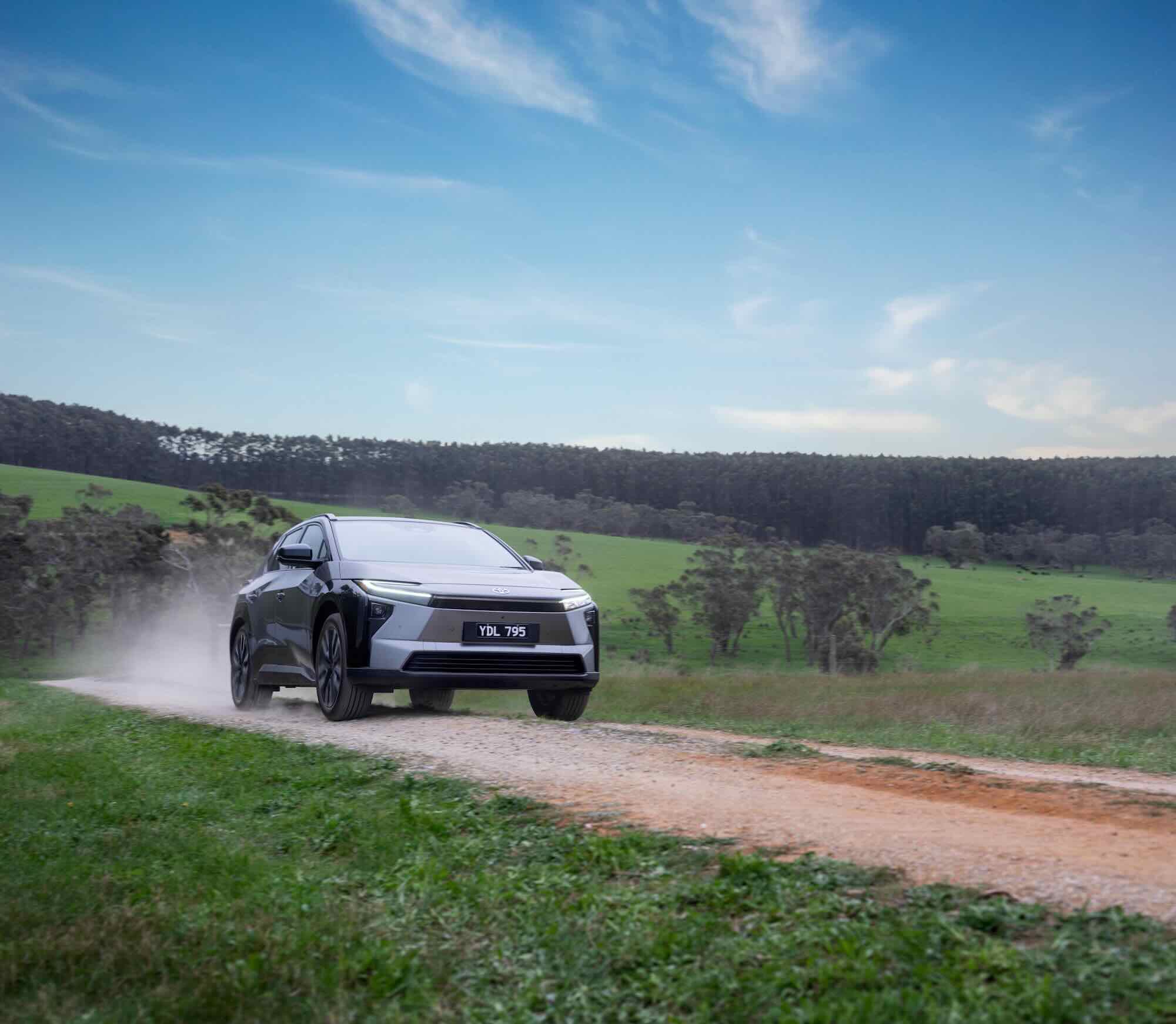
In February 2024, Toyota launched it’s first and (still) only passenger electric vehicle in Australia. The vehicle had the vibe of a legacy carmaker dragged against its will into the electrification space. The offer was an EV from a brand Australians know and trust, but with pricing and key specs that gave it a significant disadvantage against its competitors.
Fast forward a couple of years and the second version of the BZ4X arrives with more range, more power, faster charging and a meaningful price cut, effectively addressing most of the criticisms levelled at the original.
Under the hood, the updates are substantial. There’s now a larger 74.7kWh battery, which pushes range up to around 591km (WLTP) for the front-wheel-drive version, with the AWD sitting closer to 510km. Power is up too, with the FWD now produces around 165kW, while the AWD gets a far more substantial boost to 252kW. Charging has also improved with up to 150kW DC fast charging and 22kW AC capability.
Importantly, the starting price has been cut by about $10,000 to $55,990 before on roads.
I spent a week with the updated entry-spec bZ4X as a daily driver to see whether this latest round of changes has finally brought it into contention in Australia’s increasingly crowded electric SUV market.
Climbing into the cabin, my first reaction was fairly immediate: this feels a few years behind. Not necessarily in a bad way, but certainly not like a clean-sheet EV interior. It feels less like a reinvention and more like something familiar that’s been adapted for the electric era.

The steering wheel is busy with buttons, the driver display sits far back on the dash, very much in the vein of the Prius, or even something like the old Toyota Echo. Pressing the start button, the cluster lights up in that same reassuring, slightly old-school way. Even the “Ready” indicator, a staple of Toyota hybrids for years, is still present.
What began as mild disappointment gradually softened into something closer to appreciation. There’s a familiarity here that’s hard to ignore. Whether that’s a deliberate attempt by Toyota to ease drivers into EV ownership, or simply a case of sticking to what it knows best, is harder to say. Whichever the case, it brought an almost refreshing change from the high customisation, minimalist interiors that are so often found in electric vehicles in this class.
It’s a bit like sitting down at a restaurant for a set menu. The lack of choice is almost a relief, you just sit and enjoy the meal (or in this case the drive). Thankfully, the drive is enjoyable. It’s easy, uncomplicated. It lacks thrill compared to higher performance EVs (0-100km/h in 7.4 seconds for the base front wheel drive model), but that’s ok and in a way, very Toyota.
The suspension felt great and definitely leans toward comfort, soaking up rougher urban roads without fuss. Efficiency over the week sat comfortably in line with what Toyota claim – just under 14kWh/100kms. For what is technically an SUV it’s rather good.
Around the back, the boot is perfectly usable, if not especially generous. At around 452 litres, it’s enough for the weekly shop, a couple of suitcases, or the usual collection of cables and camera gear, helped by a reasonably wide opening which makes it feel bigger than it actually is, and a bit of underfloor storage for charging leads
After a week with it, the updated bZ4X feels like a car that has finally caught up. It’s more usable, more competitive, and far easier to recommend than before. The fundamentals like range, charging, pricing, now all make sense in a way they didn’t the first time around.
But in a segment that’s moving quickly, catching up isn’t quite the same as moving ahead. The bZ4X now does most things well. It just does them in a very Toyota way, which is measured, predictable, and perhaps a little cautious.For some buyers, that might be exactly what makes it appealing.