Hyundai’s luxury arm Genesis has launched the updated GV60, giving potential buyers two very different ways to buy a Genesis GV60 in Australia. The Driven was invited to drive both at the Australian launch earlier this month.
Genesis will hope the refreshed lineup will help bring some much-needed success for their GV60 lineup, which has struggled to gather any momentum thus far with just 15 sales in Australia in 2025. At one end is the updated GV60 Advanced RWD, priced from $88,300 before on-road costs. At the other is the new GV60 Magma, Genesis’s first production high-performance model, which starts at $130,000.
The GV60 Advanced model, which we’ll call the sensible one, is a rear-wheel drive, a 561km claimed range and a price that has been brought below $90,000 – fitting it just underneath the luxury car tax and FBT exemption threshold and making it instantly a much more compelling offer for those looking to purchase on a novated lease.
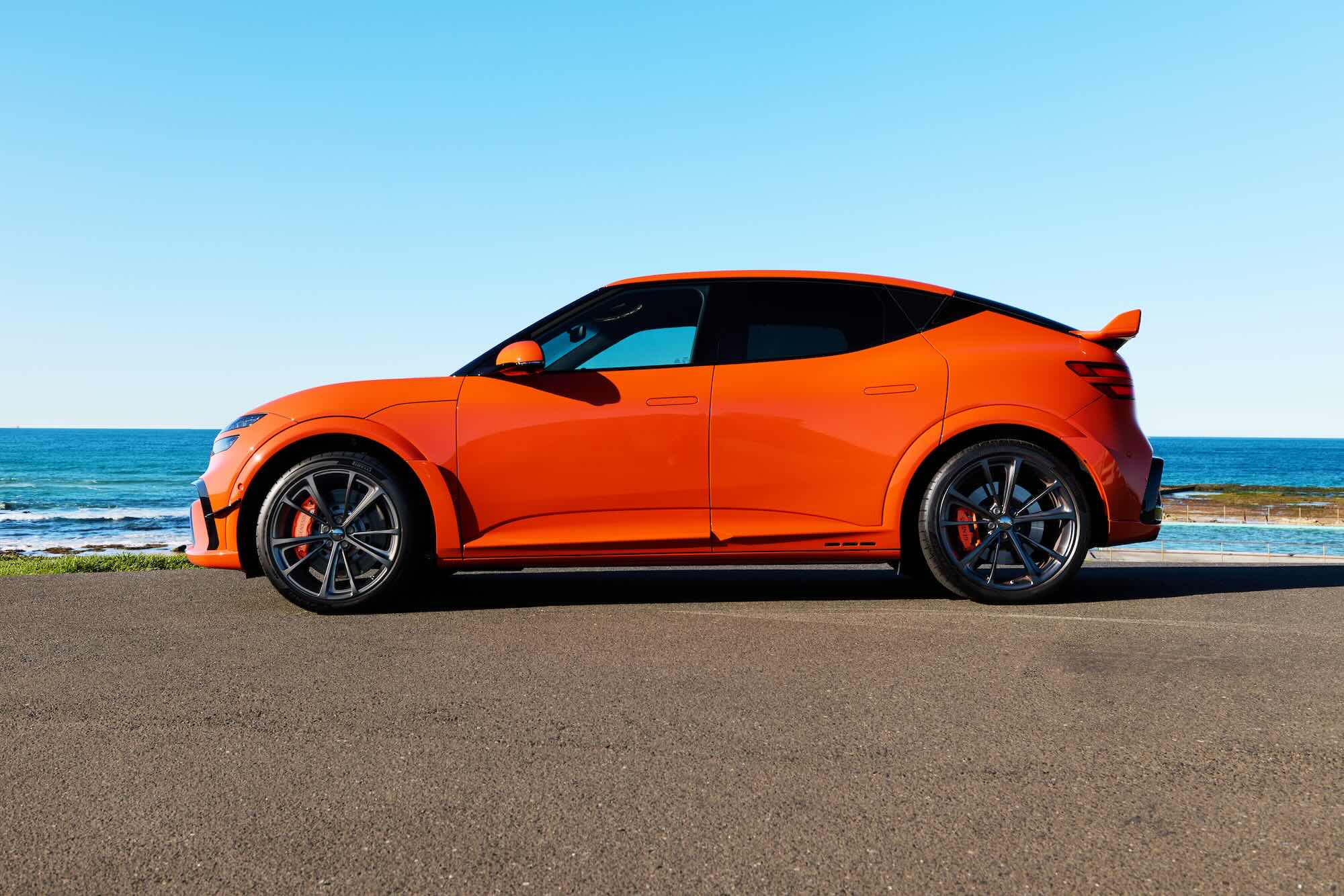
The Magma meanwhile arrives with enormous tyres, orange brake calipers, launch control and an acceleration of 0-100km/h in 3.4 seconds.
Genesis has not so much expanded the GV60 range as given it a split personality. Both use an 84kWh battery and share the same underlying E-GMP electric platform. Beyond that, they have been designed for almost opposite purposes.
The Advanced is the more important of the two from a sales perspective.
Genesis has repositioned the GV60 as a more accessible luxury EV. There is just the one iteration of the Advanced model available. It’s a rear-wheel drive, and at $88,300 list price is still serious money, but it puts the car into a much more competitive part of the electric SUV market than the previous GV60 range occupied, which started at $103,000 before on-roads.
The Advanced uses a single motor at the rear producing 168kW and 350Nm. It takes 7.8 seconds to reach 100km/h, which will not dominate many EV drag races but remains more than adequate for an upmarket family crossover. More importantly, the increased 84kWh battery offers up to 561km of WLTP range, with a claimed range consumption of 16.7kWh per 100km. As always that will depend on how, and where, you drive the vehicle.
The 400V/800V-compatible architecture will allow the battery to be charged from 10 to 80 per cent in as little as 18 minutes under ideal conditions. AC charging is capped at 10.5kW, with a 10-to-100 per cent charge taking about seven hours and 20 minutes on an 11kW charger.
There is a slightly redesigned front bumper, slim Micro Lens Array headlights, new 19-inch wheels and body-coloured wheel-arch cladding. Changes to the bumper and underbody have also reduced the drag coefficient to 0.28.
Inside, two separate screens have been replaced by a single 27-inch OLED display spanning the instrument cluster and infotainment system. The OLED gives the screen a noticeably better resolution which is instantly noticeable.
My favourite feature of the GV60 has been the crystal sphere gear selector and thankfully it remains in the updated model. When the car is switched off, it looks like an illuminated ornament; switch it on and it rotates to reveal the transmission controller. It’s completely unnecessary and rather wonderful. One of the industry’s more elaborate solutions to a problem nobody had.
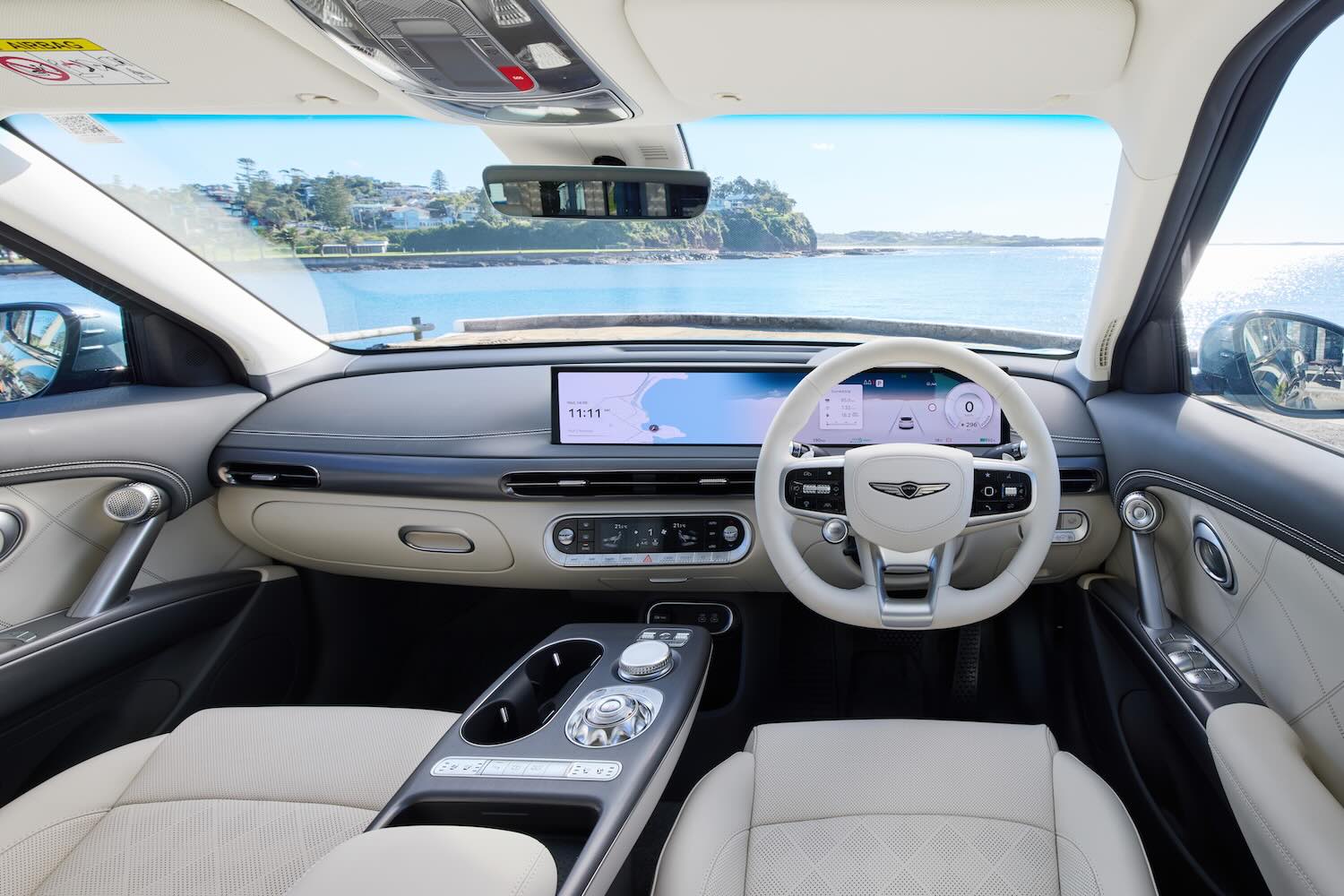
Image: Genesis
There is also a new three-spoke steering wheel, revised trim, wireless Apple CarPlay and Android Auto, Digital Key 2.0 and a more capable over-the-air update system.
It still lacks a few features you might expect from a $90,000 vehicle. You don’t get a head-up display, a digital centre mirror, massage front seats, heated rear seats, or an interior V2L socket. To get most of those things you’ll need to fork out the extra $40,000 on the Magma, which adds Bang & Olufsen sound system, head-up display, digital centre mirror, active road-noise cancellation and interior vehicle-to-load socket to the interior feature list.
It’s an interesting call by Genesis which appears to be a way to position the Magma as not so much as a pure track car, but a luxury performance vehicle. It does risk annoying Advanced customers who want a more complete list of luxury features without having to pay for a second motor and 448kW of power.
On the road, the single-motor powertrain in the GV60 Advanced is smooth, quiet and entirely adequate. It does not provide the sort of acceleration that sends your stomach back to the seat for that you’ll want the Magma.
Genesis has improved the Advanced compared to its predecessor by revising the steering ratio, adding hydro bushings to the rear suspension and increasing sound insulation around the rear seats and cargo area. The result is a quieter and more polished car, with steering that feels a little more direct without becoming artificially heavy.
There are four-piston front brake calipers and an updated Smart Regenerative Braking 3.0 system, which can use navigation, traffic and driving data to vary the amount of regeneration automatically.
And then you have the new GV60 Magma. Magma is the new performance identity of Genesis, so you can expect to see the name again as performance versions of other Genesis models.
The GV60 Magma starts with the same basic battery and cabin architecture but takes the rest of the car in an entirely different direction. The dual motors produce a combined 448kW and 740Nm under normal conditions. Press the orange Boost button and output increases to 478kW and 790Nm for approximately 15 seconds.
With Boost Mode and Launch Control activated, Genesis claims the Magma can accelerate from zero to 100km/h in 3.4 seconds, reach 200km/h in 10.9 seconds and continue to a top speed of 264km/h. Impressive, and very illegal on almost all public roads.
Predictably, all that performance comes at the expense of efficiency. The Magma’s WLTP range falls to 425km, while consumption rises to 21.5kWh/100km. It also weighs 2,270kg, almost 200kg more than the Advanced.
The Magma’s hero orange paint is not subtle, but there are other more subtle differences on the exterior. It’s 50mm wider and 20mm lower than the Advanced, with a longer body, bespoke front and rear bumpers, canard wings, aerodynamic side skirts and a winglet-style rear spoiler.
There are forged 21-inch wheels which are fitted with 275mm Pirelli P Zero tyres. Behind them sit massive 400mm front brake discs with monobloc calipers.
There is also an electronic limited-slip differential and selectable brake settings. The Comfort setting provides a more progressive pedal response for road driving, while Sport removes the initial free travel and sharpens the response for more demanding use.
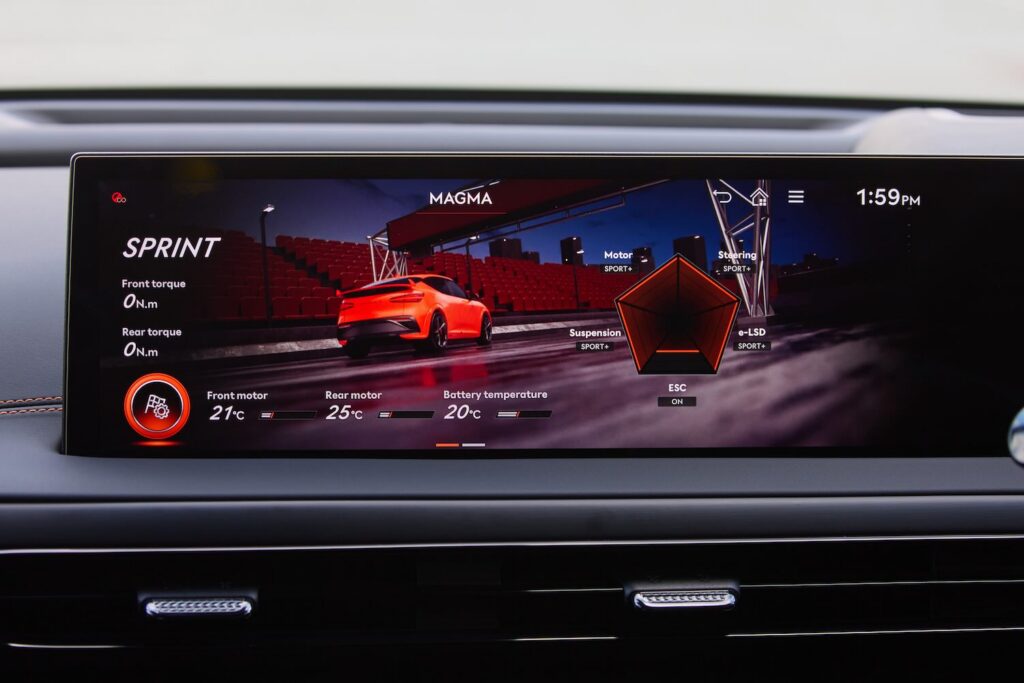
Image: Genesis
Drift Mode will direct more power towards the rear axle, while High-Performance Battery Control prepares the battery for sustained high-output driving. Genesis has given the Magma plenty to satisfy the performance-focused driver, although most owners will rarely need its full arsenal outside a racetrack.
The acceleration is as dramatic as the specifications suggest. Press down hard on the accelerator and the Magma’s speed increases at what I would describe as an alarming rate. It was part thrilling, part anxiety provoking.
Interestingly the Magma can also feel rather approachable if driven rationally in the right mode and with the synthetic engine sounds off. The steering is direct, the front end turns in confidently and the body remains impressively flat, but it does not feel intimidating in this context.
Despite the wider tyres and lower suspension, Genesis have managed to make the Magma still ride like a Genesis rather than just a track car. It can occupy a place on public roads and still fit in, unless you choose the orange paint.
That appears to be the main distinction Genesis is trying to establish for Magma. It is not supposed to be a stripped-out electric racing car. It is closer to a very fast executive express.
The Magma also joins the growing group of performance EVs attempting to recreate some of the theatre apparently lost with the combustion engine. Its Virtual Gear Shift system manipulates motor output, regenerative braking and sound to simulate the sensation of driving through the gears in a high-performance petrol car.
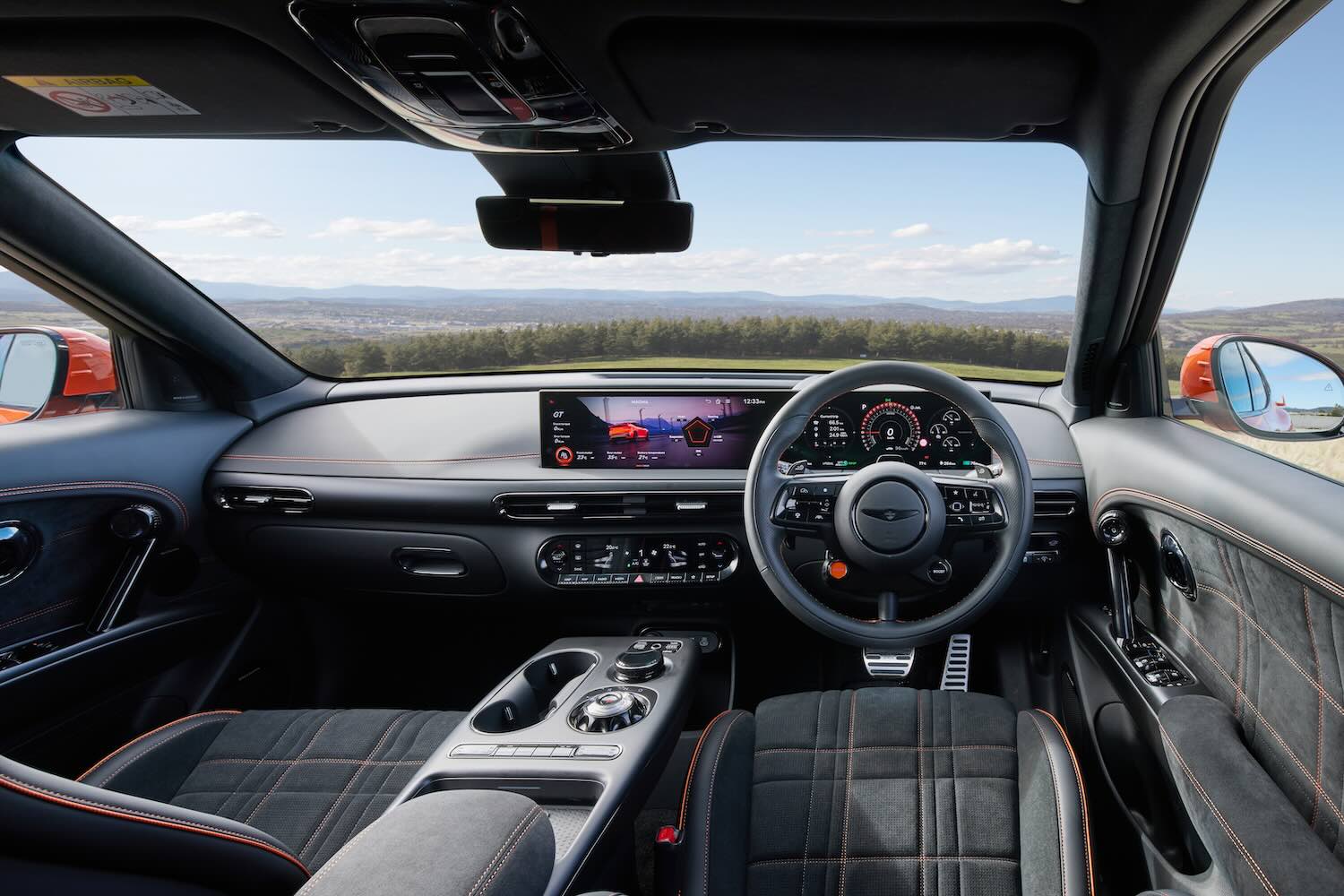
Image: Genesis
Pull a steering-wheel paddle and there is a simulated change in engine note, torque delivery and acceleration. Reach the virtual rev limit without changing gear and the car briefly stops accelerating, despite having no mechanical reason to do so.
It is objectively absurd and entertaining.
Whether it improves the experience will depend on how much nostalgia the driver has for gearboxes. Some will find it engaging; others will try it once, nod politely and return to the smooth, silent acceleration that electric motors are rather good at providing.
The two new GV60s perform very different jobs for Genesis, with two very different customers in mind. The Advanced addresses the most obvious weakness of the previous car: its price. It combines considerably more range, very fast charging, a distinctive and well-made cabin and a level of performance that is entirely sufficient for normal driving, although it still lacks a comprehensive feature list for the price point.
The Magma is Genesis’ way of saying they can very capably produce serious performance cars.
At $130,000 before on-road costs, it is a substantial $41,700 more expensive than the Advanced. It is difficult to argue that it offers $41,700 more usefulness, but usefulness is hardly the main selling point of flagship performance cars.
With the updated GV60 range, Genesis has two very good vehicles, but both occupy fairly niche corners of the market. At $88,300 before on-road costs, the Advanced sits well above flagship versions of popular electric SUVs such as the Tesla Model Y and Zeekr 7X.
Instead, it finds itself alongside more specialised luxury EVs including the Cadillac Lyriq, Volvo ES90, Audi Q4 e-tron and Polestar 4. The question is whether better range, sharper pricing and the arrival of the Magma will be enough to kickstart Genesis’s still-modest EV sales in Australia.