
The Driven
  • EV News
    • Electric Cars
    • Electric Bikes
    • Electric Boats
    • EV Conversions
    • Electric Flight
    • Electric Transport
    • Hydrogen Fuel Cell
    • Batteries
    • Charging
    • Policy
  • EV Models
  • EV Sales
  • Road Trips
  • Reviews
  • Multimedia
    • Podcasts
    • Videos
  • EV Explainers
    • EV Terms
    • FAQs
    • Readers’ Questions


The Driven
The Driven
  • EV News
    • Electric Cars
    • Electric Bikes
    • Electric Boats
    • EV Conversions
    • Electric Flight
    • Electric Transport
    • Hydrogen Fuel Cell
    • Batteries
    • Charging
    • Policy
  • EV Models
  • EV Sales
  • Road Trips
  • Reviews
  • Multimedia
    • Podcasts
    • Videos
  • EV Explainers
    • EV Terms
    • FAQs
    • Readers’ Questions
Comments
  • Charging

As petrol and diesel prices soar, EV fast-charging costs are falling

  • 30 March 2026
  • 9 comments
  • 2 minute read
  • Giles Parkinson
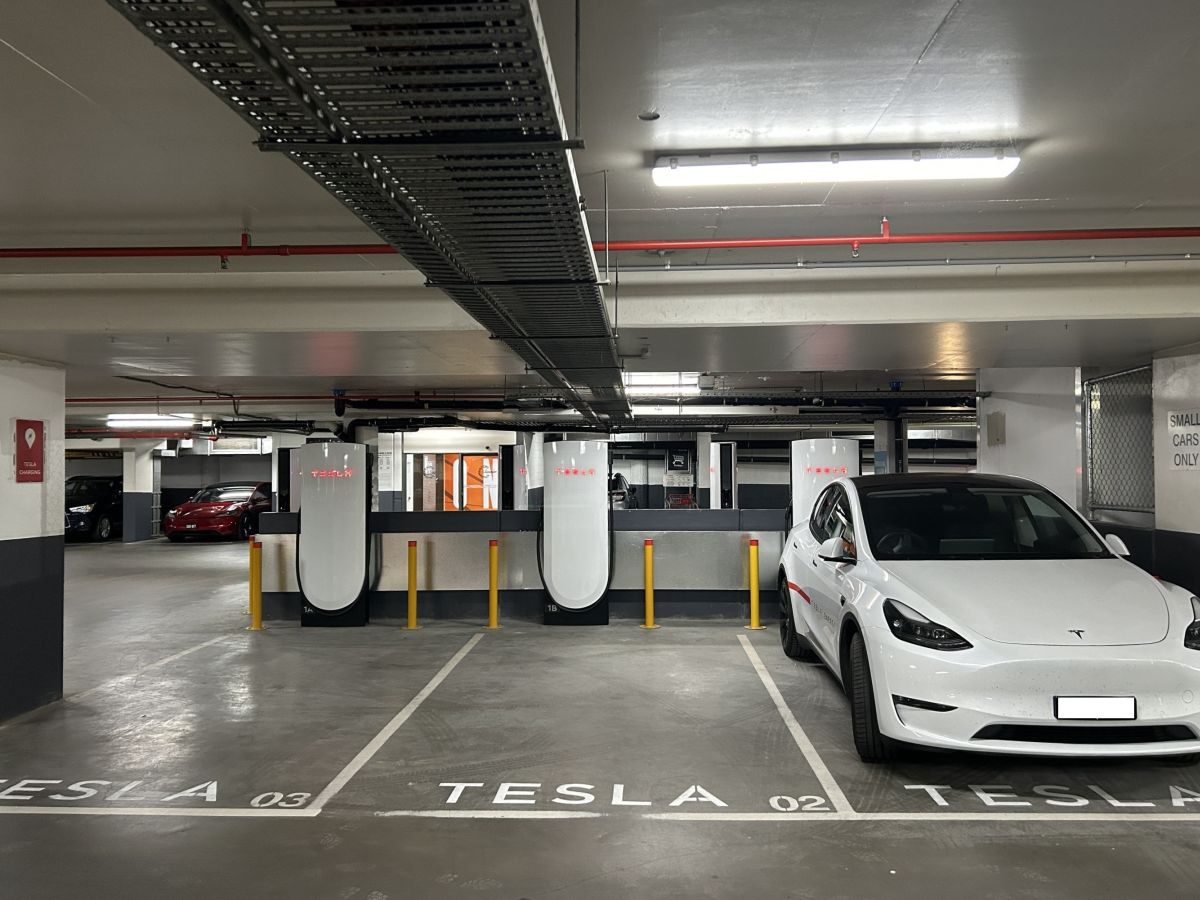
Image: Tesla Australia
Share 0
Tweet 0
Share 0
Share 0
Share 0
Share 0

As petrol and diesel prices shoot through the roof as the result of the Middle East war and growing fears of a supply crisis in Australia, the cost of charging an electric vehicle at highway fast-charging sites is actually falling.

Prices of many Tesla Superchargers, once averaging above 60c/kWh, are now averaging just above 50c/kWh, depending on location, with some prices offered as low as 34c/kWh at “off-peak” times.

Nigel Reynard, who runs a fleet of Tesla EVs in the northern rivers for his limousine service, says pricing for his nearest supercharger at Knockrow peaked at 70c/kWh in December, 2023. It is now at 52c/kWh, with rates of 45c/kWh at off peak.
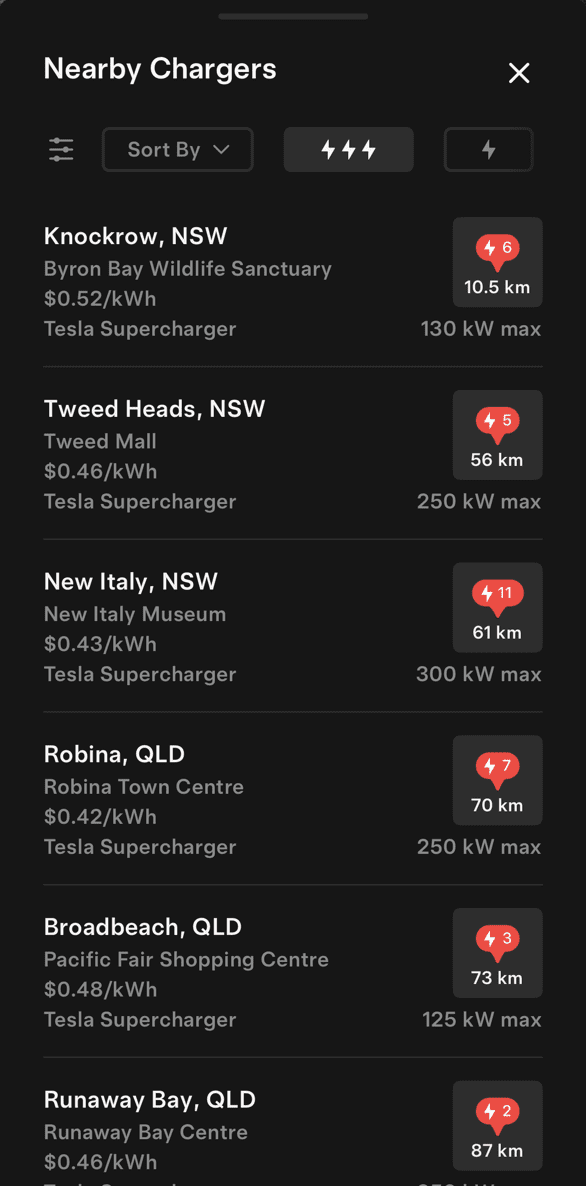
The change is significant. It is not so long ago that the cost of using highway fast-chargers was about the same as topping up a petrol or diesel car, at least when diesel and petrol were around $1.50 a litre and fast charging cost around 70c-80c/kWh. (Some fast chargers, notably those supplied by NRMA, still cost around 89c/kWh).

But the doubling in the price of diesel to around $3 a litre (and above) has changed that calculation significantly. According to a post on X by energy expert Simon Holmes à Court, the average petrol diesel car uses 7.3 litres every 100 kms, so one litre gets you 13.6 kms.

The average EV uses 15.6 kWh per 100 kms, so needs 2.13 kWh to do those same 13.6 kms. At just over 50c/kWh that equates to a total of $1.05. At 80c/kWh, that equates to $1.70. And if you are charging from home, it probably translates into around 80c if charging from the grid, or a bit fat zero (and foregone solar exports) if using rooftop solar.
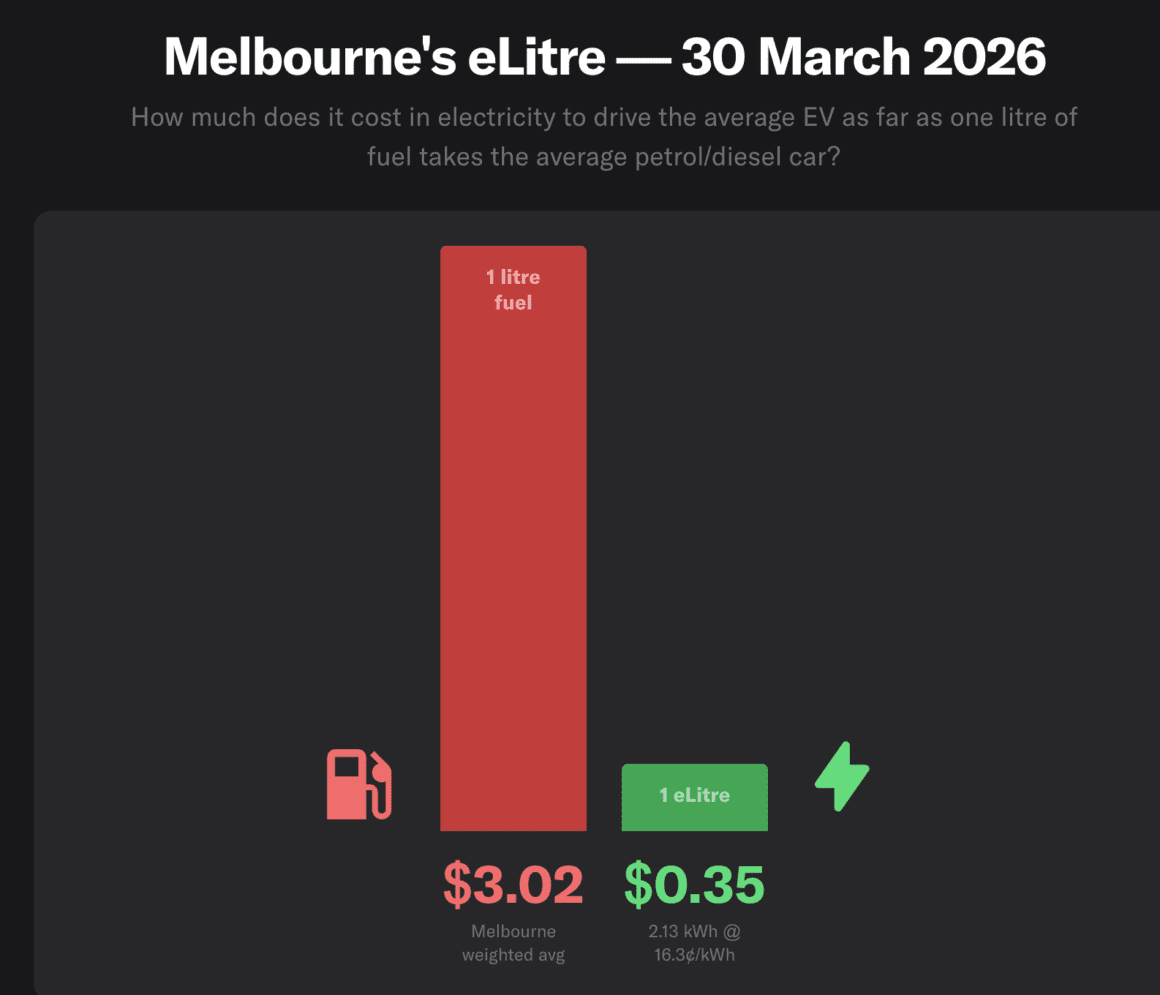
Holmes Ă  Court also published this graph above, illustrating the difference in the cost of driving an EV the same distance as an internal combustion engine (ICE) car. It is little more than one tenth of the price, and that calculation comprises a mix of home, grid and fast charging.

Given the huge savings in running the vehicle, the fact that there are now a number of EVs nearing price-parity with ICE equivalents, and many pitched with drive-away in the mid $30,000 range, then it is becoming a bit of a no-brainer.

The public is starting to twig. According to any number of sources, online searches for EVs, insurance enquiries, and the sales of second hand electric cars have doubled or more. Some EV showrooms have already been emptied, with some families buying more than one EV at a time in fear of a sustained price increase for diesel and petrol, or even rationed supplies.

 

giles parkinson
Giles Parkinson

Giles Parkinson is founder and editor of The Driven, and also edits and founded the Renew Economy and One Step Off The Grid web sites. He has been a journalist for nearly 40 years, is a former business and deputy editor of the Australian Financial Review, and owns a Tesla Model 3.

Share 0
Tweet 0
Share 0
Share 0
Share 0
Share 0
Share 0
Share 0
Share 0
Subscribe
Connect with
Login or register
I allow to create an account
When you login first time using a Social Login button, we collect your account public profile information shared by Social Login provider, based on your privacy settings. We also get your email address to automatically create an account for you in our website. Once your account is created, you'll be logged-in to this account.
DisagreeAgree
Notify of
I allow to create an account
When you login first time using a Social Login button, we collect your account public profile information shared by Social Login provider, based on your privacy settings. We also get your email address to automatically create an account for you in our website. Once your account is created, you'll be logged-in to this account.
DisagreeAgree
Please login or register to comment
9 Comments
Inline Feedbacks
View all comments
Get the free daily newsletter

I agree to the Terms of Use

  • EV News
    • Electric Cars
    • Electric Bikes
    • Electric Boats
    • EV Conversions
    • Electric Flight
    • Electric Transport
    • Hydrogen Fuel Cell
    • Batteries
    • Charging
    • Policy
  • EV Models
  • EV Sales
  • Road Trips
  • Reviews
  • Multimedia
    • Podcasts
    • Videos
  • EV Explainers
    • EV Terms
    • FAQs
    • Readers’ Questions
  • Press Releases

the driven electric vehicle podcast

Get the free daily newsletter

I agree to the Terms of Use

Stay Connected
The Driven
  • About The Driven
  • Get in Touch
  • Advertise
  • Contributors
  • Terms of Use
  • Editorial Guidelines
  • Privacy Policy
  • Sponsored Post
Your best source for electric vehicle news & analysis.

Input your search keywords and press Enter.

wpDiscuz