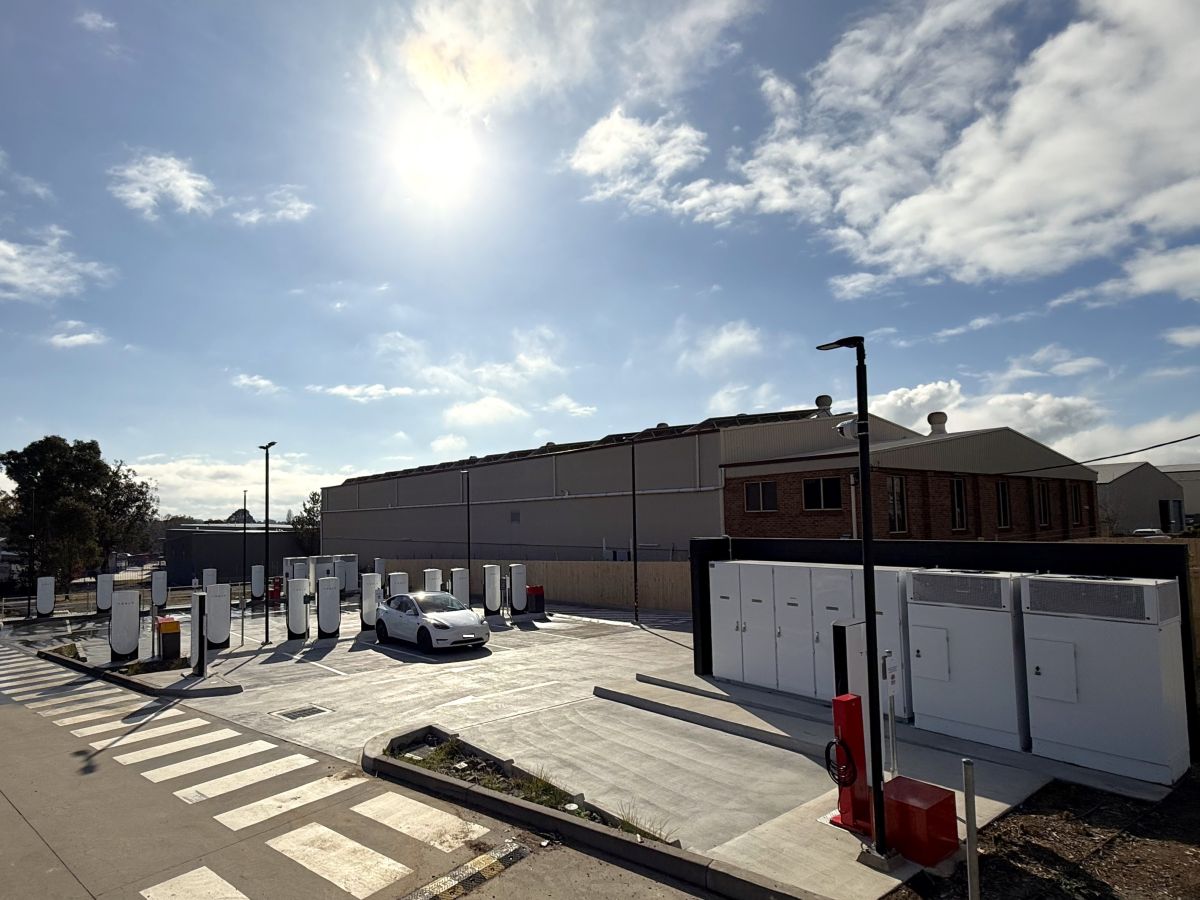
Image: Tesla Australia
Tesla earlier this year started delivering its next-generation 500 kW superchargers, which offer twice the speed of previous generations thanks to the new V4 supercharger power cabinet.
Now, it appears that the company has stopped production of the older V3 cabinets after 7 years and 15,000 cabinets, and will produce only the latest generation of EV charging equipment.
“Gigafactory New York built their last V3 Supercharger cabinet, marking the end to 15k+ V3 cabinets over 7 years,” Tesla Charging said on X, the Elon Musk owned social media network.
Tesla has been ramping up production of the new V4 cabinets, which the company has previously said will make the rollout of new sites easier.
Although the New York Supercharger Gigafactory has switched to V4 supercharging cabinets, it’s unclear if the Shanghai supercharger factory has followed them just yet.
It’s likely that Tesla would like to streamline production of these power cabinets across multiple facilities, meaning that we are likely to see these new cabinets land sometime in Australia later this year, enabling high-powered charging for more EV drivers.
Tesla revealed in November, 2024, that its upgraded V4 supercharging cabinets double the charging speed, up to 500 kW per stall, for compatible cars. For trucks such as the Tesla Semi, this could reach speeds of up to 1.2 MW per stall.
The new V4 cabinets that power the supercharger dispensers operate at 400-1,000 V, supporting 800 V vehicles by delivering faster speeds for those from Hyundai, Kia, Porsche, and Tesla, including the Cybertruck.
In addition to the faster charging capabilities of the V4 cabinets, the next-generation system can support up to 8 stalls, double the current 4 stalls per cabinet at existing V4 sites.
When the V4 cabinet system was announced, Max de Zegher, director of Tesla charging in North America, said: “Posts can peak up to 500kW for cars, but we need less than 1MW across 8 posts to deliver maximum power to cars 99% of the time.”
As mentioned, Tesla has also shared that the new cabinets and electrical setup will reduce complexity, the deployment cost, and, more importantly, the space required at sites for the power cabinets.
This will make rolling out sites much faster, which is much needed as EV adoption reaches new highs in markets such as the US and Australia.
We look forward to seeing similar hardware being deployed in Australia in the near future as the company approaches 150 sites nationally.
These upcoming deployments should reduce costs, helping keep Tesla supercharger prices low compared to other high-powered networks today, some of which are approaching 90 c/kWh.
Riz is the founder of carloop based in Melbourne, specialising in Australian EV data, insight reports and trends. He is a mechanical engineer who spent the first 7 years of his career building transport infrastructure before starting carloop. He has a passion for cars, particularly EVs and wants to help reduce transport emissions in Australia. He currently drives a red Tesla Model 3.
Polestar breaks down the cradle-to-gate carbon footprint of its Polestar 5 four-door GT - taking…
Iran war highlights how oil has become the Achilles Heel of the global economy. EVs…
We get a test drive of Suzuki's first electric SUV with one variant packing some…
Audi flags release of a new A2 e-tron, a compact electric vehicles (EVs) that the…
Cars, rockets and mining vehicles could drive themselves even when the global positioning system goes…
Strata and apartment complexes are beginning to relent on allowing EV charging, as demand and…