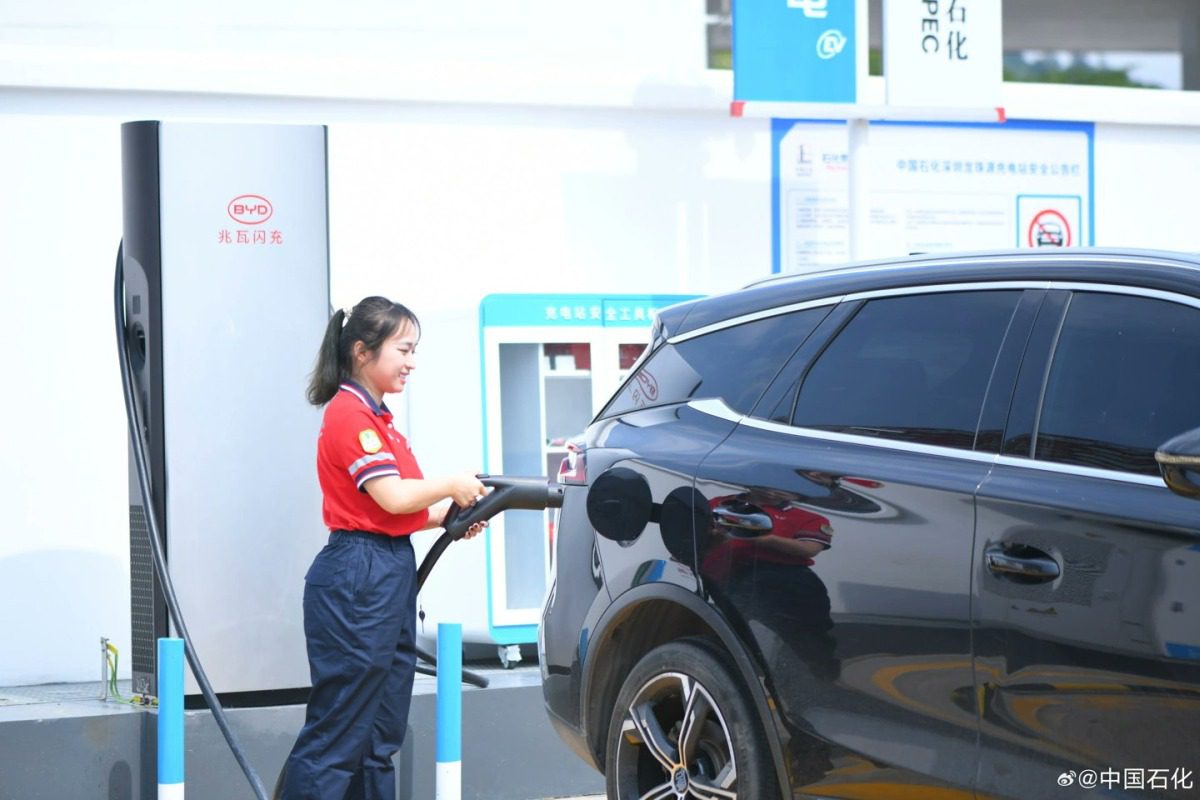
Image: BYD Seal 07 EV BYD via Weibo
BYD, one of the fastest-growing car makers and the world’s biggest battery manufacturer, has announced its second-generation Blade battery, which when charged with the company’s latest Flash Charging, achieves 10% to 70% charge in just 5 minutes.
The new Lithium Iron Phosphate (LFP) battery packs will keep their safety credentials but now incorporate charging speeds of up to 1,500 kW at the company’s upcoming Flash Charging sites.
In a post on X, the company shared some remarkable metrics around the charge times, including those in freezing temperatures:
At the same time, the company said it will be rolling out thousands of new flash charging sites across China to begin with, that will incorporate the new T shaped charging gantries, designed to charge vehicles at scale.
Various models were also announced that have the latest Flash Charging tech, one of which is officially the longest range EV in the world, claiming over 1,000 km of range. That is the new Denza Z9 GT.
In 2025, less than 12 months ago, the company announced its “Super e-Platform” which was originally found on the company’s flagship Han sedan and Tang SUV models.
The 1,000-volt architecture supported up to 1,000 amps of charging current, theoretically adding around 400 km of range in just five minutes. This would place them among the fastest-charging mass-market EVs currently available.
At that time, BYD launched the first version of its “Flash Charging” network, which began rollout in China last year.
That rollout was going to be done in partnership with other infrastructure suppliers, with an expected initial count to be around 15,000 of its 1 MW charging stations.
The latest announcement takes it up a level, with multiple new models now featuring the next-generation Flash Charging tech, enabling more drivers to benefit from faster charging than filling up.
Last week, we also reported that Flash Charging was heading to Europe, with reports surfacing from there suggesting a potential launch in the coming months.
BYD’s new platform is definitely one to watch out for, as it’s a major leap forward in the charging technologies available in BYD and most other EVs today.
With the new next-generation Blade Battery and Flash Charging tech that’s designed to significantly reduce charging times and make “range anxiety” a thing of the past, it’s likely to convince millions of buyers of ICE vehicles to make the shift to cleaner EVs sooner.
Riz is the founder of carloop based in Melbourne, specialising in Australian EV data, insight reports and trends. He is a mechanical engineer who spent the first 7 years of his career building transport infrastructure before starting carloop. He has a passion for cars, particularly EVs and wants to help reduce transport emissions in Australia. He currently drives a red Tesla Model 3.
EV lobby says tax cuts for electric cars and reintroducing state-based rebates could help more…
As petrol prices climb, the economics of going electric look increasingly compelling. New modelling reveals…
Bigger is not always better … at least when it comes to electric car batteries.…
The federal government boasted that EVs with V2G capability would be powering homes before the…
Fully electric trucks may still be years away, but new trailer technologies are already helping…
The car industry has met the first NVES target, but the FCAI warns compliance will…
Flash charging sounds great but if extremely rapid charging leads to greater battery degradation then maybe not something to be looking for. The EV industry will really benefit from greater insight re charging speeds/AC-DC charging and battery capacity loss over time.
I suspect that the battery manufacturer - BYD.....knows something about the BYD flash charger's effect on it's own battery.
For men in a hurry.......and need to talk about shortness.
It’s not a “game changer” if the technology only exists in China.
What would be a game changer is if I got anywhere close to 150kw charging as claimed on my current BYD in Aus - 108kw is about the best it gets on 250kw superchargers.
Don’t get me wrong, I’m never going back to petrol but charging speeds are just as dubious as range claims.
It starts in China but will certainly make its way here, whether from BYD or a competitor.
I've gotten 88 kW - the max supported by my Dolphin - plenty of times. But imagine you had a car that could charge at max 1,500 kW and you were only getting half (750 kW), would it even matter?
It’s hard enough to get a grid connection for a 350 kW charger. 1500 kW is nuts.
Ever faster charging is solving the wrong problem. We don’t need to replicate the petrol station mindset. BEVs allow us to do things differently, so we should do them differently.
If charging takes less than 10 minutes, then you are back to standing next to your vehicle the entire time it is charging. I don’t see that as a win.