Image: Joe Tegtmeyer via X
Last week, we reported that Tesla had produced its first steering wheel- and pedal-free two-seat robotaxi, the Cybercab, at its Texas factory — marking a significant milestone in the company’s autonomy ambitions.
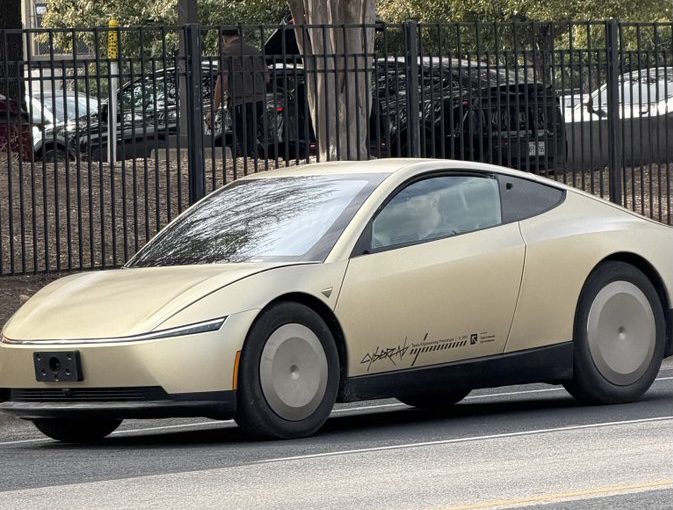
Now, just days later, multiple golden Cybercabs that are eventually expected to cost around A$45,000 have been spotted at GigaTexas, looking identical to each other.
In new drone footage from a Texas-based drone operator and factory build enthusiast, Joe Tegtmeyer, drone footage shows newly produced Cybercabs parked in the outbound lot at Tesla’s Austin factory.
In the footage, the three Cybercabs have no steering wheel, which would make them fully autonomous and also appear to have a tow hook attached to the front bumper.
This highlights that these could be vehicles for a safety evaluation program from the National Highway Traffic Safety Administration (NHTSA), similar to ANCAP in Australia.
These models also have staggered wheels, with the front featuring hubcaps and the rear featuring larger alloy wheels, painted white.
Official mass production of the Cybercab is expected to start in under two months at the Texas and according to the company’s CEO, Elon Musk, will be it’s highest volume vehicle in years to come.
Tesla first revealed the Cybercab at the company’s “We, Robot” event in late 2024.
Hundreds of fully autonomous test rides with the Gold Cybercabs were offered, along with those in the company’s best-selling Model Y in its Robotaxi form.
This event was on closed roads at Warner Bros. studios in California, and grabbed global attention.
Since then, plenty of sightings of the golden model have been made, with most occurring either at Tesla’s test track near Fremont, California or in Texas.
On-road testing has also been spotted in various conditions, including snow and rain, with many test vehicles having a physical steering wheel as a backup for evaluating engineers.
The Cybercab is expected to cost around A$45,000 as a self-driving robotaxi, with good boot space and fewer interior components than Tesla’s other passenger-car products.
According to Tesla engineers, this car is expected to have 50% fewer parts than the Model 3, helping reduce costs and scale as mass production begins in the coming months.
If Tesla meets its stated timeline, the Cybercab could represent one of the most ambitious attempts yet to commercialise fully autonomous transport at scale.
Riz is the founder of carloop based in Melbourne, specialising in Australian EV data, insight reports and trends. He is a mechanical engineer who spent the first 7 years of his career building transport infrastructure before starting carloop. He has a passion for cars, particularly EVs and wants to help reduce transport emissions in Australia. He currently drives a red Tesla Model 3.
Sam takes a good look at the Audi Q6 e-tron Performance - a large, handsome…
Audi’s first PPE-based EV has arrived in the form of the Q6 e-tron Performance. But…
Lucid Motors will cut 12% of its workforce as it pushes to streamline operations and…
The Electric Car Discount has had its naysayers, but it's definitely doing what it promised:…
The average real-world fuel consumption of plug-in hybrid electric vehicles in Europe is around 300%…
BYD's sleek new electric sports car spotted, revealing key details ahead of imminent reveal.
And the competition in the autonomous space must buy expensive vehicles from other companies and spend even more to equip those vehicles in sensors and control machinery.
If it's a numbers game, Tesla are way in front.