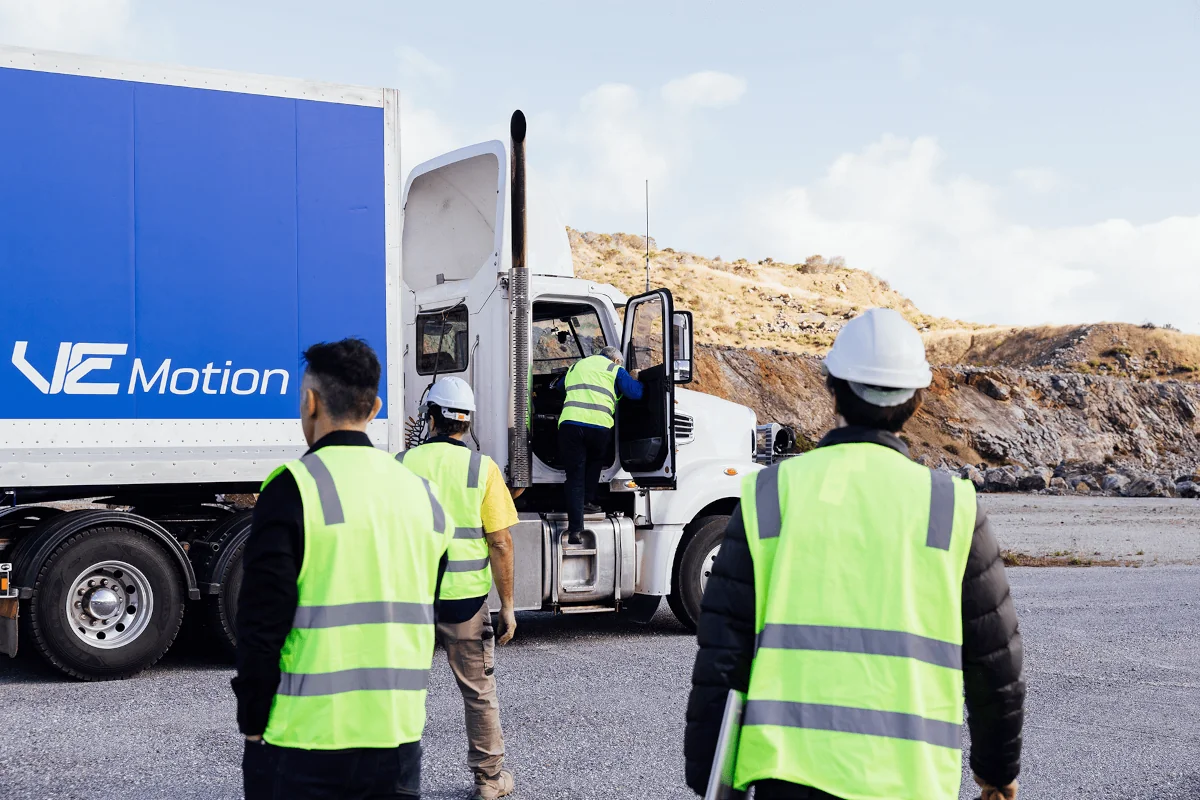
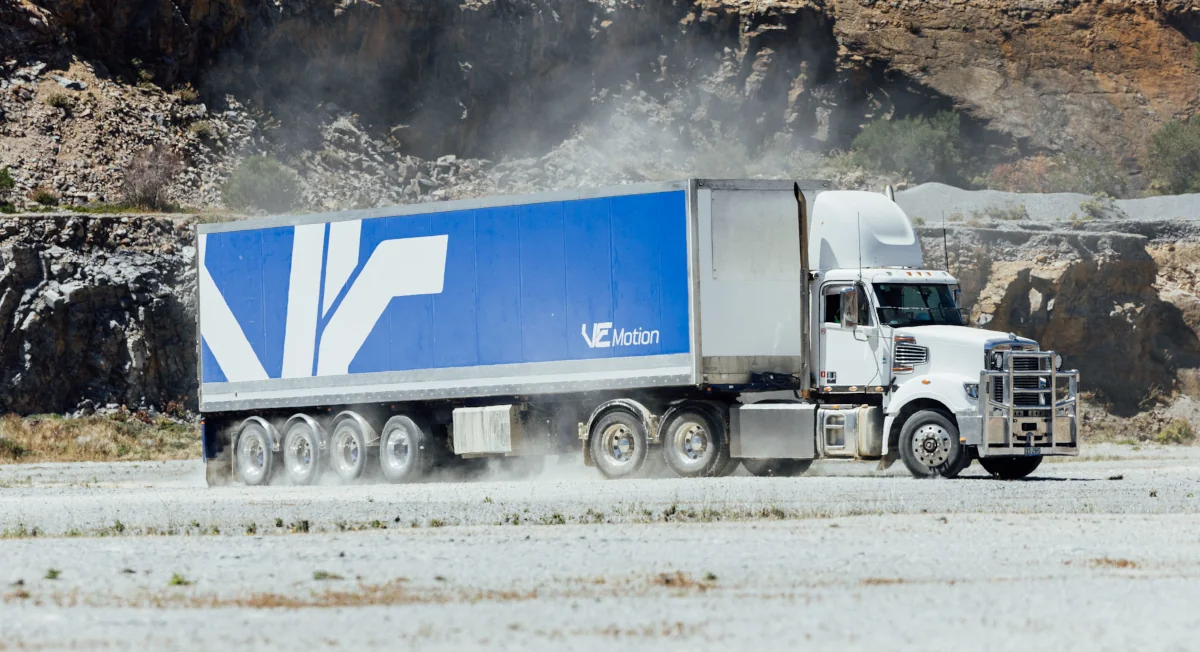
VE Motion trailer hitched to diesel prime mover. Source: VE Motion
South Australian company VE Motion has launched Australia’s first commercially available powered trailer system for heavy transport, offering a large battery pack for the trailer – instead of the prime mover – that it says can cut diesel use by up to 50 per cent.
VE Motion says its Powered Trailer System allows fleet owners to significantly reduce their fuel costs through efficiency improvements, as well as boosting performance via propulsion assist, regenerative braking and onboard power for trailer-based systems like pumps, blowers and refrigeration units.
The trailer system has been designed and engineered in South Australia, with VE Motion investing more than $4 million into research and development since 2018. Trailer systems are built and assembled in Murray Bridge, SA.
VE Motion Co-founder and CEO Dean Panos said the idea for the system came from a simple observation that diesel remains the most expensive and highest-emission fuel in Australia’s energy mix, yet it still powers almost all heavy transport.
“From our background in power generation, it was clear that electrification makes sense for heavy transport from an operating cost perspective,” Mr Panos said.
“The problem is that full-electric trucks come with very high capital costs, added mass, range limitations and operational disruption. That is why uptake has been almost non-existent.” Panos said powered trailers offered a practical alternative.
“They deliver real fuel savings, of up to 50% on diesel, more power and better efficiency, without forcing operators to replace fleets or change how they work. That is why we built VE Motion, to make that solution work for Australian conditions.”
A base trailer kit with 200 kWh battery pack starts from under $200,000. “This is roughly a quarter the price of a battery electric prime mover, while still providing half the benefits in terms of diesel savings and carbon emissions.” co-founder and CTO Stephen Bussenschutt added.
With up to 10,000 trailers manufactured in Australia each year, Bussenschutt said he sees their main market as being a supplier to these trailer manufacturers, where there is a much bigger opportunity compared to electric prime movers.
The VE Motion Powered Trailer System has been successfully demonstrated operating on South Australian roads as part of a heavy vehicle combination. Trials with fleet owners across Australia and New Zealand are also underway, to further refine and improve the product based on real world testing.
Ideal customers for this system would be fleet operators with large depots fitted with a lot of solar and/or the ability to charge these vehicles cheaply from the grid. For example, line haul freight operating between major hubs or cities, with enough downtime to recharge the batteries.
During operation, the system works like other plug-in hybrid electric vehicles, with its electric motor boosting propulsion when possible and recovering energy through regenerative braking. If necessary, trailers can still operate in diesel only mode if the battery is depleted due to range or charging constraints.
VE Motion’s system is supplied as a complete modular kit that can either be fitted to new or existing heavy-duty trailers, by freight operators or trailer manufacturers. The system consists of 3 major components described below, installed using familiar components and processes so it can be easily integrated.
An e-axle featuring a 295 kW Linamar electric drive unit integrates an electric motor, gearbox and inverter, providing approximately 400 horsepower of propulsion assist. The e-axle is rated for a Gross Axle Weight of up to 10 tonnes.
Scalable battery packs are mounted on custom brackets between the trailer chassis rails, available in 200 kWh, 400 kWh or 600 kWh capacities, giving approximately 200 km, 400 km and 600 km of reduced diesel consumption range respectively. Batteries are sourced from CATL and use lithium iron phosphate (LFP) chemistry.
Charging is provided via a standard CCS2 plug, with DC charging speeds between 120 – 180 kW. An onboard 25 kW AC charger is also fitted, enabling up to 22 kW from a standard 3-phase outlet, much cheaper to install where fleet operators are able to top up idle trailers that are parked for several hours between trips.
The onboard charger is vehicle to load (V2L) and vehicle to grid (V2G) capable, although Mr Bussenschutt said these functions will be coming at a later stage, potentially enabling further sources of revenue for fleet operators.
Embedded control and safety systems fitted to the trailer include a battery management system, safety contactor box, power distribution unit and vehicle control unit. A 7-inch touch screen is also installed in the prime mover cabin, giving drivers the ability to adjust regeneration and propulsion assist as required.
In terms of operational savings and environmental benefits, VE Motion estimates their system reduces diesel consumption by up to 50 %, offsetting 80 to 300 tonnes of carbon emissions per vehicle per year. This equates to $50,000 to $200,000 in annual diesel savings or up to 125,000 litres.
The hybrid system reduces engine, brake and retarder wear on trucks, which also helps to lower maintenance costs and total cost of ownership. Reduced noise and tailpipe emissions are further added benefits of the system, providing improvements to both truck drivers and people living nearby transport corridors.
Other performance benefits include better acceleration, hill climbing, gradability and startability, factors that improve performance of all trucks, particularly heavy road trains that are often performance limited. VE Motion will be performing further system tests with road trains next week, as part of an industry showcase day to be held in Rapid Bay, SA.
Tim has 20 years experience in the IT industry including 14 years as a network engineer and site reliability engineer at Google Australia. He is an EV and renewable energy enthusiast who is most passionate about helping people understand and adopt these technologies.
Stellantis, one of the world’s largest car manufacturers, takes a stunning $A37 billion hit as…
BYD's first EV in the market gets a much needed upgrade with new drivetrains, more…
More than 40 years ago, Nicole Kidman's career was launched by a film about BMX…
EV and car leasing lobbies say the FBT exemption for EVs has been a huge…
BYD's next flagship BEV sighted in regulatory filing revealing key specs.
They said the technology would never work, but Nio has now completed 100 million EV…