
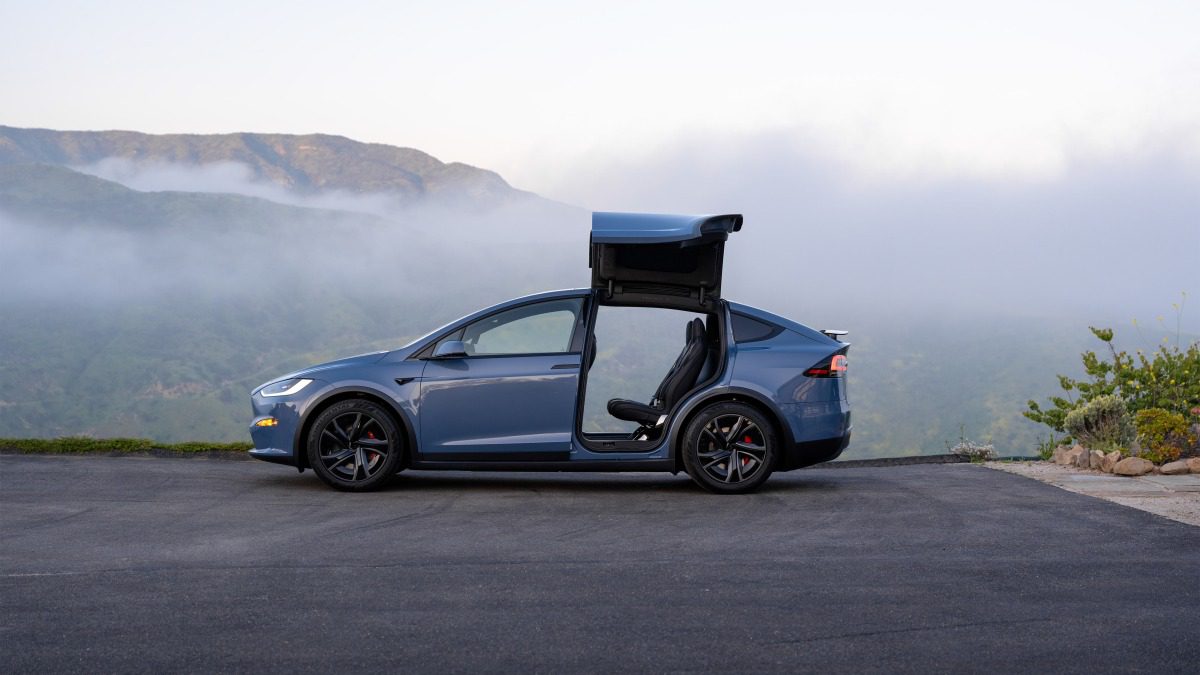
Tesla has officially dumped its first flagship models, the Model S sedan and the Model X SUV, and will bet its future on the development of robots and autonomy, even as CEO Elon Musk if forced to row back on some of his wilder predictions.
The company made the announcement in its fourth-quarter earnings call on Thursday morning (Australian time), confirming that the Model S – which was launched in 2012 and was proof that Tesla was serious, and good at EVs – and the Model X, launched in 2015 with distinctive Gulf-wing doors – would come to an end.
The Fremont factory in California, which made the EVs, along with the first Model 3s, will be repurposed in the image of the company’s big future bet – making Optimus humanoid robots.
Musk expects there will be billions of humanoid robots in the world, and confidently predicts that everyone will want one, but his early predictions have not come to much. Despite predicting a year ago that “thousands” of Optimus robots would be doing “useful” things on Tesla’s production lines by the end of the year, Musk admitted in the earnings call that none of them were.
This is the way the Musk explained the future it at the start of the earnings call.
“We’ve updated the Tesla mission to amazing abundance,” Musk said. “And this … intends to send a message of optimism about the future, like we’re most likely headed to an exciting, amazing era of abundance.
“And I think with the … advent, or with the continued growth of AI and robotics, I think we actually are headed to a future of universal high income, not universal basic income, but universal high income.
“I mean, there’s going to be a lot of change along the way, but, but that is, that is the that is what I see as the most likely outcome. So, so I think that’s that it makes sense to update Tesla’s mission, to reflect that goal.”
Make of that what you will, but Ai and robotics is definitely where it is at.
Tesla, controversially, even announced it is investing $US2 billion into Musk’s private company, xAI, despite Tesla shareholders suing Musk alleging a breach of fiduciary duty over his founding of xAI in the first place – and, as Electrek notes, despite Musk previously insisting that Tesla did not need that particular technology.
Musk is also going big on Robo-taxis, and is pushing for the driverless vehicles to get regulatory approval to operate in other cities – and despite Tesla’s claims otherwise, it has yet to gain approval in San Francisco, and has only rolled out a few such vehicles in Austin, Texas. He still expects to have fully autonomous cars approved in up to half the US by the end of the year.
Tesla is also betting big on battery storage – manufacturing it, not just deploying it – and building 100 GW of solars cells, partly at least to serve the giant data centres it will need to service its AI ambitions, even those in space, Musk says.
All told, Tesla intends to spend $US20 billion this financial year, including on new factories for batteries, solar, robots, the Semi and the Cybercab (Robotaxi).
“We’re making big investments for an epic future,” Musk said.
“I think these all make a tonne of, tonne of strategic sense and and then I guess I have, like, one, I guess, like, it’s not exactly, it’s not exactly bad news, but it’s a, it’s, it’s, we’re it’s, it’s time to basically bring the Model S and X programs to, to an end with an honorable discharge,” he said.
“Because we’re really moving into a future that is based on autonomy, and so if you’re interested in buying a Model S or X, now would be the time to order it, because we expect to wind down S and X production next quarter and basically stop production of Model S and X next quarter.”
The vehicles have not been available for purchase in Australia for several years, although Musk said the company will continue to support existing vehicles.
On the Cybertruck, the electric ute that has had disappointing sales and mixed reviews, Musk said its future might lie in performing cargo deliveries. “There’s a lot of cargo that needs to move locally within a city, and an autonomous Cybertruck could be very useful for that,” Musk said.
And that was about it as far as mentions of EVs went in the hour-long earnings call. It was all AI, robotics, FSD, and a little bit of energy storage and making batteries and solar.
For the record, Tesla EV sales fell 9 per cent in 2025, and automative revenues were down 11 per cent, and even though fourth quarter revenue beat expectations and came in at $US24.6 billion, the annual number of $US94.8 billion represented the company’s first annual fall. Net income fell 61 per cent.

Giles Parkinson is founder and editor of The Driven, and also edits and founded the Renew Economy and One Step Off The Grid web sites. He has been a journalist for nearly 40 years, is a former business and deputy editor of the Australian Financial Review, and owns a Tesla Model 3.