Tesla’s upcoming two-seater Robotaxi, the Cybercab, has been spotted testing without any side mirrors for the first time.
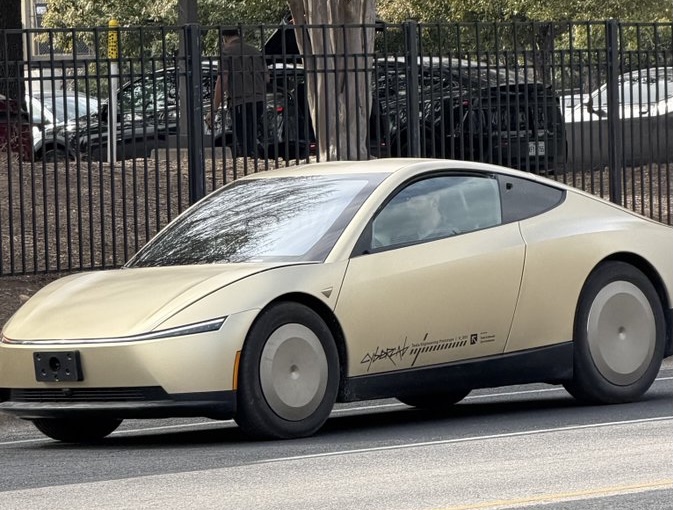
A gold Cybercab was spotted parked on a road with an operator getting ready to undertake evaluation testing, and was snapped up by Johnarrow on X.
This time around, though, the side mirrors that have been seen on other test vehicles are no longer there, hinting at a possible mirrorless vehicle for its autonomous operation.
It also shows that Tesla is likely to use side repeater cameras and the rear camera to help the car see what’s around it during operation.
My first sighting of the Cybercab IRL. Feels like this is the iPhone moment for Tesla. Soon anything not fully autonomous will be just like seeing a flip phone in the world today. Rare and the owner is probably a drug dealer pic.twitter.com/mshqCAAZcY
— John Arrow (@johnarrow) January 21, 2026
The latest sighting of the expected driverless car without any steering wheel or pedals during operation comes only weeks after initial sighting of the Cybercab testing on public roads had emerged in December.
Those photos show a car leaving an underground carpark in Austin, Texas and had Texas manufacturer plates, hinting that it’s a test vehicle.
Tesla initially showcased the Cybercab at the company’s “We, Robot” event in 2024, which was at Warner Bros. studios in California.
Hundreds of demos with the Cybercab and Model Y Robotaxis also occurred at the event on closed roads.
Since then, dozens of sightings of the golden model have been made, with most either at Tesla’s test track or in Tesla showrooms in the US.

Over the last 13 months, since the first unveiling, various changes have been made to the design of the vehicle. On the newer versions of the uniquely shaped car is the frameless window design, similar to the company’s most popular models, the Tesla Model 3 and Model Y.
There are also other smaller updates, such as ambient lighting on the inside and the use of similar interior design on the dashboard.
These updates appear to simplify the Cybercab’s design, which, according to previous reports by Tesla’s engineers, will have only half as many parts as a Tesla Model 3.
This will help bring the cost of around $A45,000 self-driving robotaxi down, helping the company scale much quicker than the often very specialised vehicles seen in competitors like Waymo in the US.
In the shareholder’s deck of the Q3 earnings call in October, the company shared photos of the pilot production line as it aims to begin production of the unique two-seater vehicle in April 2026.
An update on the vehicle is expected at the upcoming earnings call next week to see if all is on track for production in 3 months. With even fewer parts, such as mirrors, required for Robotaxi operations, the new model will be quite uniquely placed in the autonomous vehicle market in the years to come.