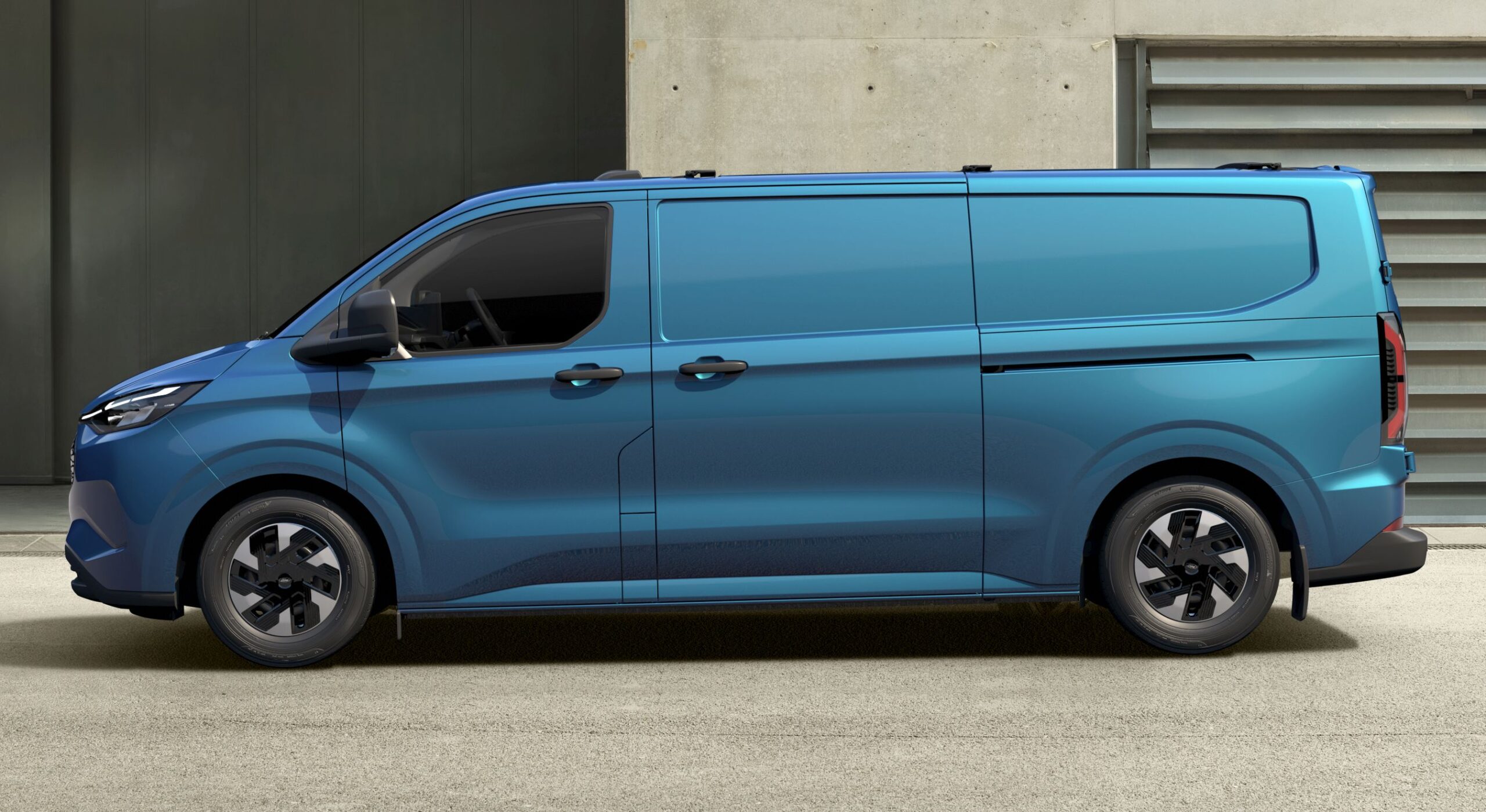
The Ford E-Transit Custom is marketed as the ‘baby brother’ to the Ford E-Transit, and is smaller in payload and volume than the current E-Transit van (around 1.1 tonne for the Custom and 1.6t for the Transit).
The just launched all-electric version of the Custom is offered in Australia in two rear-wheel drive body forms: the long wheelbase (LWB) ‘Trend’ and short wheelbase (SWB) ‘Sport’ version. (The ICE versions – full diesel and PHEV petrol – are front-wheel drive with an all-wheel drive diesel version also available).
The Trend has a secure, windowless cargo area designed for work, whilst the Sport differs through the addition of some rear windows, an electrically adjustable driver’s seat, plus the cosmetic additions of alloy wheels, rear spoiler and a ‘go-fast’ stripe running vertically from the front grille, over the bonnet and on through to down the rear doors.
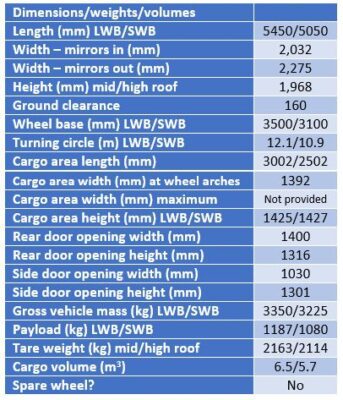
Both share the same drive-train and 64kWh battery system. Both also have similar payloads and the same tow rating (2.3t braked). The main differences, apart from the cosmetics, are in length (5,050 mm for the SWB and 5,450 mm for the LWB) and cargo volume (5.7m3 and 6.5m3 respectively).
The Transit Custom has been offered here in Australia since 2013 and has become (alongside the Toyota HiAce, Hyundai Staria, LDV Deliver 7, etc) a favourite of many tradies as a practical workhorse. The question now is: will the advent of the all-electric E-Transit Custom make it the first all-electric one tonne van to move into the mainstream business arena?
First impressions:
The version on loan for the 10 day test was a LWB Trend with no rear windows, dual sliding side doors and a central rear vision camera based ‘mirror’.
From the driver’s seat, little (if anything) differs from the ICE versions – which, as mentioned in my review of the E-Transit back in 2023, is a good thing. The reason? During a fleet transition period where all three versions might be available within a fleet, drivers stepping between them won’t be confused by differering control positions or functions.
What drivers will notice as they swap between them is the better driving dynamics of the BEV due its rear-wheel drive configuration and instant electric acceleration. (Versus the lag offered by a turbo diesel or PHEV CVT).
Like its bigger brother the E-Transit, in day-to-day driving I found it easy to keep up with traffic off the lights – something I never experienced in my days on the road as a sparky driving ICE utes and vans.
Visibility using the side mirrors is excellent with both large flat and lower convex blind-spot viewing sections. The rearview camera based mirror also provided an excellent rear-view – although it did suffer from the standard problem of camera-based mirrors: that being you need to refocus the eyes to a close-up rather than distant focal point. (Mirrors don’t need this).
For normal-sighted people this is reatively easy, but as someone who wears glasses for long distance vision I found I needed to remove my glasses to use it – which is not all that practical! Thankfully, in the E-Transit you can remove the distraction and turn it off and rely solely on the side mirrors, as you would normally do in van-based commercial vehicles.
Interior:
The E-Transit Custom comes standard with seating for three. The driver’s seat in the Trend has manual fore and aft, height, lumbar and rear tilt, along with steering wheel reach and tilt. Between those, most people should find it easy to set a position that suits. The Sport adds full electric adjustment of the driver’s seat.
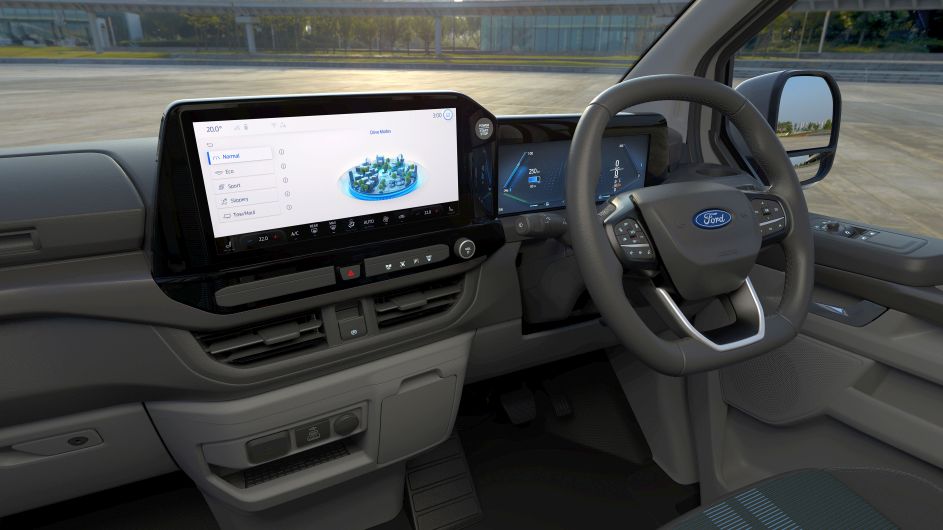
There also plenty of door pockets, a folding cupholder on the dash by the driver, plus two positions for clipping a mobile phone holder. Charging via USB B, C and 12V socket outlets are all catered for.
The rear load area comes standard with a single sliding side door and rear barn doors – although dual side sliding doors and a lift-up rear tailgate are both optional extras. (The van provided came with dual side sliding doors). Tie-down points in the rear are provided as standard, as is a metal bulkhead behind the passenger compartment.
Driving:
As mentioned earlier, the E-Transit Custom looks and feels the same as the ICE versions, but drives considerably better than these thanks to its rear-wheel drive and electric acceleration. In fact, just like the larger E-Transit, it drives almost too well by making it is easy to forget you are driving a sizeable van rather than a passenger car.
Driving range and charging
According to the generally more realistic WLTP test cycle, driving ranges for the E-Transit Custom are 301 km for the LWB and 307 km for the SWB Sport. in my week of driving the LWB, this range should be relatively achievable for around-town to outer urban use. Note: if using it for extended highway travel, expect 10% to 15% less than the WLTP number.
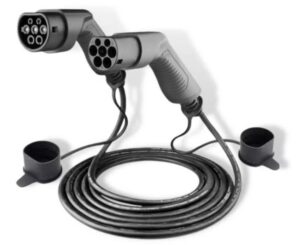
AC charging is up to 11 kW three phase (7.4 kW single phase), giving a zero to 100% charge time of around 6.7 hours three phase (roughly 50 km recharged per hour) or 10 hours on single phase. DC charging is up to 125 kW, allowing a 10% to 80% charge to take a shade under 40 min – meaning the E-Custom could get 240 km of recharge during a lunch break.
My one criticism would be that there is no regenerative braking adjustment available. It is either on or off, and when on, does not seem very strong. This is likely a deliberate choice by Ford though, as it makes swapping from ICE and electric versions a seamless experience for those not used to the advantages of stronger regenerative brake settings.
Towing
The E-Custom is rated for towing with a rating of 2,300 kg braked/750 kg unbraked.
General
Unlike ICE versions of the Transit Custom, the electric version doesn’t come with a spare wheel. As also noted in The Driven’s launch review, the option of fitting Ford’s Pro Power Onboard system to the E-Transit Custom (as available in the UK) is not offered here, despite its being fitted to the Australian Ranger PHEV.
On enquiry, Ford note that at this stage there are no plans to offer Pro Power V2L with the E-Transit Custom. Given this feature is likely to become a ‘must-have’ for BEV and PHEV tradie vehicles, it does seem an odd decision. Especially as the Farizon SV van and KGM Musso ute both include it as standard.
A final point to include here is if you are cross-shopping the E-Transit Custom with the newly arrived electric VW transporter, you might get a strong sense of déjà vu.
The reason? They are the same van! The VW has a slightly different nose treatment plus a VW badge on the steering wheel, but in all other respects it is the E-Transit Custom. Produced as a joint venture with Ford, and both are manufactured at Ford’s Otosan plant in Turkey.
Summing up:
At $83,692 for the electric Trend versus $63,252 for a diesel, or $73,522 for the PHEV, it is not a huge premium to pay over the ICE versions to go all-electric. Being better to drive and cheaper to run than its ICE versions, the E-Custom makes a strong case for choosing it over those, and not just because it is the greener option.
Businesses wanting to buy a new Transit Custom van would therefore be well advised to compare the electric TCO (Total Cost of Ownership) for their use-case. It also comes across as currently the overall best electric van in its segment.
Competition in the one tonne van category is warming up though, with competitors to the E-Custom including the Farizon SV, LDV eDeliver 7 and Peugeot e-Expert. (And, of course, it’s twin the VW Transporter BEV).
The Ford E-Transit Custom is pricier than the LDV (it starts at $64k on-the-road) and Farizon (starting at $70k on-the-road). but similarly priced to the Peugeot e-Expert. The E-Transit Custom by the way has the best tow rating of the four.
As a final note – Ford (and consequently VW) have just announced a larger battery (70 kWh) for the E-Transit Custom/ Transporter BEV combo. This will see the WLTP range upgraded to around 380 km.
DC charging has also been modified to give a 10%-80% charge in around 30 minutes instead of 39 minutes for the current version. No announcement has been made yet as to when (or if) this change will flow through to the Australian versions.
Specifications for the E-Transit Custom: (Source: aeva.au/fact-sheets)
Seating capacity: 3
Dimensions and weights:
Battery:
- 64kWh (usable)
Charging:
- 1 phase AC: 7.4 kW (maximum)
- 3 phase AC: 11 kW (maximum)
- DC: 125 kW (maximum)
Charge port location:
- Front-right (corner of bumper)
Vehicle to Load connection (position and power):
- The E-Transit custom is currently not V2X capable
Energy consumption: (WLTP):
- LWB: 24.8 kW/100km
- SWB: 24.2 kWh/100km
Drive configuration:
- rear wheel drive
Towing: unbraked/braked
- 750kg/2,300kg
Performance:
- Maximum power/torque: 160 kW/415 Nm
- 0 – 100km/hr: not specified.