

The Society of Motor Manufacturers and Traders (SMMT) in the UK gathers new vehicle sales data in much the way that the Federal Chamber of Automotive Industries (FCAI) here does through its VFACTS arm.
The recently released SMMT data for November sales of UK light commercial vehicles (LCVs) makes for some interesting reading.
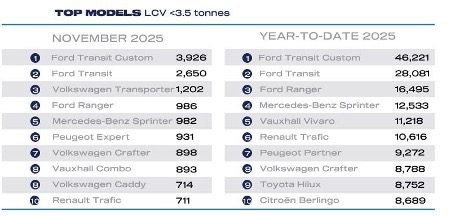
Unlike Australia, where dual-cab utes dominate the sales charts (probably due to some poorly designed Fringe Benefits Tax rules), the UK tends to favour vans such as the Ford Transit, Volkswagen Transporter and VW Caddy.
(In fact, only two utes appear in the UK top 10 – these being the Ford Ranger and Toyota Hilux).
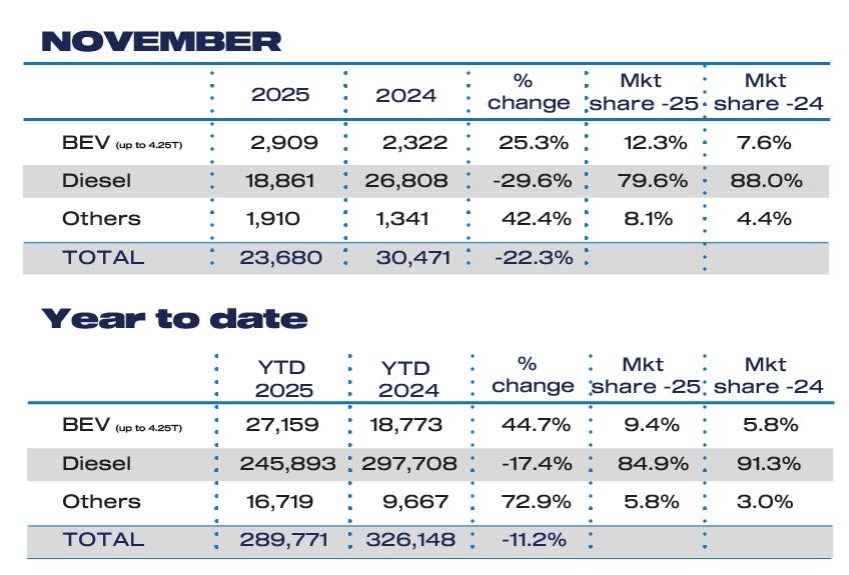
Whilst the UK market has seen a drop in business investment confidence, the BEV section of it has not, rising by 25.3% to 2,909 units, accounting for 12.3% of the overall market – 2025’s highest monthly share.
Growth in BEV LCVs has been impressive across the year, up 44.7% compared with the same period in 2024, with 27,159 registrations.
Unfortunately, the BEV LCV market (at a year-to-date share of 9.4%) not only lags the passenger vehicle percentage (at 25.4% in November and 20.7% year-to-date) it is a significant distance behind the 16% share mandated by the UK government for 2025. (This rises to 24% for 2026).
To combat this shortfall, the UK government has recently announced the extension of their Plug-in Van Grant, new Depot Charging Scheme and has proposed planning reform for private charger installations.
In response to the figures, Mike Hawes, SMMT Chief Executive, said,
“Lacklustre light commercial vehicle uptake highlights weak economic confidence, and slower fleet renewal means slower decarbonisation. While it is encouraging that zero emission van uptake is rising, the pace of change severely lags government ambition, and every lever must be pulled to support demand and protect industry investment – both of which are essential to our shared net zero goals.”
As for Australia –the electrification of the LCV market here has been lagging far behind BEV passenger vehicles. In part this has been caused by a lack of BEV options in the dual-cab ute segment, although the rise and rise of BYD Shark PHEV sales is testament to a pent-up demand for electric options.
(For a break-down of BEV sales in Australia, see The Driven’s monthly sales breakdown here).
2026 will therefore be interesting to see what effect the arrival of the KGM Musso EV has – as well as the hopefully soon arrival of the LDV eTerron 9 ute.
Also (hopefully) with the changes to the FBT applying to BEVs, the trend will finally shift away from large utes and towards electric vans for commercial uses and electric cars where FBT would otherwise be dubious for the previously chosen utes.
Perhaps (I say even more hopefully) we will follow the UK example and see some Australian government support to kick-start a more robust eLCV transition with funding and/or tax support for the purchase of eLCVs and the installation of workplace charging.