
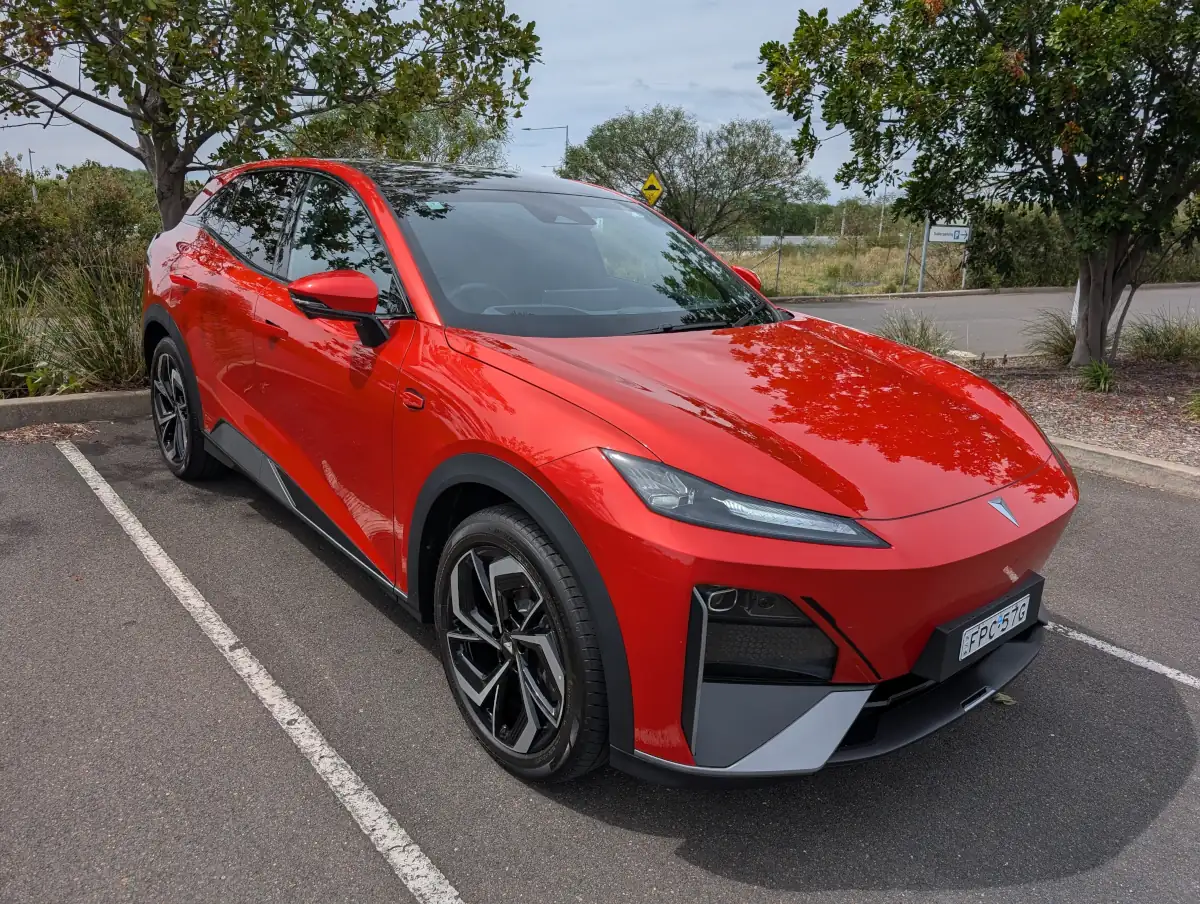
Deepal is one of the newest Chinese automakers trying to establish themselves in Australia, launching with the S07 here at the end of 2024. The S07 is a stylish mid-size SUV competing against over 20 models in the most crowded segment of our burgeoning EV market.
It makes sense for new entrants to start by offering a medium sized SUV, given they make up 5 of our 6 top sellers, but there are so many high quality options to choose from that it is tough to stand out from the crowd and tempt buyers away from popular models like the Sealion 7, Model Y, Kia EV5 and Geely EX5.
A single rear-wheel drive S07 variant is available, starting from $49,900 plus on-road costs or roughly $55,000 driveaway. It comes with an 80 kWh battery pack that delivers up to 475 km of WLTP range and 3.3 kW vehicle to load (V2L) output, but no official support for vehicle to grid (V2G) at this stage.
The S07 feature list is impressive, although it lacks a unique drawcard like that of its E07 Multitruck stablemate, able to transform between SUV and ute with the touch of a button. The S07 was also criticised early on for poor calibration of its driver assistance systems, which may partly explain mediocre sales performance of just 244 vehicles year to date.
I was originally booked in to review the S07 back in April, but the loan was cancelled so Deepal could roll out a software update to address these safety system concerns. Has Deepal managed to fix the issues and make the S07 a worthy competitor? I spent a week in one to find out.
Attractive design with a generous frunk
According to Deepal’s marketing, the S07 was designed in Turin, Italy with interior elements inspired by yachts of the Mediterranean. I don’t understand the yacht reference, but I think the S07 does look attractive from the outside, in a macho, aggressive kind of way.
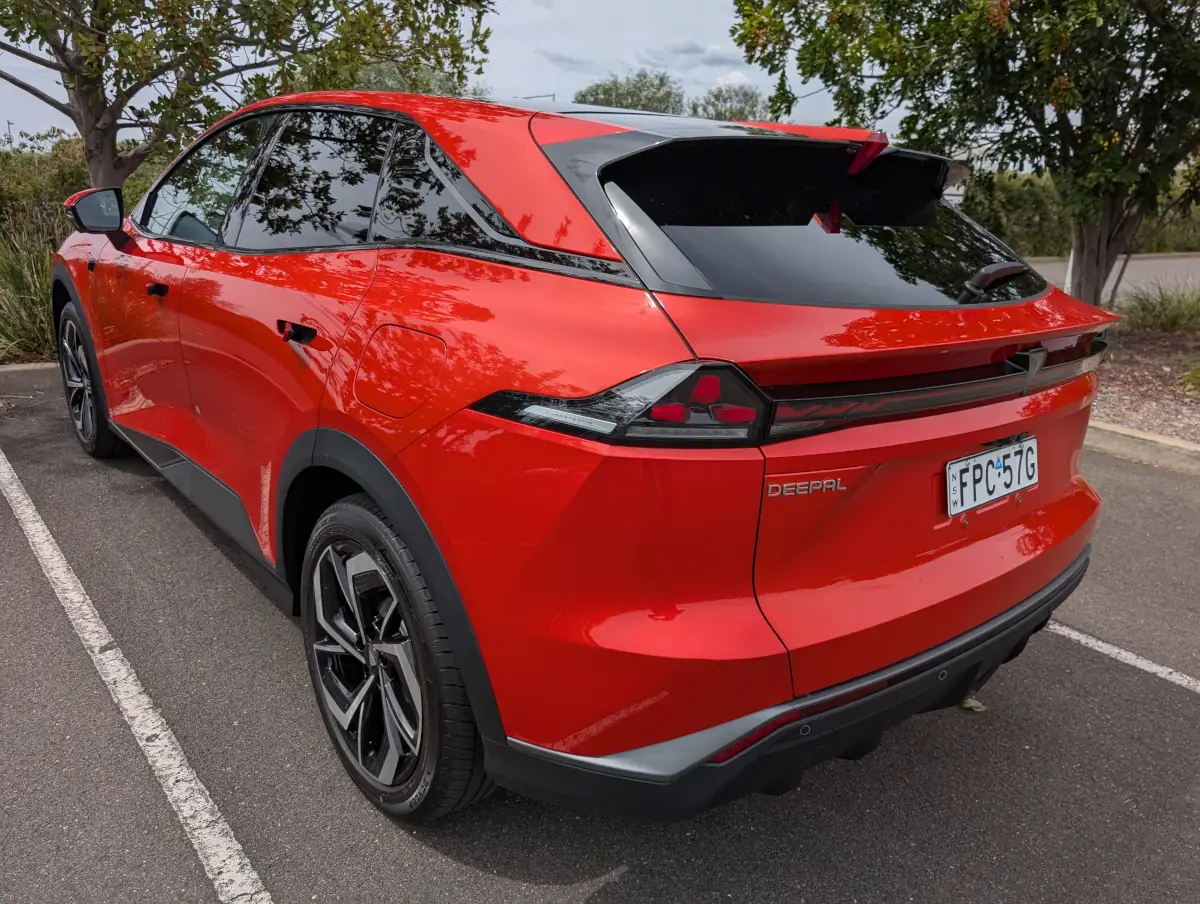
A roof spoiler with integrated brake light, plus a full width taillight featuring an illuminated Deepal logo give the S07 an interesting, attractive looking rear end as well. Others seem to agree as I got a couple of thumbs up and “nice car” remarks from passers-by.
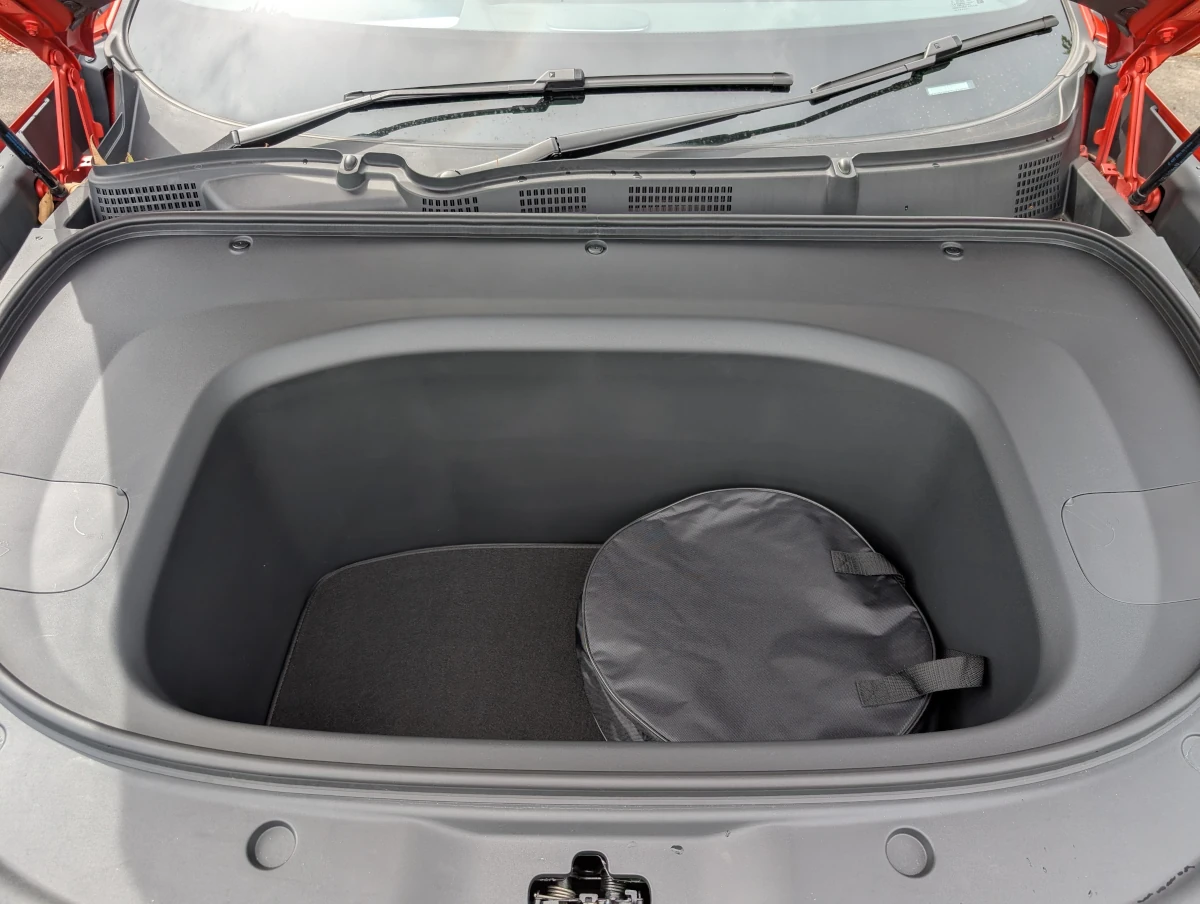
Underneath the bonnet is a usefully sized 125 L frunk, opened by pulling twice on a lever beneath the steering wheel. Mine was fitted with a piece of carpet at the bottom, but this can be easily removed if you want to throw in wet or dirty gear.
Boot space in the S07 is below average for a medium SUV, measuring 445 L with the rear seats up and 1,385 L with the seats folded. There are no cubby holes on either side to stash small items and only a moulded section to store the tyre repair kit underneath the boot floor, so it’s not the most practical boot either.

Fully featured interior, but tall people beware
The S07 unlocks itself as you approach with the hexagonal key fob in your pocket, popping out the door handles and even starting up the air-conditioning, which I first noticed from the relatively noisy heat pump.
If you walk past the car with the keys often, there is an option to disable automatic unlocking and prevent this from draining the battery unnecessarily.
At the centre of the minimalist Deepal S07 cabin is a 15.6-inch touchscreen that tilts from side to side, depending on whether the passenger or driver sits down first. This feels like a gimmick and something else that can potentially go wrong, rather than something I found genuinely helpful.
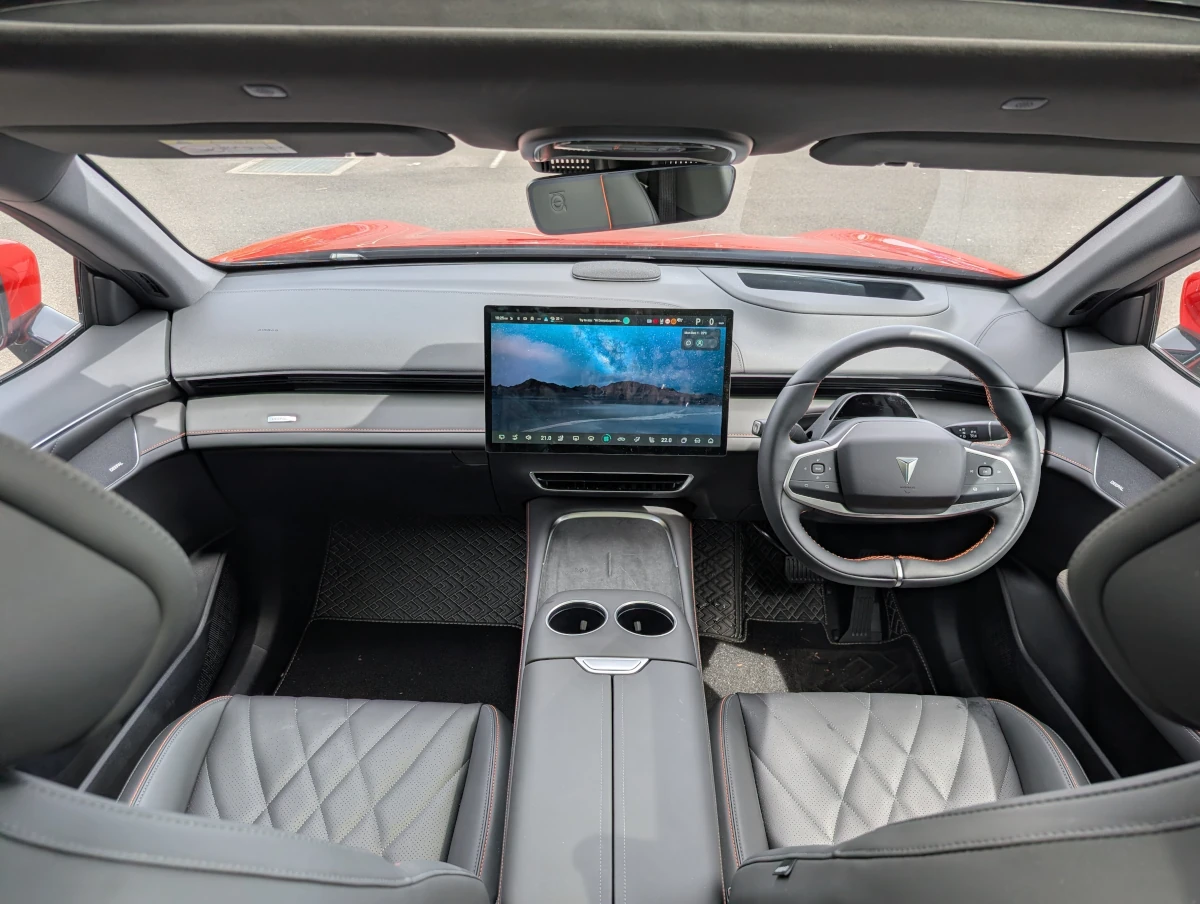
Gimmick aside, all of the expected features and creature comforts can be found in the Deepal S07, including wireless phone charging, wireless Android Auto and Apple CarPlay, heated steering wheel, heated and ventilated front seats.
After a while I found the front seats felt flat and unsupportive, becoming uncomfortable on longer trips. Despite the S07’s size and my average Australian male height of 175 cm, I also found myself perched too high up even with the driver’s seat at its lowest setting.
The problem was not so much with vertical headroom, more that the sloping roof line causes the top of the windscreen to feel closer to your forehead than other cars and partially obscures the view forwards, especially when using the sin visor.
Wondering how even taller people would manage, I asked my 190 cm high friend to sit in the car and he had to slouch down or duck his head slightly to avoid looking directly at the roof or sun visor. Headroom in the back seats is also limited, his head was touching the horizontal roof beam at the back of the glass sunroof before the rear headrests.
Rear passengers have plenty of legroom and are well looked after by a fold down armrest with 2 cupholders, door and seat pockets plus their own controls for adjusting the air conditioning, sliding the passenger seat forwards or backwards as well as opening or closing the electronic sunroof shade.
Software still needs more work
As mentioned above, Deepal has tried to address early feedback regarding overzealous driver assistance features by rolling out over the air software updates to reduce the sensitivity of these systems. The S07 I tested was running Deepal OS 2.0.2 which contains these fixes.
One of the improvements Deepal has made is that driver monitoring, speed limit warnings and lane keep assist functions can be easily toggled via shortcuts accessed by swiping down from the top of the screen. When I picked up the car these systems were all disabled by the previous driver so I enabled them again before setting off.
Whether or not giving users the choice to permanently disable some of these features is really fixing them is a separate discussion that I won’t get into. At least Deepal says they worked closely with ANCAP to ensure these changes do not affect the 5-star safety rating the S07 has been awarded.
Pretty quickly on my first drive, the driver monitoring system started beeping and telling me to pay attention, even though I was looking straight ahead and watching the road. I was wearing sunglasses, so I suspect Deepal’s driver monitoring system has similar issues to that of the Geely EX5 which could not see through my glasses properly.
Display of key driving information is another area that needs work, as the speed and cruise control settings are readable, but occupy only a small section at the top right of the screen rather than having their own dedicated panel. As a result, the S07 feels very reliant on the head up display which is fine unless you are wearing polarised sunglasses.
You may be luckier than me depending on the type of glasses you wear. I found the head up display was very dim with my sunglasses on, and it disappeared completely with certain slight head movements. To be fair to Deepal, this is a common issue that a lot of heads up displays face.

The best example of user interface problems surfaced while I was charging the car at home when Amber sent notification of an unexpected price spike in the middle of the day. My own car charging uses Amber’s EV charging automation which stops automatically in this situation so the battery and solar can export as much as possible.
However, this automation does not work for other EVs plugged into my Tesla Wall Connector so the Deepal kept on charging full speed at 7 kW. Most EVs will stop charging and unlock the charge port while pressing the button on the wall connector handle, but the Deepal simply refused to unlock. Releasing the button commenced the charging again.
I searched everywhere through the user interface to find a stop charging button or a way to unlock the charge port. This is something that should be easily accessed from the charging screen on all EVs, apparently not on the S07 unless I’m going blind.
Short of switching off the circuit breaker and/or using the emergency charge port unlock cable hidden beneath the boot floor, I could not find a way to stop the car charging. In the end I reduced the charge limit to 60% and waited for the charge port to unlock itself, by which time the price spike was over anyway.
Driving experience was not my cup of tea
Getting straight to the point, the Deepal S07 driving experience was not my favourite. There was not anything particularly bad about it, more a case of many little things adding up that were not to my liking. These things are also highly subjective, so others may completely disagree and that’s fine.
Regenerative braking in the S07 is tied to the drive mode rather than being a separate option. It is strongest in eco, weak in normal and virtually non-existent in sport mode. There is no option to disable creep either, but auto hold can be activated by firmly pressing the brake pedal when you come to a stop.
A fully customisable drive mode can be used to mix and match your preferences for acceleration, steering feel and regenerative braking strength from 0 to 100 %. This is the drive mode I settled on, normal acceleration combined with 100 % regen.
Acceleration from the single motor rear-wheel drive setup in the S07 is sufficient albeit slower than many EVs, taking 7.9 seconds to reach 100 km/h. Worse than this though was the accelerator pedal lag, with very noticeable delays between foot movements and the car speeding up or slowing down which feels unnerving.
The Deepal S07 also tripped me up a few times while parking or making 3-point turns, continuing forwards instead of reversing and vice-versa. Even with your foot on the brake the car needs to slow right down to a crawl before it will let you change direction.
I thought the suspension could be better, as it felt too firm and crashed over bumps at times while seeming soft and generally comfortable in other situations. They say good suspension can make a car feel lighter, but the S07 feels heavier than its 2,073 kg kerb mass in my opinion.
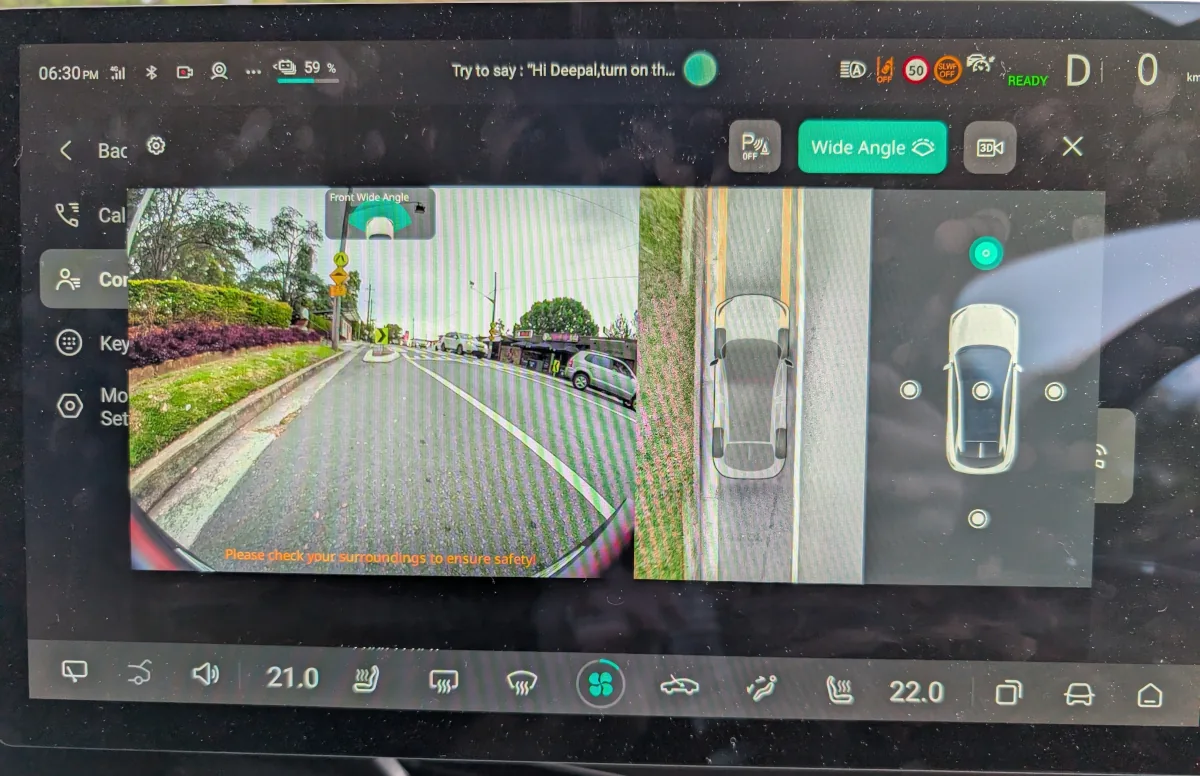
Finishing with some positives, an excellent 360 degree camera system helps with parking, including a wide angle one mounted on the front bumper so you can easily judge distances. Efficiency was also decent, averaging 159 Wh/km over my entire loan period.
Conclusion
The Deepal S07 looks great in person and comes with a long list of standard features included. A starting price below $50,000 also makes it look like good value on paper too, coming in below the Tesla Model Y, BYD Sealion 7 and Kia EV5.
Deepal is currently offering $5,000 cashback and 3 years of free servicing for S07 purchases until December 31st, which brings the S07 price down further towards Geely’s excellent value EX5.
However, despite software updates to improve the driver assistance systems, I still experienced issues and had to disable the driver monitoring system. In general, the infotainment experience is unintuitive and has shortcomings, for example the inability to stop a charging session through the car interface.
With these things in mind it is hard to recommend the Deepal S07 over the competition at this stage. If Deepal can improve the software through future updates as well as tweak the driving dynamics, it still has the potential to live up to its good looks.
Table of key specifications for Deepal S07
| Variant | Deepal S07 | ||
| Starting price | $49,900, plus on-road costs | ||
| Paint colours and options | 7 exterior colours:
|
||
| Battery size and chemistry | 80 kWh, Nickel Manganese Cobalt (NMC) | ||
| Range | 475 km WLTP | ||
| Driven wheels | Rear-wheel drive | ||
| Power / Torque | 160 kW / 320 Nm | ||
| Maximum charging speed | 11 kW AC, 92 kW DC | ||
| Charging time | 7 kW AC (0 – 100 %) – 11 hours 11 kW AC (0 – 100 %) – 8 hours 100 kW DC (30 – 80 %) – 35 minutes |
||
| Bidirectional charging | V2L up to 3.3 kW, via external adapter sold separately |
||
| Exterior dimensions | Length: 4,750 mm Width: 1,930 mm Height: 1,625 mm Wheelbase: 2,900 mm Ground clearance: 145 mm |
||
| Kerb mass | 2,073 kg | ||
| Towing capacity | 750 kg unbraked / 1,500 kg braked | ||
| Storage space | Frunk: 125 L Boot, rear seats up: 445 L Boot rear seats folded: 1,385 L |
||
| Service interval | 12 months / 20,000 km | ||

Tim has 20 years experience in the IT industry including 14 years as a network engineer and site reliability engineer at Google Australia. He is an EV and renewable energy enthusiast who is most passionate about helping people understand and adopt these technologies.