Image: Freepik
This is the exact wrong moment for automakers to lose their nerve in the transition to electric vehicles (EVs).
A decade of consistent growth has culminated in record-breaking EV sales. More than 1.2 million new light-duty EVs were sold through the first three quarters of 2025, higher than any prior year; the EV sales share reached nearly 12% in the third quarter.
More broadly, over 7 million EVs were sold from 2015 to September 2025, with more than half occurring in the past 3 years.
American drivers want EVs, and the data prove it. Yet several U.S. manufacturers have backtracked on their commitment to the EV transition.
If these automakers retreat now, European, Chinese, and South Korean manufacturers will eagerly fill the gap. The decisions made by automakers and policymakers today will determine who leads the next era of clean vehicles—and who gets left behind.
A key driver of this growth is expanded EV model availability, and in particular more affordable options.
In 2015, only VW offered at least five different EV models across its brands; by 2025, 10 automakers offered five or more EV models, with seven automakers offering 10 or more.
Over this same timeframe, annual EV sales increased by a factor of 12. In 2015, there were 19 car, zero pickup, and six crossover/SUV EV models on the U.S. market.
In 2025, there are 28 car, 6 pickup, and 79 SUV EV models available. Many of these models start below $50,000—and buyers have responded. Through September 2025, 68% of BEV sales were of models starting under that threshold. Diversification has opened new market segments and attracted a wider range of consumers, resulting in record sales and market shares.
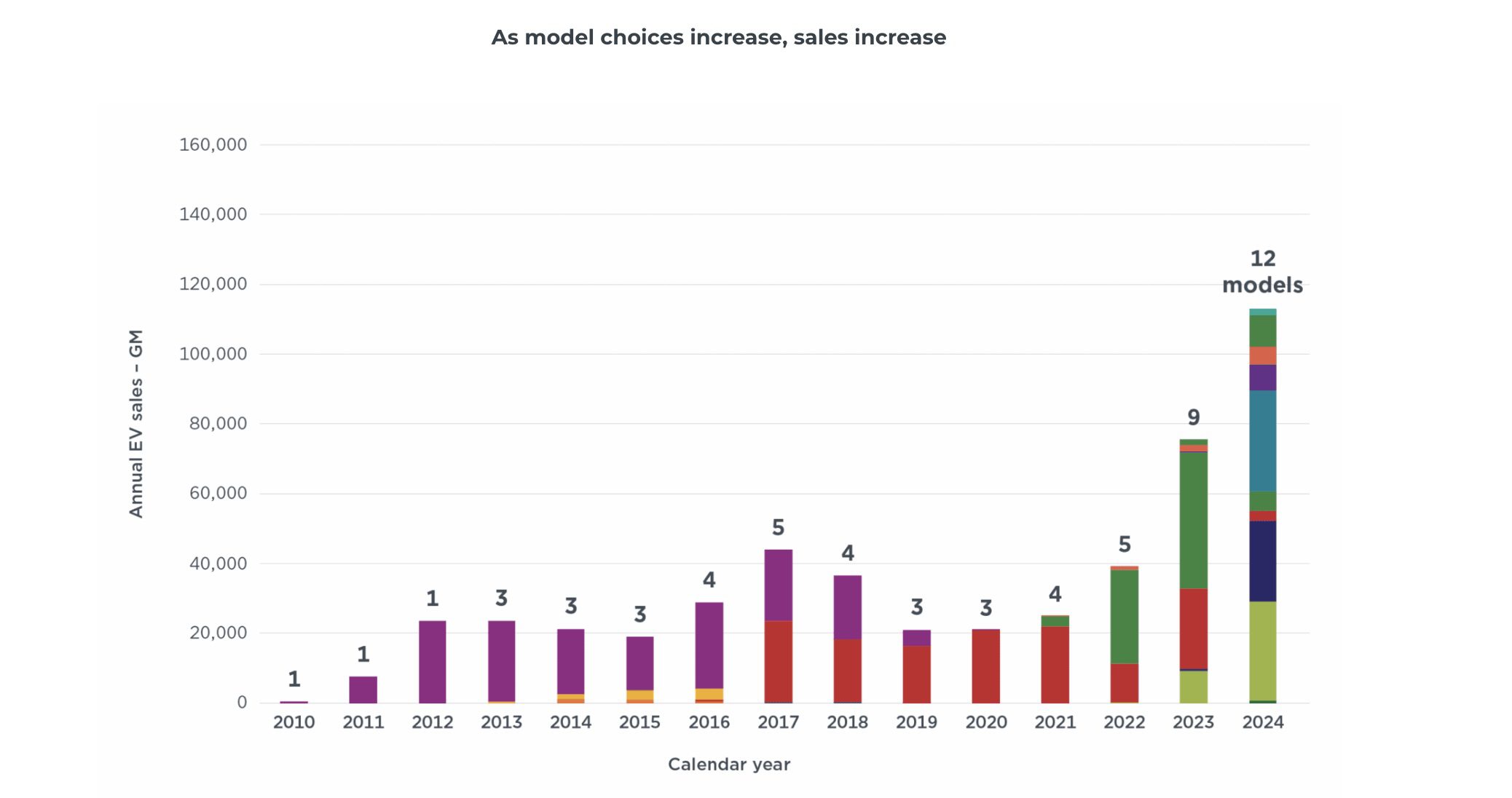
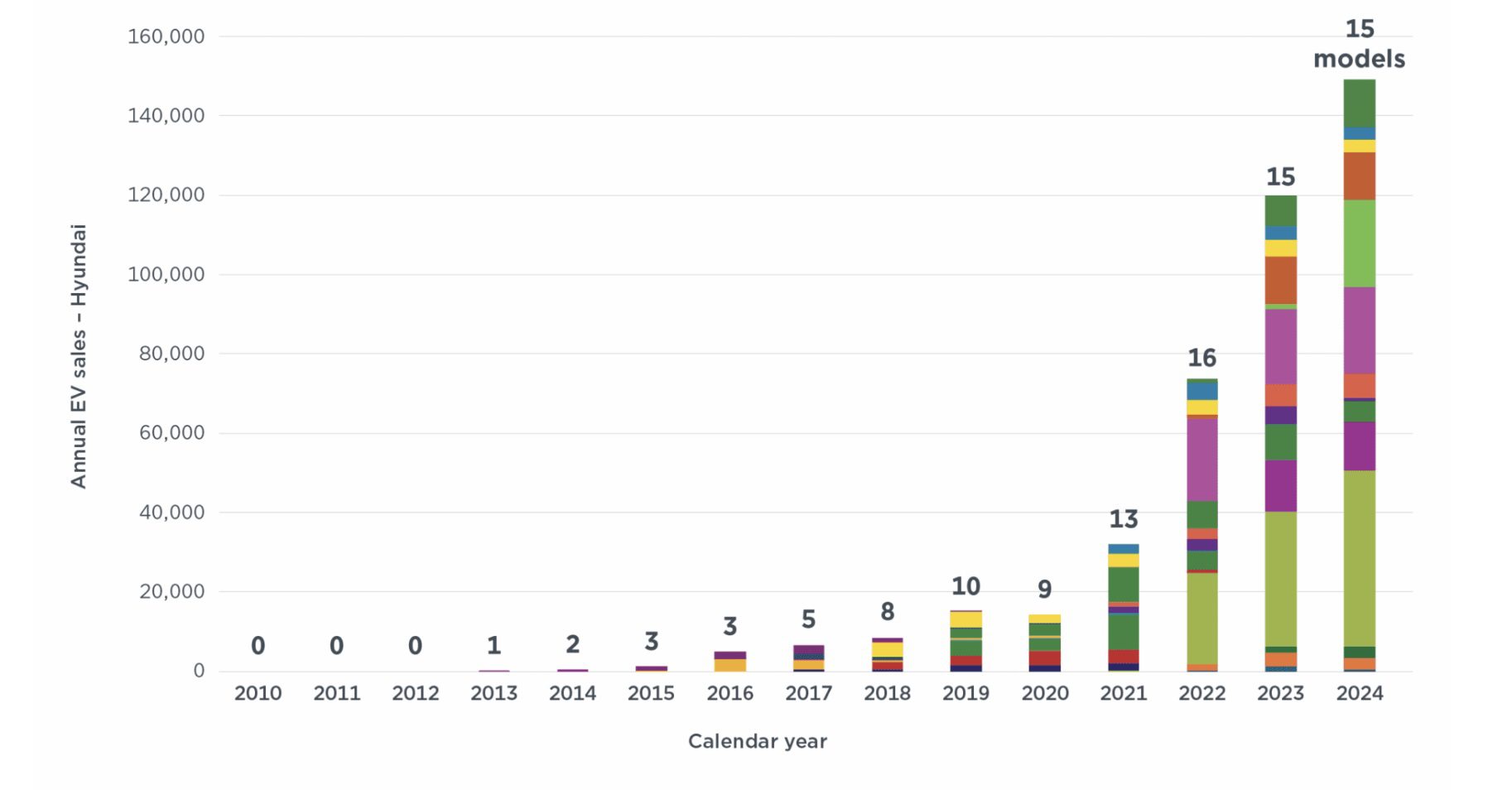
Sales data from GM and Hyundai bear out this trend. In 2015, both automakers offered only three EV models; by 2025, GM and Hyundai offered 14 and 15 EV models, respectively.
The automakers’ EV sales have grown significantly alongside the number of available models. GM’s EV sales have grown more than 7 times since 2015, and Hyundai’s more than 100 times.
Consumer appetite continues to grow alongside these expanded offerings. Recent surveys of U.S. buyers have found that the majority of respondents are interested in purchasing an EV as their next vehicle—indicating substantial untapped demand beyond the 12% market share achieved last quarter.
When an all-electric vehicle like the Ford Mustang Mach-E outsells its iconic gasoline-powered namesake—reportedly by 2-to-1 in recent months—it signals a significant shift in consumer preferences toward EVs. The industry’s challenge is not convincing Americans to go electric, it’s ensuring that supply and model availability keep pace with demand.
Yet even as sales hit record highs, several U.S. automakers have announced delays, scaled back investment, or shifted focus away from pure EV strategies.
Executives cite reasons such as uncertain regulatory environments, higher-than-expected costs, and concerns over consumer adoption rates.
Some companies have slowed production lines or postponed the launch of new models, despite record sales and the strong demand signals described above.
This backtracking raises critical questions about long-term vision and global competitiveness as the rest of the world races ahead.
The expiration and reduction of federal tax credits for EVs have effectively increased the upfront cost of electric vehicles in the United States.
But the economics still favor EVs: drivers save thousands in fuel and maintenance over the lifetime of a battery electric vehicle—savings that more than offset the higher purchase price and result in lower total cost of ownership even without incentives.
As battery prices continue to fall due to global competition and economies of scale, EVs are on pace to soon reach cost parity with conventional vehicles, making the economic advantage even more compelling.
In response to changes in federal incentives, some automakers have taken proactive steps to maintain momentum.
Tesla slashed prices on its Model 3 and Model Y. GM brought back the Bolt and introduced lower-priced Equinox EV versions. Ford adjusted pricing and released new, more affordable trims of the Mustang Mach-E and F-150 Lightning.
These shifts demonstrate manufacturers’ strategies to continue their EV sales momentum absent federal incentives, but also highlight the challenge of sustaining growth as federal incentives wane. Automakers that bring affordable EVs to market and adapt to the policy changes are likely to have higher EV sales, and to be in a leadership position in the longer term.
Recognizing the limitations of federal support, states have stepped in with innovative policies and incentive programs. Colorado recently increased rebates for qualifying new EVs to $9,000.
California’s ZEV Forward report recently offered recommendations for spurring zero-emission vehicle sales, which included streamlined permitting, expanded rebates, and EV requirements to accelerate adoption.
Cap-and-invest programs in California channel proceeds into EV infrastructure and rebates for low- and moderate-income households. Meanwhile, the U.S. Climate Alliance launched the Affordable Clean Cars coalition, helping states share best practices and coordinate incentives. States are expected to continue to fill gaps in federal support to sustain momentum.
Early data from fall 2025 illustrate the underlying strength of EV demand despite near-term disruptions. Preliminary October sales figures show BEV sales dropped about 25% compared to October 2024, as the federal consumer purchase incentive expired.
However, September BEV sales surged more than 40% year-over-year, suggesting strong consumer interest drove many buyers to act before the incentive ended.
While the market may experience a brief adjustment period, the fundamentals remain solid: expanded model availability, improving economics, and proactive industry and state responses position the EV market for continued growth. As new models launch and consumers adapt to the post-incentive landscape, we expect EV sales momentum to recover.
The U.S. electric vehicle market stands at a crossroads. Record sales, expanding model lineups, and strong consumer demand point to a bright future—if industry and policymakers resist nearsighted backtracking.
As nations vie for EV leadership, American manufacturers that maintain or intensify their EV strategies stand to win big, at home and abroad. Conversely, those that retreat risk ceding ground to European, Chinese, and South Korean automakers, which are doubling down on electrification.
Going forward, full commitment to electrification will be a prerequisite for relevance in the global automotive market. Automakers that stay the course, investing in new models and manufacturing capacity, are poised to reap the rewards of global competitiveness and domestic market leadership.
Policymakers can support American automakers with innovative policy, ensuring incentives and infrastructure keep pace with evolving technology and consumer needs. The winners will be those that seize the opportunity, act boldly despite near-term challenges, and lead the charge into the electrified future.
Aaron Isenstadt is an Independent Consultant and Kelli Pennington is ICCT Global Communications Manager
The roll out of electric buses to two additional routes - including the busiest in…
Analysis of EV registrations show massive growth in March as surging fuel prices and fears…
We got behind the wheel of GAC’s new electric hatchback to see what $31,990 gets…
Renault is offering a drive-away price of $49,990 for its battery electric Megane E-Tech hatchback…
After almost 3 years since the trials on the Toyota BEV ute started, the company…
Australia's green bank is committing $100 million to help VW Group offer discounted loans for…