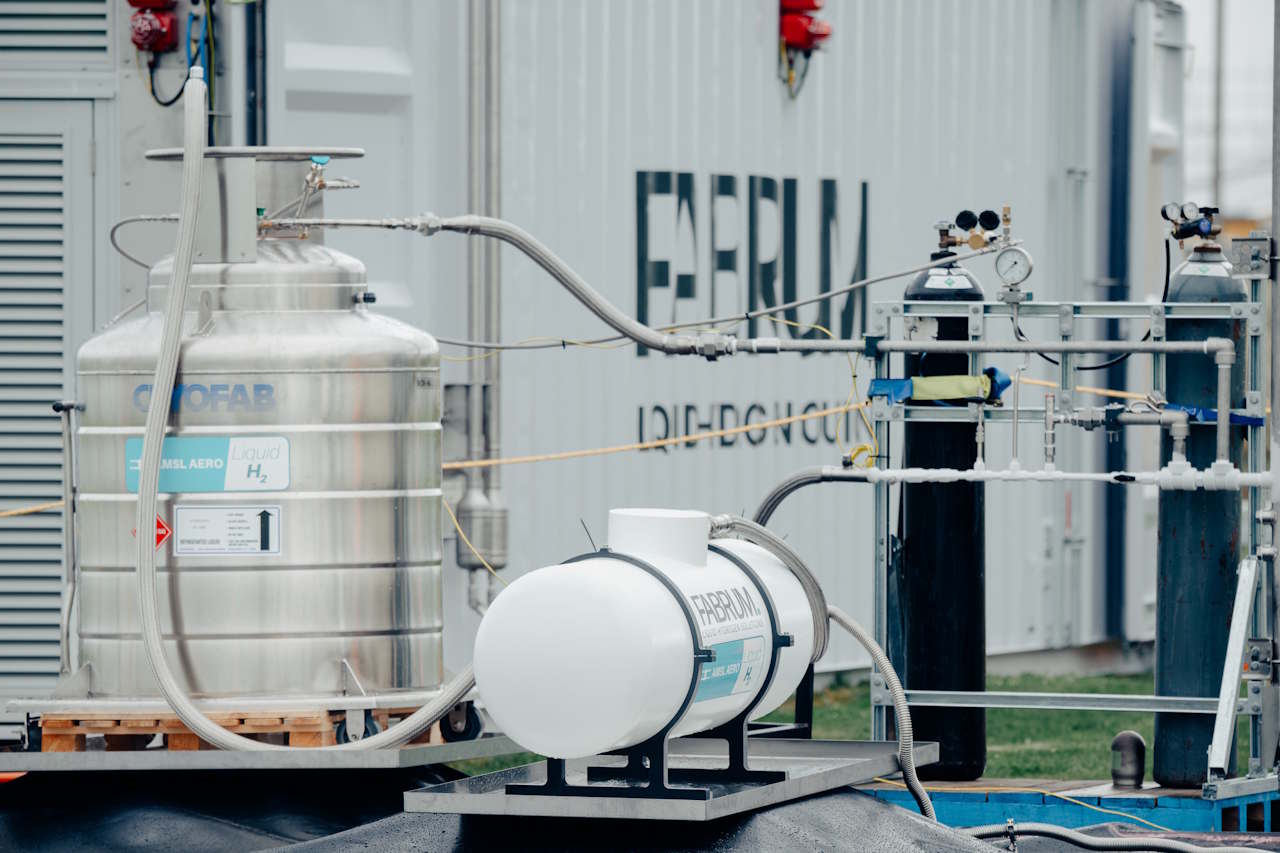
A trio of companies from New Zealand and Australia say they have successfully filled innovative new aviation tanks with liquid hydrogen produced and stored on-site for the first time at an international airport in preparation for pre-flight testing.
New Zealand company Fabrum has designed and manufactured advanced composite liquid-hydrogen tanks for two Australian emission-free aircraft companies, AMSL Aero and Stralis Aircraft.
In a landmark achievement that could enable the first hydrogen-electric flights in the region, Fabrum successfully refuelled tanks at its dedicated liquid-hydrogen test facility at Christchurch Airport, which was developed in partnership with the airport at its renewable energy precinct.
Both AMSL Aero, a zero-emissions aircraft company developing Vertiia, a long range hybrid electric Vertical Take Off and Landing (eVTOL) aircraft, and Stralis Aircraft, which is developing a 15-seat electric aircraft powered by hydrogen fuel cells, have taken delivery of tanks from Fabrum that will be used in their respective aircraft.
AMSL Aero will install the new composite onboard aviation tanks on its Vertiia eVTOL aircraft for long-range flights, while Stralis Aircraft will power its hydrogen-electric propulsion system with liquid hydrogen from Fabrum’s cryogenic aviation tanks which will be mounted on its fixed-wing test aircraft.

Image Credit: Steve Holden
Image Credit: Steve Holden
“Our lightweight composite tanks, together with our hydrogen liquefier and refuelling systems, are critical enablers for hydrogen-powered flight,” said Christopher Boyle, managing director of the Christchurch-based Fabrum.
“By bringing all the elements together for the first time on site at an international airport – producing, storing, and dispensing liquid hydrogen into composite aviation tanks as a fuel – we’re proving that liquid-hydrogen technologies for aircraft are now available and that hydrogen-electric flight will soon be a reality in Australasia.”
Based on over two decades of research and development in the fields of cryogenics and composites, Fabrum’s triple-skin composite liquid hydrogen tanks provide enhanced thermal insulation as well as fast refuelling, as compared with conventional double-skin tank designs.
According to Fabrum, its tanks deliver up to 70 per cent faster refuelling times and an 80 per cent reduction in boil-off losses during refuelling.
“Vertiia is the world’s first eVTOL designed from inception to be powered by hydrogen for long-range, cargo, and passenger operations,” said Dr Adriano Di Pietro, CEO of Sydney-based AMSL Aero.
“Vertiia must be as light as possible to achieve its 1,000 km range, 500kg payload, and 300 km/h cruising speed. Liquid hydrogen is the lightest zero-emission method of storing energy for long-distance flight; no other technology currently comes close.

Image Credit: Supplied
Image Credit: Supplied
“This is a major milestone.”
Fabrum, AMSL Aero, and Stralis Aircraft are all members of the Hydrogen Flight Alliance in Australia, which is advancing the development of hydrogen-electric flight.