
NSW has cracked an impressive milestone in the nation’s transition to sustainable transport, with 100,000 full battery electric vehicles now registered on NSW roads.
The Roads and Maritime Service of NSW (RMS) ticked over this milestone on Thursday, 16 October 2025.
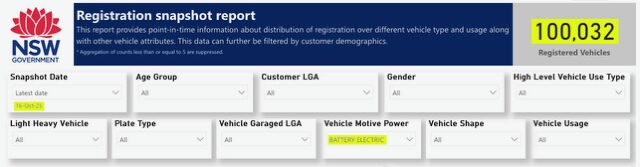
Figure 1 – The NSW Roads and Maritime Service (RMS) dashboard records the 100,000 BEV milestone on 16 October 2025.
The 100,000 BEV milestone covers all classes of road-registered motor vehicles – passenger vehicles, motorbikes, vans, buses and trucks.
This milestone appears to represents a significant turning point, because a number of other critical milestones have also been reached in NSW:
- The number of purely fossil-fuel passenger vehicles peaked more than a year ago;
- BEVs are now more than 1.5% of the entire vehicle fleet; and
- BEV passenger vehicles are now more than 2% of the entire passenger vehicle fleet.
The road to 100,000 BEVs
NSW is the only state in Australia to provide daily vehicle registration statistics on its impressive Power BI registration snapshot dashboard. It would be better if a nationwide analysis could be done, but other states don’t provide vehicle registration data in anything near the same level of detail or timeliness as NSW, or in a publicly accessible form (1).
The 100k milestone is significant given the mocking of EV uptake by sceptics over the past decade. Ridiculed by some commentators for being “just 0.01% of the market” ten years ago, battery EVs hit a new record of 11% of all new vehicle sales in September – a 1000-fold increase.
Table 1 shows these milestones over the years for NSW. Every 10-fold increase has taken approximately 5 years to achieve. The most recent ten-fold increase, however, has been the quickest, taking just over 4 years.
| Number of BEVs registered NSW | Month | Time gap |
| 100 | November 2011 | |
| 1000 | July 2016 | 4 years 8 months |
| 10,000 | September 2021 | 5 years 2 months |
| 100,000 | October 2025 | 4 years 1 month |
Table 1 – NSW BEV registration milestones
Figure 2 shows the growth in BEV registrations in NSW since 2010. Tesla’s incredible run in this vehicle category is also shown on this chart. Tesla first reached 50% market share of all BEVs on the road in NSW in March 2017 and peaked at 63.6% market share in September 2022.
But on 7 May 2025, Tesla’s 8 year and 2 month domination of the BEV market in NSW came to an end when its fleet market share slipped below 50%, and it is almost certain to never to climb back there again due to increasing marking competition.
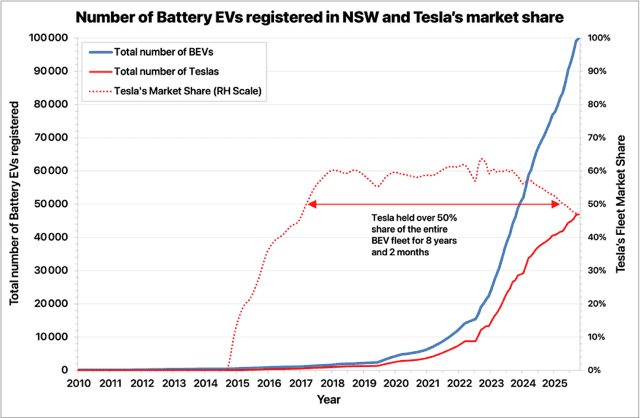
Figure 2 – the growth in BEV and Tesla vehicle registrations in NSW.
Is the BEV “technology adoption gap” about to be crossed?
Despite some popular press claiming otherwise, Figure 2 shows BEV sales are continuing to grow. But what is true is that the previously exponential rate of growth has moderated over the past 2 years – which is entirely expected.
That could be due to what is called the “technology adoption gap” (some even say “chasm”) where the “innovators” and “early adopters” have already transitioned to some new technology (in this case BEVs), but the “early majority” are yet to make the leap.
But with BEV sales hitting the new record of 11.3% of all new vehicles sold in September, that “adoption gap” could soon be crossed.
While the number of new BEVs on the road is great news, what is more important is how much of the vehicle fleet this represents. NSW has hit two other significant milestones:
- BEVs are now more than 1.5% of the entire vehicle fleet, reaching this milestone on 30 August 2025; and
- BEV passenger vehicles are now more than 2% of the entire passenger vehicle fleet (based on ADR Category Level 1 classification), reaching this milestone on 22 September 2025.
That means more than 1 in every 50 passenger vehicles on the road today in NSW is battery electric. If you think you are seeing more electric cars on the road, you are correct.
Still, there’s a long way to go before BEVs are a majority of all vehicles sold, let alone a majority of all vehicles on the road.
Norway has had the world’s most pro-EV policies for the past decade, and a majority of all new vehicle sales there have been electric for the past 5 years. But it’s still taken more than 10 years for BEVs to be more than a quarter of all vehicles on Norwegian roads. The proportion was 28.9% in February 2025, with one report that the 30% milestone has now been reached.
Is the beginning of the end of the ICE age?
High levels of BEV sales are great, but if the total number of vehicles on the road with internal combustion engines (ICE) is still increasing, then vehicle emissions are still rising.
There is good news here too:
- The number of purely fossil-fuel passenger vehicles in NSW peaked more than a year ago (February 2024) at 4,416,279; and
- The number of pure fossil fuel and hybrid passenger vehicles (i.e. everything that is not a plug-in) appears to have reached its peak on 29 August 2025, at 4,603,138; and
- The total number of passenger vehicles that aren’t battery electric also seems to have reached its peak on 29 August 2025, at 4,615,271.
While pure fossil fuel passenger vehicles registrations have definitely peaked in NSW, a few more months of data is needed to categorically state that non-plugin and non-BEV passenger vehicles registrations have also peaked. But there is little doubt they have plateaued. Figure 3 shows this data over the previous 2 years, with dotted lines showing the trend.
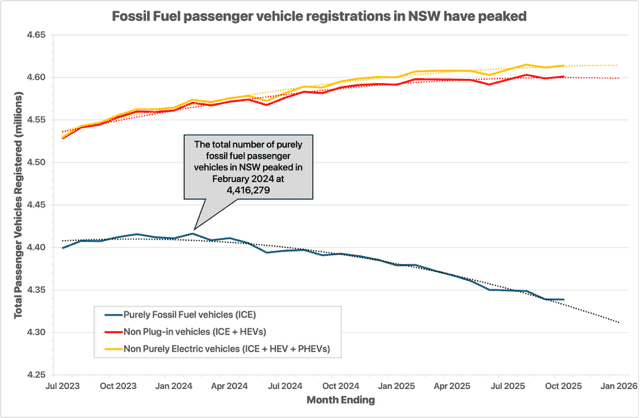
Figure 3 – The beginning of the end of the ICE age in NSW?
Widening the net to the entire NSW vehicle fleet (i.e. not just passenger vehicles but all motor vehicle categories) shows that purely fossil fuelled vehicles peaked in 6,017,961 in August 2024, and dropped below 6 million in June this year.
The toughest metric of all – the total number of non-BEVs of any kind – appears to have plateaued in NSW over the past month at just under 6.3 million vehicles, but it is not yet decreasing. This is likely due to compelling battery electric alternatives in heavier vehicles classes not being available yet at scale.
It will take a little more time before it can be definitively stated that it is the beginning of the end of the ICE age in NSW, but the writing is on the wall.
The local areas in NSW leading the way
An article I wrote for The Driven in July last year “Which areas really have the highest penetration of EVs?” used the RMS vehicle registration dashboard data to look at the variation of BEV adoption across NSW by Local Government Area (LGA).
Perhaps unsurprisingly, the highest adoption rates a year ago were all in the Sydney metropolitan area, with the top five LGAs being Ku-ring-gai (3.63%), Mosman (3.54%), Woollahra (3.47%), Willoughby (3.40%) and Hunters Hill (3.28%).
But by the end of September 2025, Sydney City had rocketed up the charts from 8th position to first, with 5.25% of all registered motor vehicles garaged in that LGA being BEV. However, a large proportion of those vehicles (61%) are government and commercial fleet vehicles so it appears that Sydney City is a special case.
There are now two ‘residential’ LGAs with over 5% BEV penetration, or better than 1-in-20 vehicles being battery electric. These are Ku-Ring-Gai (5.15%) and Willoughby (5.02%). Rounding out the top five LGAs are Mosman (4.75%) and Woollahra (4.66%). And this is not driven by business registrations – 75% of BEV registrations in these four LGAs are private. This is not vastly different to the NSW motor vehicle fleet overall, where 81% of all motor vehicle registrations are private.
Byron remains the leading regional LGA in NSW with 1.94% BEV penetration.
At the bottom of the table, the number of LGAs in NSW where there are no BEVs registered has decreased from 24 last year to 20 today. Coolamon, Lachlan, Narrandera and Weddin LGAs have welcomed their first BEVs.
The NSW BEV wooden spoon remains unchanged. At the end of September 2025, Moree Plains LGA had 10,590 motor vehicles registered – but not one of them was battery electric.
1: According to data from the Bureau of Infrastructure and Transport Research Economics (BITRE), NSW represents 31.3% of the national BEV fleet. Extrapolating the NSW milestone implies there are now 320,000 BEVs nationally.

Brendan Jones is an electrical engineer, data scientist and passionate advocate for renewable energy and electric vehicles.