
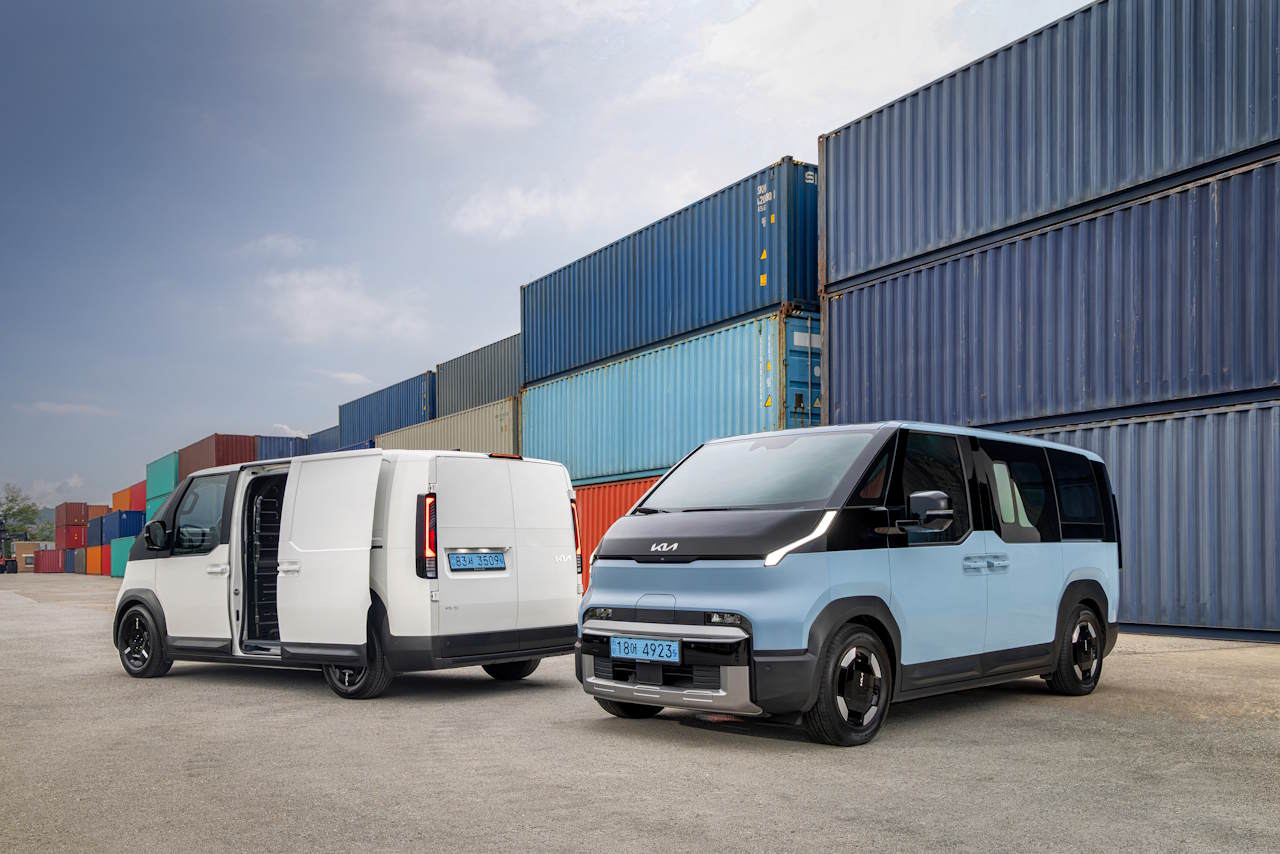
South Korean carmaker Kia has confirmed it will launch an all electric van, the PV5, in Australia sometime in the middle of 2026, following an initial launch in its home market and then Europe in the coming months.
The PV5 is the first dedicated model to be launched under Kia’s new Platform Beyond Vehicle (PBV), which is built on the company’s electric Electric-Global Modular Platform for Service (E-GMP.S) platform unveiled earlier this year.
The PV5 will fit into the middle of what will eventually be a full range of electric vans. Measuring in at 4,695mm in length, slightly shorter than a Toyota HiAce, for example, the PV5 will aim to create its own path forward, as it also will not be available in any internal combustion engine (ICE) variants.


It will be available in three body styles – Passenger, Cargo, and Chassis Cab – and has been designed in close collaboration with customers from across the world who helped shape some of the specific elements, including a removeable front passenger seat, walk-through configuration on High-Roof variants, and stain-resistant interiors.
Kia is also introducing in tandem with the PV5 its new Flexible Body System, a modular building-block design that supports a diverse range of configurations.
According to Kia, the Flexible Body System “supports the rapid development of up to 16 variants from a limited number of assemblies”. Front cabin modules are standardised, but the rear-end, roof, and quarter glass components can all be modified during production to create the different variants.
Kia says the PV5 will suit airport taxi services and premium passenger transport; mobile offices, on-site service support, or a mobile production hub for film crews; and on the weekend, the PV5 can supposedly transform into a lifestyle vehicle to take family and friends camping.


The PV5’s features include both indoor and outdoor vehicle-to-load (V2L) capabilities, which can supply up to 3.68 kilowatts (kW) of electricity.
Tailored battery configurations differ slightly between the passenger and cargo models, with both offered the choice between battery capacity options of 51.5 or 71.2 kilowatt-hours (kWh) using a nickel cobalt manganese (NCM) battery chemistry. The Cargo model, however, will also be offered with a third option, a 43.3 kWh lithium iron phosphate (LFP) battery.
Motor output of up to 120 kW and 250 Nm of torque is the same for both Passenger and Cargo models, and expected range tops out at around 415 kilometres (WLTP) – though this depends on options for both models:
For the Passenger, a maximum range of 412 km requires the choice of the 5-seater model with the 71.2 kWh battery; meanwhile, for the Cargo, a maximum range of 416 km requires the 71.2 kWh battery.


Both models, however, boast the same fast charging capability across all battery types, able to charge from 10 to 80 per cent within 30 minutes.
Mass production of the PV5 Passenger and Cargo models is already apparently underway at Kia’s Hwaseong EVO Plant in Korea, with additional variants scheduled to roll out sequentially.
A first Australian display will be held at the Mobility Live conference in Sydney on October 15 and 16 ahead of the official launch of the PV5 Cargo sometime in Q2 or Q3 of 2026. Local suspension tuning is expected to get underway before the end of 2025, with further details on trim variants, features, and pricing to be announced down the track.

Joshua S. Hill is a Melbourne-based journalist who has been writing about climate change, clean technology, and electric vehicles for over 15 years. He has been reporting on electric vehicles and clean technologies for Renew Economy and The Driven since 2012. His preferred mode of transport is his feet.