
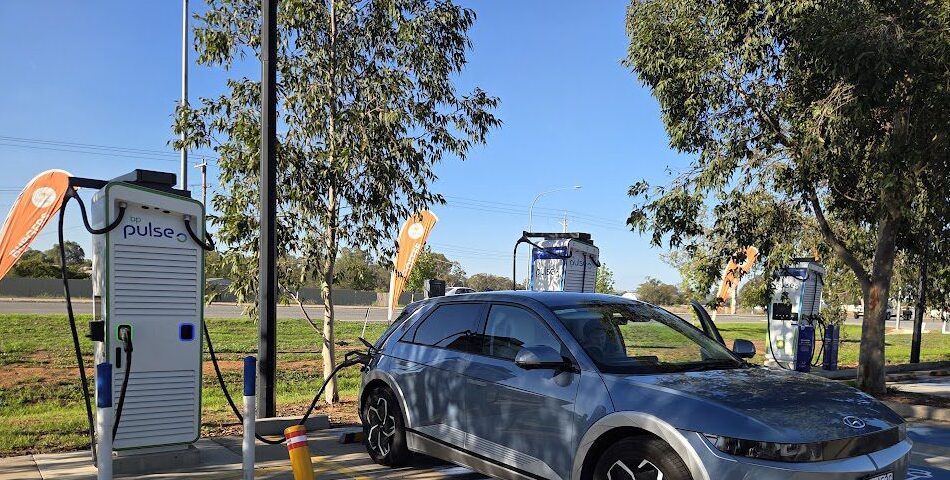
Many people skeptical of EVs think you cannot drive long distances without long charging times. We know that not to be true, but sometimes it’s easier to show it than explain it.
Last month, my friend Craig Harvey and I undertook a long distance drive from Canberra to remote New South Wales and back to demonstrate that EVs can easily cover 1,000 kilometres in a day. This is a distance greater than most drivers would ever attempt in a single day.
We also wanted to demonstrate that the charging time is actually less than the recommended breaks you should take. In an earlier article I discussed how A Better Route Planner (ABRP) can help you plan really long trips with the minimum charging time.
This trip was inspired by the 1,000 Kilometre Challenge popularised by Norwegian Youtuber Bjorn Nyland. For over a decade, Nyland has driven press cars on 1,000 km highway trips across Norway and meticulously recorded the trip data.
The advantage of this type of EV benchmark is that it incorporates charging performance en route. Vehicles with long ranges but slow charging are pitted against cars with shorter ranges, but faster charging. Think of it like the Bathurst 1000 for EVs.
Trip plan
For our trip, I planned a route using ABRP from Hall Village on the north-west edge of the ACT to Hay (NSW) and back in my Hyundai IONIQ 5. We started from Hall as it is a convenient reference point for anyone else who may want to replicate this experiment in the future. The round trip journey is about 990 kilometres, and takes you into the more remote parts of New South Wales where charging is arguably the most sparse and, supposedly, challenging.
ABRP suggested three stops: Gumly Gumly on the eastern side of Wagga Wagga, Hay, and Gumly Gumly again on the return leg. In the days leading up to the drive, I could see that these chargers had been reliable.
Hall to Gumly Gumly (220 km)
At 8 am one sunny morning we set off from Hall Village with 98% state of charge and drove at the signposted speed to Gumly Gumly. We charged there with a 300 kW BP Pulse charger for nine minutes adding 20% charge. This was just enough time to buy our mid-morning coffees! The coffee from the Wildbean Cafe was good – a key benefit promoted by BP Pulse of their locations.
For those who haven’t used these Alpitronic Hyperchargers before, they offer a nice data display for the nerds including a charge curve (see photos below).
 |
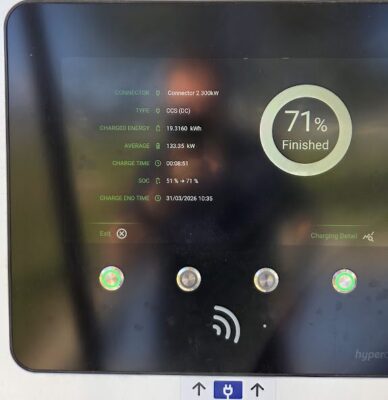 |
First charging stop: 9 minutes
Gumly Gumly to Hay (273 km)
With a change of driver, we proceeded on to Hay. We met some of Hay Shire’s councillors and chatted about the local solar farms and EVs in the bush while we waited for our charge. This was a relatively long charging session up to 76% that took 20 minutes using the 180 kW NRMA chargers behind the Hay Shire Council building.
Having not been to Hay in a few years, I found the charging facilities to be quite amazing now. I’ve been around EVs for a while, but charging at 180 kW in a pretty remote town is impressive.
Note that even for the next leg back towards home, it was not even necessary to charge to 80%. Taking just what you need is what keeps the charging sessions fast.

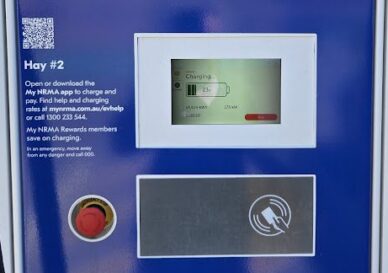
Second charging stop: 20 minutes
Hay to Gumly Gumly (273 km)
Back on the road with lunch and a fresh driver, we drove back to Gumly Gumly. We didn’t spend very long in Hay as we wanted to try and be off the highway by dark. We arrived at Gumly Gumly with 11% state of charge and needed to charge to 68%. The area around Gundagai is notoriously hilly and energy hungry.
This charging stop took 14 minutes using the same 300 kW charger we had used that morning. 800V charging for the win.

Final charging stop: 14 minutes
Gumly Gumly to Hall (220 km)
The final leg was from Gumly Gumly back to Hall along the Hume and Barton Highways. We arrived back in near darkness to the same car park we had left 11 hours earlier with a state of charge at 10 per cent.
Cost
Charging at highway DC fast chargers (especially 300 kW ones) is the most expensive to charge because you are paying for your use of expensive, high-powered equipment.
The total cost of DC charging for this trip was $89. A bit more should be added to account for starting from home at 100%, mostly by charging using rooftop solar. Call it $100 for 1,000 km. The cost of the trip still compares favourably with any ICE vehicle similar in size to the Hyundai IONIQ 5.
More leisurely trips would cost less than this because slower chargers could be used, and more of the charging could come from cheaper overnight charging at accommodation en route.
Summary
Our trip was uneventful and we had an excellent charging experience. The chargers all delivered their rated power and there were no queues.
We did agree, though, that having such short stops on a 1,000 kilometre day trip is pretty miserable! It’s better to slow down a little bit and, in some cases, stop for lunch and use a slower, cheaper charger.
The ‘Stop, Survive, Revive’ recommendations are for a 15 minute break every two hours. Over this ten hour trip, the recommendation would be four breaks of 15 minutes – a total of one hour. With two people sharing the driving, our relief driver always had ample rest, sustenance and control over of music.
Over the 1,000 km, we stopped to charge for a total of 43 minutes, which is 17 minutes less than the recommended breaks for a single driver.
Myth busted!

Ben Elliston is the ACT branch chair of the Australian Electric Vehicle Association and an independent energy researcher.