
There is a significant reshaping of the electric vehicle market occurring in Europe.
Over the past year, the share of pure battery electric vehicles in western Europe has jumped to 18.4 per cent, from 14.3 per cent in the previous 12 months. But there is a big reshaping in the market shares of the biggest car companies, with VW taking a commanding lead, and one time market leader now falling back into the pack.
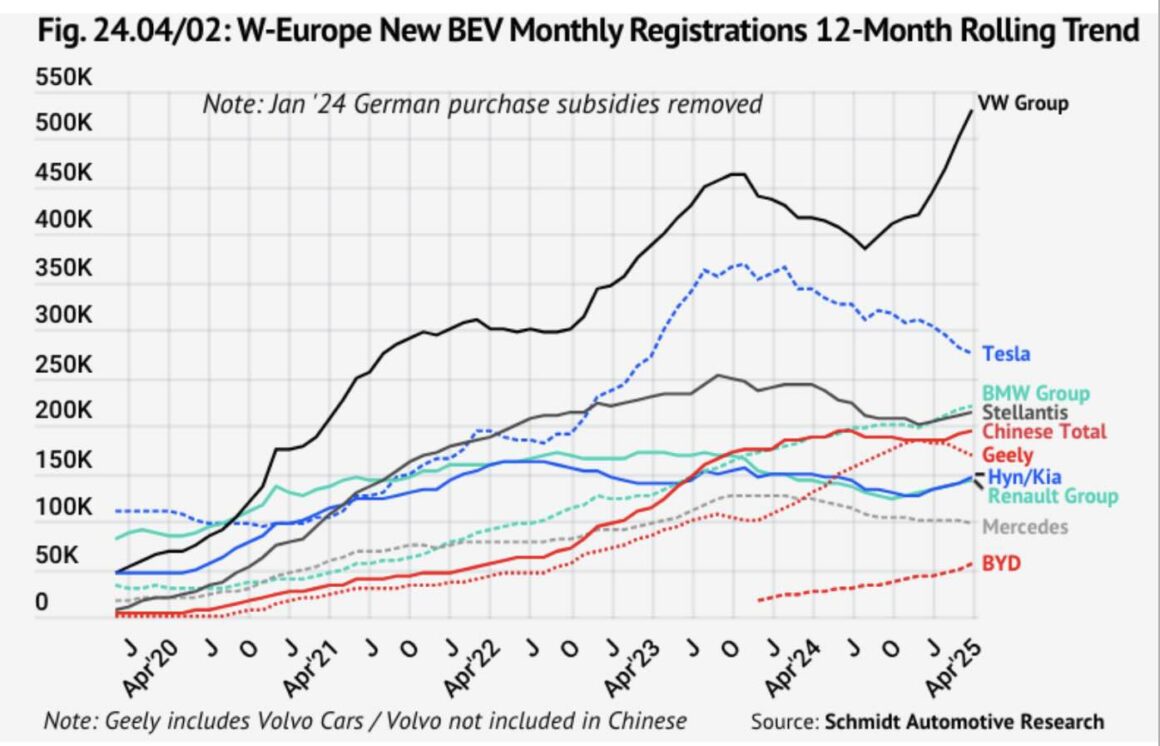
These graphs from leading European car analyst Schmidt Automotive illustrate clearly the trends over the last five years.
Tesla was once the biggest seller of EVs in Europe, but by late 2020 had lost that mantle to VW and, briefly, to Stellantis. What followed was a surge in sales across all brands, including the new Chinese entrants. But things have started to change in the last two years.
Tesla sales started to decline just over a year ago, after a brief boost from the refreshed Model 3, and its market share has fallen further this year, with the added complexity of Elon Musk’s political machinations clearly having an impact.
This is particularly the case in the EU’s biggest car market, Germany, where Tesla once sold one in every five EVs, but now manages less than 1 in 10, and where there has yet to be seen any benefit from the Model Y refresh.

“During the first half of 2023, every fifth (20% ) Tesla registered across the region landed in Germany,” Matthias Schmidt writes in a new report.
“During the past 6 months, however, it halved to just 9% of its regional total, ending up on German roads, possibly also attributed to the toxic impact of CEO Musk’s lurch to supporting the AfD political party ahead of the last election.
“The slight regional uptake during the early part of 2024, but which faded almost immediately, can be attributed to the Model 3 facelift. No immediate impact has yet been spotted from the Model Y facelift introduced during Q1 2025.”
The story is mixed, however, for the new Chinese brands, with Geely suffering from a poor response to the new Smart EVs, while other Chinese brands are racing out with hybrid models that are not impacted by the EU’s tariffs on full battery electrics.