Volvo EX30 exterior
A common EV myth (comprehensively debunked many times: examples here and here) goes along the lines of ‘EVs use so much energy in production of the battery that they don’t offer a real climate solution’.
The facts are that an EV repays that debt as compared to an internal combustion engine (ICE) vehicle relatively quickly. Plus, from then on it produces less climate damaging pollution than said ICE vehicle – even when run exclusively on grid sourced electricity.
On top of this, emissions attributable to running an EV decrease with an increasingly ‘green’ grid, unlike a fossil fuelled vehicle.
On the other hand, discussing cradle-to-grave emissions for products is something we should consider whenever buying anything – although it is a very hard thing to do properly.
To that end, Volvo are committed to accompanying the release of each battery electric vehicle (BEV) with a comprehensive life cycle assessment (LCA) of its carbon footprint.
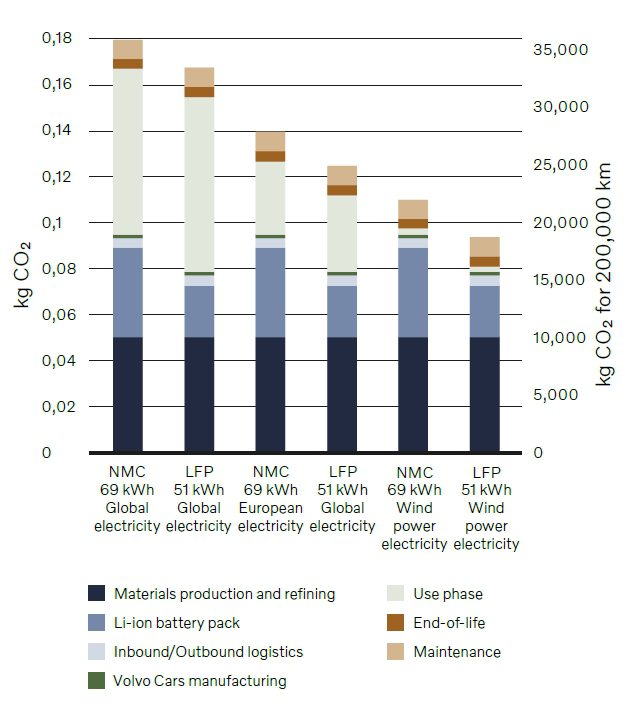
Based on the life cycle analysis (LCA) methodology in the ISO 14067 standard, Volvo’s report focuses on the cradle-to-grave greenhouse gas (GHG) emissions and global warming potential (GWP) over a driving distance of 200,000 kilometres.
This resulted in a total carbon footprint of 23 tonnes per 200,000 km, which is approximately 60 per cent less than a petrol powered XC40.
Overall, the LCA of the Volvo EX30’s carbon footprint ranges from 0.11 to 0.18 kg CO2-eq/km (22 to 36 tonnes of CO2-eq per 200,000 km) for the NMC equipped model and 0.089 to 0.16 kg CO2-eq/km (18 to 31 tonnes of CO2-eq per 200,000 km) for the LFP-equipped model, meaning the LFP-equipped model has a 16 per cent lower carbon footprint than the NMC-equipped model.
The report went on to make the point that the electricity source significantly impacts the car’s carbon footprint with wind-generated electricity significantly reducing the car’s carbon footprint as compared to global or European electricity mixes.
Volvo plans to better these numbers in coming years.
By 2025, their battery suppliers expect to reduce emissions from manufacturing the LFP battery by 20 per cent (and 46 per cent in the case of the NMC battery) through replacing electricity usage during cell manufacturing with renewable energy sources, increasing the share of recycled content in their materials and reducing their supply chain emissions.
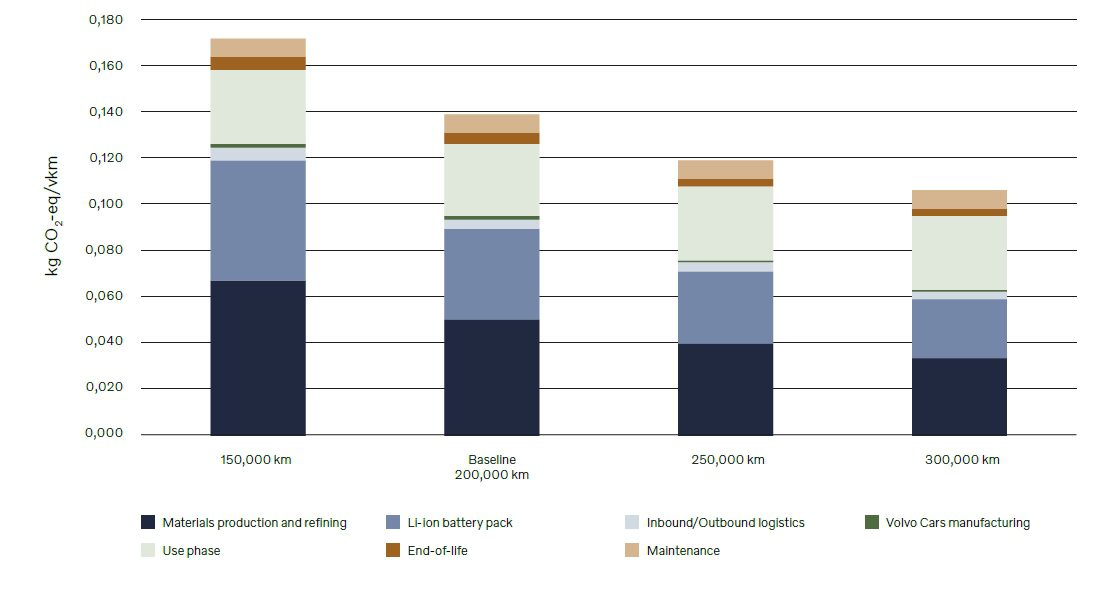
It is also worth noting that the emissions per kilometre are dependent on the overall life of the car.
Whilst picking the industry accepted number of 200,000 km as the lifetime distance for a vehicle, Volvo argue in the report that larger personal vehicles commonly travel further than this in their lifetimes. If the distance is changed to 300,000km – then the CO2-eq/km drops by around a third to 0.11.
Bryce Gaton is an expert on electric vehicles and contributor for The Driven and Renew Economy. He has been working in the EV sector since 2008 and is currently working as EV electrical safety trainer/supervisor for the University of Melbourne. He also provides support for the EV Transition to business, government and the public through his EV Transition consultancy EVchoice.
Plans for the biggest heavy electric truck depot in Australia get a government boost, and…
Over the 1,000 km to a country town and back, we stopped to charge for…
Electric cars have overtaken petrol models in monthly new car registrations in Europe's biggest economy,…
Chery cuts price on its E5 Ultimate trim electric SUV by more than $6,000, making…
Kia has announced pricing for its first electric van in Australia, coming in below competitor…
An annual fee for driving electric vehicles could put the brakes on their record sales…