

A series of studies on the potential of vehicle to grid (V2G) technologies have underlined the huge benefits it can bring to Australia’s grid and its transition to green energy.
The studies, by energy consulting company enX (and commissioned by ARENA), found that V2G will not just reduce grid demand – and overall system costs – it will also deliver significant electricity bill savings to EV owners, although the scale of those savings will depend on the type of tariffs used.
The studies analysed how various pricing signals, applied to vehicle-to-grid charging, can have a significant impact on electricity use behaviour, reduce peak network demand and reduce electricity costs for consumers.
“Its a huge opportunity” said Jon Sibley, director of enX and lead author of the report, during a recent ARENA webinar covering the report.
“It could be the largest resource in our energy transition. We found that V2G is such a flexible resource, it really benefits, it thrives under very dynamic pricing situations.”
Sibley says in order to unlock the true potential of V2G, consumers need to properly compensated.
“If we want to get the most efficient participation from all these distributed energy resources in the system, we want to send quite pointy wholesale and network price incentives.”
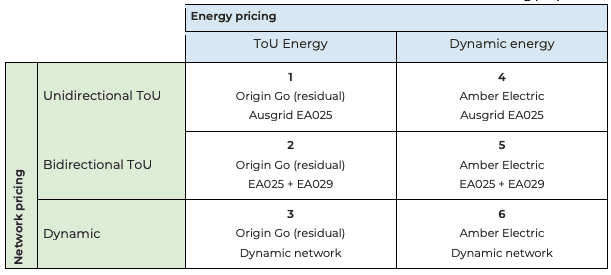
Three network pricing tariffs (unidirectional time-of-use, bidirectional time-of-use and dynamic) in combination with two retail pricing structures from Amber Electric and Origin were studied. The reports compare the options in relation to efficiency and fairness, market fit and social equity.
Significant reduction in electricity peak demand with just 10% uptake of V2G
The researchers ran a simulation based on electricity demand data from Ausgrid’s Metford substation during a critical peak demand “case study week” from March 6 to 12 last year.
Some 520 electric vehicles with various plug-in profiles were modelled against the 6 network tariffs and retail pricing scenarios. The data was then scaled to represent a 10% uptake of V2G.
The results showed that V2G can substantially reduce substation critical peak demand and that with just 10% uptake of residential vehicle-to-grid, peak electricity demand could be reduced by over 6%.
“The greatest reductions in peak demand (2.54 MW) were achieved under dynamic pricing (s3 & s6). This equates to 6.29% of substation firm capacity (41.6 MW).” notes the report.
“ToU retail pricing scenarios s1 & s2 [unidirectional] were the worst performers; each promoted solar exports during the day (due to fixed feed-in tariffs) and EV battery discharge only for self-consumption.”
“Spot pass-through arrangements [bidirectional dynamic pricing] encouraged significantly more charging during solar hours, and significant pre-charging ahead of anticipated evening peak events. Otherwise charging predominantly occurred overnight.”
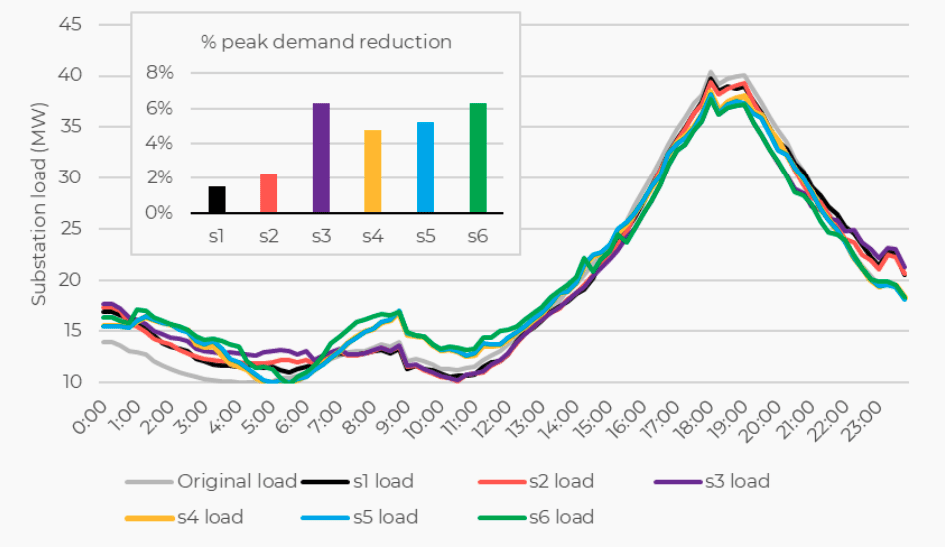
residential V2G uptake. The ‘original load’ is actual substation load during the period, Source: ARENA/enx report
Critically, the report also notes that the cost of using various tariffs was lower that the cost of expanding the network, making such schemes low-hanging fruit for network operators.
“The cost of critical peak demand reduction in each scenario was lower that the estimated long run marginal cost (LRMC) of network expansion.” says the report.
“An ‘efficient’ network tariff encourages efficient use of network assets, typically reflected in lower demand peaks and higher troughs.
“A flatter load profile mitigates the need for network capital expenditure which reduces costs for all network users. An efficient tariff also encourages consumers to use electricity only when they value it more than the cost of delivering it.
“While all scenarios delivered reductions at a cost below LRMC, ES Figure 2 shows that in s2 and s5, the network achieved net earnings over a year.
“This suggests that, with the assumptions in our model, Ausgrid’s current bidirectional network support tariff would slightly over recover revenue from V2G customers. Overall, it is appropriate for customers to receive a net payment of variable costs where they are providing services that reduce the cost of the network for other customers.”
V2G can significantly reduce energy bills, even compared to unidirectional smart charging
In addition to simulating peak demand scenarios, the researchers also modelled the long term cost/revenue benefits for consumers associated with the various tariffs.
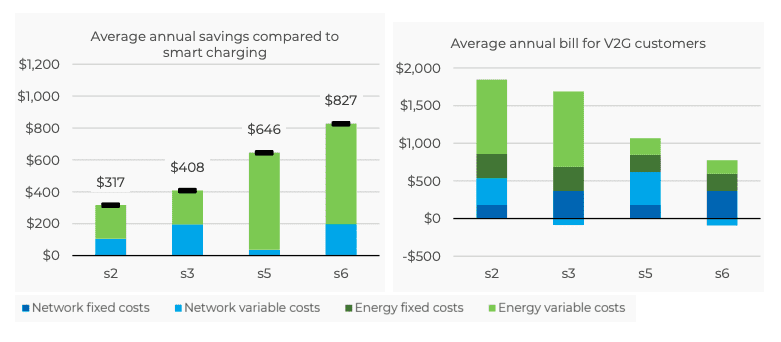
Of the six tariffs modelled, all four vehicle-to-grid tariffs (dynamic and bidirectional ToU) showed significant annualised energy bill savings compared to unidirectional smart charging.
“V2G is more cost-beneficial than smart charging for all customers under all modelled scenarios with average savings per household of $550 per annum.”
Customers on Amber Energy’s “spot-pass through” dynamic network pricing (s6), had the lowest overall annual electricity bills, saving on average $827 per year compared to those on unidirectional smart charging.
“Amber has pioneered spot pass-through pricing for residential customers in Australia.” notes the report.
“They have provided details on their pricing structures to enX for the purposes of this study. Amber provides spot price passthrough pricing (currently 30-minutes average), a monthly subscription fee, and passthrough of other cost elements (including network tariffs).”
The study also found that the dynamic tariffs, s3 and s6 actually received a net payment for network variable costs (light blue in the graph above).
“One small customer was even able to pay for all household load, charge their EV and earn net revenue of $95 in a year.” notes the report.
Australia’s electricity grid will look very different in in coming years
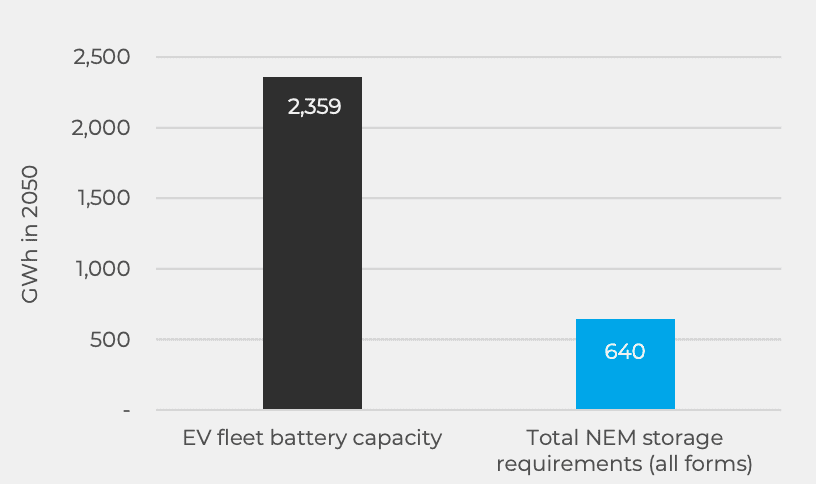
In its previous report, Opportunities and Challenges for Bidirectional Charging in Australia, enX found that by the early 2030s, most of the National Electricity Market (NEM) energy storage capacity is expected to be located on distribution networks in customer-owned distributed energy resources (DER) such as batteries, especially EV batteries.
By 2050, EV fleet battery capacity will dwarf total NEM storage.
“Unlike historical types of customer load, DER is designed to be sensitive to network pricing arrangements (i.e., they have high demand elasticity). This creates new opportunities to promote more efficient grid investment outcomes, reducing costs for all electricity customers, that were not previously available.” says the report.
V2G is a winner for everyone
The researchers say that while Australia’s current overall approach to bi-directional charging tariffs is fragmented with different tariff structures in different areas, there are several highly innovative pricing approaches being trialled across the country.
“While V2G is largely nascent in the Australian market, it is an opportunity we need to prepare for.” says enX.
The key findings of the study show that dynamic tariffs are the most grid-beneficial arrangement for V2G, delivering the highest rate of peak demand mitigation, as well as delivering the best outcomes for customers in terms of reduced annual electricity costs.
“Spot passthrough retail contracts [like Amber] can greatly reduce costs for EV owners with smart charging and V2G. Customers with flexible, and especially bidirectional resources, can move their load and generation around to take advantage of dynamic spot market conditions, insulating themselves from price risk exposures.”
At scale, vehicle-to-grid with dynamic pricing enables energy to be shifted from periods of surplus to periods of deficit.
If tariffs are well designed with good price signals for consumers, V2G and dynamic pricing could supercharge the transition to clean energy and clean transport while saving everyone thousands in electricity costs.
enX’s report Network Tariffs for V2G was commissioned by ARENA (Australian Renewable Energy Agency).

Daniel Bleakley is a clean technology researcher and advocate with a background in engineering and business. He has a strong interest in electric vehicles, renewable energy, manufacturing and public policy.