EV Charging. Unsplash - Michael Marais
This is the first of a three part series on the transition to EVs. Next installment is on EVs as mobile batteries. Part two reconsidered electric vehicles as “batteries on wheels” and assessed the implications for charging policies, technologies and integration. Part three looks at how effective tariff setting can reduce electricity bills and reduce the need for expanding the grid.
Electric vehicles (EVs) offer a massive opportunity to reduce emissions and improve urban air quality, in conjunction with modal shift to better public and active transport. However, crafting effective EV charging strategies requires holistic thinking at the intersection of transport, energy, built environment, behavioural science, and economics.
Part one of this three-part series examines the EV owner experience and introduces charging policy fundamentals.
The article is written from an Australian perspective, where full battery electric vehicles accounted for only 7.2% of new vehicle sales in 2023, but where governments are generally promoting electrification and where around one in three houses has rooftop solar.
When you drive an ICE (internal combustion engine – gasoline/diesel fuelled) vehicle, you’re bound by the location of service stations, and tied to the economics of oil prices and global geopolitical energy security concerns. Step behind the wheel of an EV (battery electric vehicle) and suddenly, any power point is a bowser.
While many of the world’s electricity grids are still somewhat tied to global coal and gas prices, that’s changing fast as they move towards a greater mix of renewables and storage.
EV owners experience thrilling acceleration, non-polluting, quiet, and effortless driving, and substantially lower running costs. But they need to get used to different behaviours when it comes to the vehicle’s energy source.
There’s also a certain thrill the first time you plug your EV in at home and realise that you may never visit a gas station again, except perhaps to check your tyre pressure or use the carwash.
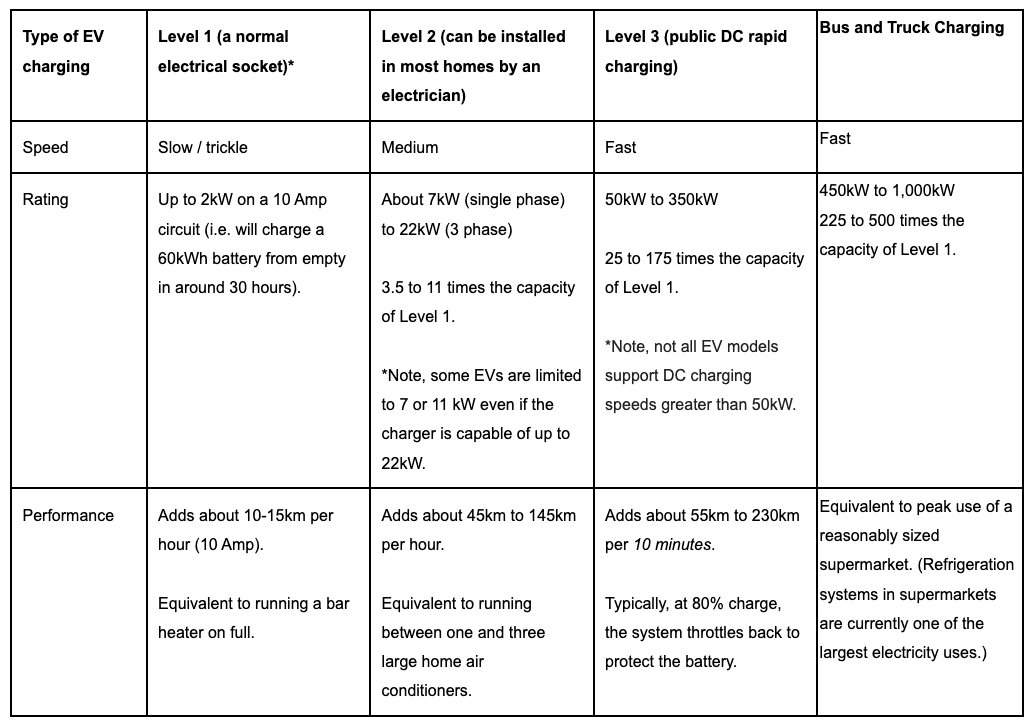
That thrill might be slightly tempered when you see how long it’s going to take to charge. It could be anywhere from hours to nearly two days, depending on how empty your battery is and what speed you’re charging at (see Table 1).
On the other hand, you quickly realise that unlike going to a service station, which you tend to only do when your tank is mostly empty, you can plug the car in whenever you’re home, topping it up as often as you need.
Who cares if it takes hours to charge? It’s not like you need to hold the charging plug the whole time. You’re free to leave it charging while you do whatever you want. The act of charging takes but a few seconds. And if you have solar on your roof and can charge during the day, there’s the double thrill of – at least partially – driving on free sunshine.
If you don’t have the luxury of off-street parking at your home, or you do but perhaps you’re in an apartment with no useable power point or charger near your parking spot, then you may well not
even be considering an EV. The inconvenience and uncertainty of having to find a public charger and potentially wait for an hour or hours to charge might be more than enough to put you off.
That’s where we’re relying on governments and municipalities to come up with well-considered strategies around the deployment of public charging infrastructure.
Depending on how it’s done, the implementation of widespread EV charging infrastructure and use could either be a huge asset, or a gigantic millstone to the power grid, as we electrify and
decarbonise. So, it’s important that we try to get it right. But as one starts to unpeel the onion, it quickly gets complicated.
The first thing to recognise is that EV charging strategy is a multidisciplinary field requiring input from many stakeholders. It sits at the nexus of several domains including transport, energy, built environment, behavioural science and economics.
Public charging infrastructure strategies need to balance a variety of objectives, including:
Progressive politicians seem to love to be photographed at the openings of new “Level 3” DC Fast Chargers, holding the charging plug in a car as if they’re pumping gas.
While it’s great that some can charge a car from near empty to 80% in less than 20 minutes, the real workhorses of EV charging infrastructure are actually the Level 1 (slow / trickle) and to a lesser extent Level 2 (medium speed) chargers.
In essence, Level 1 is a simply standard electrical point, used in conjunction with a mobile charging device carried in the vehicle.
Level 2 requires a wall or pole mounted box to be installed at the location and in Australia typically a single or three phase, 32 Amp electrical circuit. Refer to Table 1 for a comparison of charger types. Slower charging also increases battery life.
In fact, given the enormous power draw of Level 3 chargers (which can be equivalent, when in use, to the typical use of dozens of homes), in urban areas with electrical network constraints, policies should actively seek to limit Level 3 charging to very specific use cases, and avoid charging during certain times of day.
Most private vehicles have extraordinarily low utilisation rates: over 95% of the time they’re sitting idle in a driveway or car park, collectively chewing up vast amounts of land and concrete. Australian cars travel on average just 30-40km per day.
Policies that reduce private ownership by fostering cheap, convenient public mass transit, car-share schemes, excellent cycling/pedestrian infrastructure, and greater use of two and three wheelers are a critically important step in creating genuinely sustainable mobility.
In the meantime, with so many vehicles parked so much of the time, slow or medium speed charging is a perfectly appropriate solution.
This article was originally published on Illuminem. Part two of this three-part series will reconsider electric vehicles as “batteries on wheels” and assess the implications for charging policies, technologies and integration.
David McEwen is a Director at Adaptive Capability, providing climate risk and net-zero emissions (NZE) strategy, program and project management. He works with businesses, community leaders, policy makers, designers and engineers to deliver impactful change. His book, Navigating the Adaptive Economy, was released in 2016.
Backed by solar and a battery, the two fastest EV charging stations in W.A. have…
Tesla celebrates its latest Supercharger milestone, delivering its 150th site across the country.
A full breakdown of all electric vehicle sales by month in Australia in 2026. Latest…
MG offers fresh round of incentives on popular models and luxury IM variants too, even…
Geely throws in finance offer and a free home charger for its already popular EX5…
Kia offers deals on its EV3 and its EV5 to help move MY25 stock as…