

In December 2021 my family moved into a newly built house on the Sunshine Coast in Queensland. For 21 months I have been monitoring our energy use to calculate a break-even analysis for my home’s investment in renewable energy. A break-even analysis looks at the true costs of the investment against the returns the investment yields.
I was pretty relaxed about this investment because it was highly achievable for us and I was confident it was the right thing to do. But seeing my friends’ raised eyebrows, and comments that “it’ll take 40 years to pay for itself”, made me interested in when it would break-even.
As I was retiring and we were selling our old house, the timing was good – I was able to pay for the solar set-up and EVs out of proceeds of the sale of my old home and money accessed from my super.
This means that the cost of finance is not a feature of my analysis. Likewise I didn’t see the point of factoring in any opportunity cost because the purpose of my renewables transition is to do my bit to reduce carbon emissions, rendering the opportunity cost incalculable.
My analysis demonstrates that it can be affordable to make quite a significant private investment in residential renewable energy, namely solar panels, batteries, and electric vehicles.
Here is an excerpt.
New Electric Vehicles Capital Cost
We purchased Electric Vehicles to replace our ICE Cars. This was done at a point when we were going to buy new cars anyway given our vehicles were 8 and 9 years old.
Therefore, I’ve included the cost of the EVs as a Marginal Cost relative to the cost of the internal combustion engine (ICE) cars we might otherwise have purchased. That is to say, we factored the extra we had to pay for the EVs as a cost of the transition to renewables, not the whole cost of the cars.
The only case in which factoring the full cost of the EVs would be appropriate is if you were never going to replace your current ICE vehicle.
Marginal Cost of Teslas
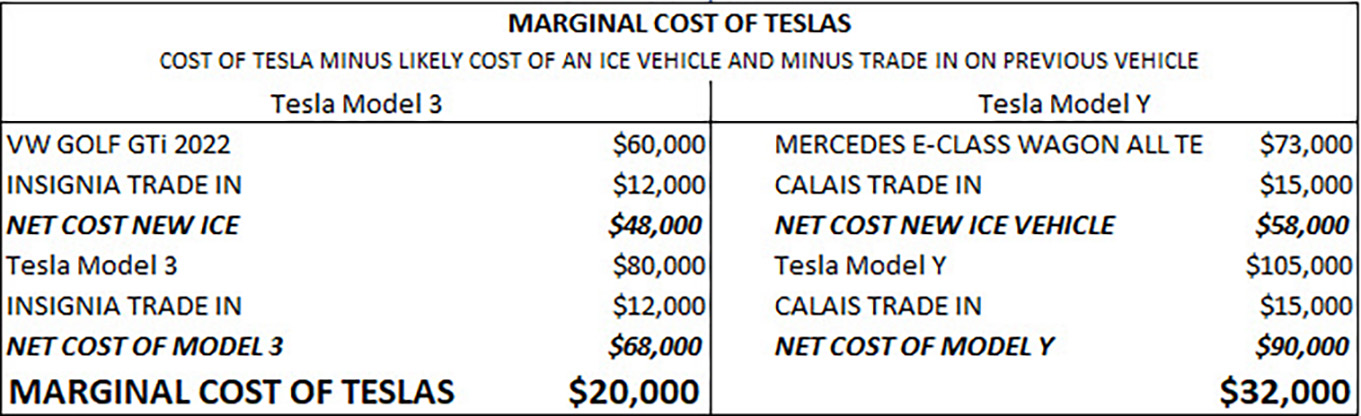
EVs famously have significantly lower maintenance costs than ICE vehicles. Ours are both quite new (21 months and 5months), so we have had no maintenance costs on the vehicles so far.
I modelled some estimates of the costs of services and repairs to our previous ICE Vehicles and the expected costs for the new EVs and found a saving of around $1500 per vehicle per year. But have only factored for $500 per car per year.
This is an excerpt from a story published on SwitchedOn, a new section from our sister site RenewEconomy that focuses on electrification. For the full analysis of the electrification story please go to the original story here.