
Tesla has hiked the price to use its network of Superchargers to up 68 or 69 cents per kilowatt hour, nearly twice what it was almost four years ago.
The new rate is a 32% jump from the early 2022 rate of 52 cents per kilowatt hour (which had increased since to 57c/kWh), and is roughly in line with soaring wholesale electricity prices that in June saw the energy regulator take the unprecedented step of suspending themarket.
Tesla buys the power for its Supercharging network from Iberdrola, previously known as Infigen. It cut a deal with the energy provider, which owns the Lake Bonney wind farm and big battery and numerous other wind farms, in the first weeks of 2020.
The new Supercharger pricing can be checked by drivers by pressing on a Supercharger location on the car’s navigation map. It is thought that the difference in pricing across networks would depend on local daily supply charges.
For example, the Gold Coast Supercharger at Pacific Fair costs 68c/kWh, while the Knockrow charger in Northern NSW costs 69c/kWh.
It’s not the first time Tesla owners have seen big jump in the price of Supercharging.
In January 2019, the rate sat at 35c/kWh, but jumped up to 47c/kWh – a 35% increase. Just days later, the EV maker responded to customer backlash for the decision, and dropped the rate down to 42c/kWh.
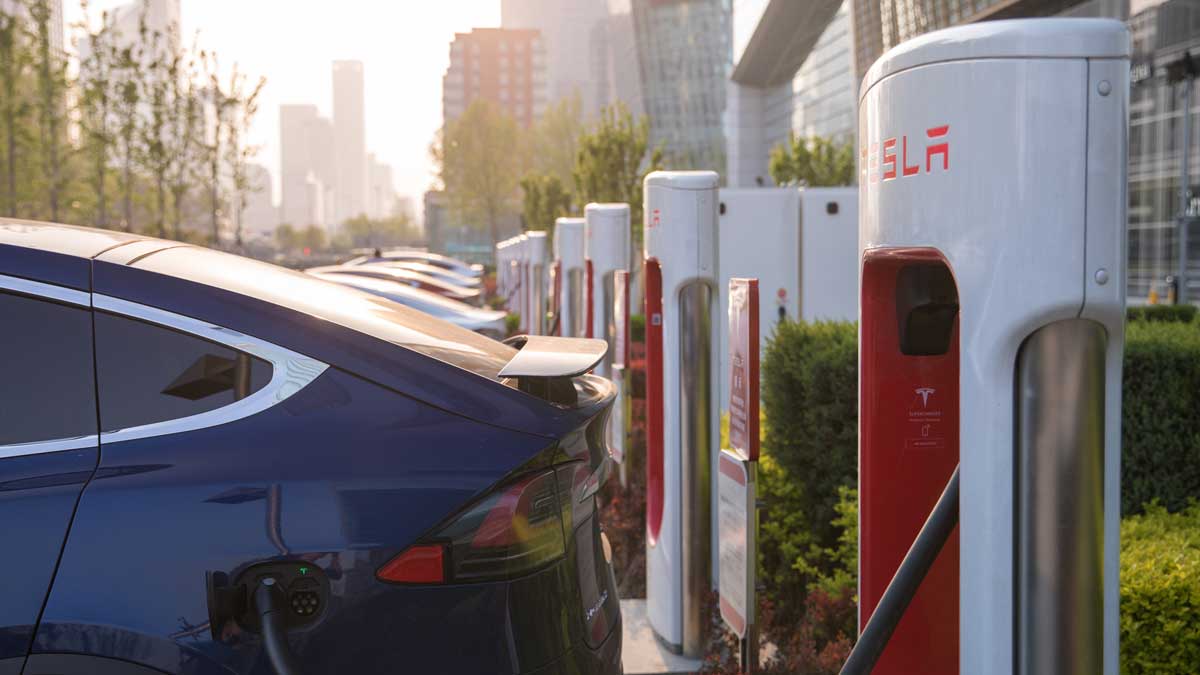
More Superchargers on way but first delays
While it is understandable that the Supercharger rate has now increased again amid rising electricity prices, one issue of concern is the delayed rollout of Superchargers in Australia.
As The Driven reported in May, some planned Supercharger sites were delayed by up to 12 months, likely a result of the ongoing global supply chain crisis.
However, with a new massive influx of Tesla electric cars – most notably the Model Y – the need for more charging options is higher than ever before. As The Driven reported on Tuesday, there are as many thousands more Tesla cars ready to be delivered to drivers in coming months.
Although most drivers only need to use DC fast-chargers when travelling, because the brand remains the single largest contributor to EVs in Australia, more Tesla Superchargers will help to alleviate demand for other EV owners that cannot use the proprietary network.
A new survey by The Driven shows that according to Tesla’s Supercharger location page, some planned sites have been delayed another three months. Holbrook has been delayed another 12 months.
Some locations are no longer on the list, including certain central capital city locations (shown in italics).
A central Sydney and Centennial Park location have been struck off the list, as has Brisbane Central. Other locations no longer planned include Newcastle and Homebush.
However, there are now nine extra locations on the planned rollout, with a focus on popular locations outside capital cities and in regional areas.
While Nunawading in Melbourne’s east is gone, there will now be a Supercharger at Wheelers Hill instead. There will also be a Supercharger at Blaxland in the Blue Mountains west of Sydney, as well as Campbelltown, and in Dandenong in Melbourne’s south-east .
Kempsey, halfway between Sydney and Brisbane is also on the list, as well as Miriam Vale and Mackay on the Queensland mid-coast.
Next to go online? Tenterfield and Wollongong.
| Location | State | Pre-May 2022 |
May 2022 |
Current target (as of 01/09/2022)
|
| Armidale | NSW | Q1 2022 | Q4 2022 | Q1 2023 |
| Bairnsdale | VIC | Q4 2022 | Q4 2022 | Q1 2023 |
| Blaxland | NSW | – | – | Q1 2023 |
| Brisbane Central (CBD) | QLD | – | 2023 | – |
| Brisbane South (Coorparoo) | QLD | 2022 | 2023 | Q1 2023 |
| Brisbane West (Indooroopilly) | QLD | Q2 2022 | Q3 2022 | Q3 2022 |
| Bundaberg (Childers) | QLD | Q3 2022 | Q3 2022 | Q1 2023 |
| Campbelltown | NSW | – | – | Q1 2023 |
| Dandenong | VIC | – | – | Q1 2023 |
| Hobart | TAS | Q1 2022 | 2023 | Q1 2023 |
| Holbrook | NSW | Q1 2022 | Q4 2022 | Q4 2023 |
| Homebush | NSW | Q2 2022 | Q3 2022 | – |
| Kempsey | NSW | – | – | Q1 2023 |
| Lancelin | WA | – | – | Q1 2023 |
| Mackay | QLD | – | – | Q1 2023 |
| Mandurah | WA | – | – | Q1 2023 |
| Melbourne Central | VIC | Q4 2022 | 2023 | – |
| Melbourne East (Nunawading) | VIC | Q4 2022 | 2023 | – |
| Miriam Vale | QLD | – | – | Q1 2023 |
| Newcastle | NSW | Q2 2022 | Q4 2022 | – |
| Perth | WA | Q1 2022 | Q4 2022 | Online |
| Rockhampton | QLD | Q3 2022 | Q3 2022 | Q1 2023 |
| Sydney Central | NSW | Q2 2022 | Q3 2022 | – |
| Sydney East (Centennial Park) | NSW | Q4 2022 | Q4 2022 | – |
| Tenterfield | NSW | Q2 2022 | Q3 2022 | Q4 2022 |
| Wheelers Hill | VIC | – | – | Q1 2023 |
| Wollongong | NSW | Q3 2022 | Q3 2022 | Q4 2022 |