
The total cost to buy and operate an electric van in Europe is now cheaper than diesel alternatives, according to a new study and backed up by a survey of European van buyers that found most want to go electric.
The new study published by Transport & Environment (T&E), Europe’s leading clean transport campaign group, analysed the total cost of ownership (TCO) of electric and diesel vans, which includes purchase, operating, and maintenance costs. The TCO is a crucial metric for commercial vehicle operators.
T&E modelled the TCO of diesel and electric vans for six groups of end-users – including business-to-consumer and business-to-business transporters, vocational users, short-term rental services, lessees, and private users – in France, Germany, Italy, Poland, Spain, and the United Kingdom, which accounts for 76% of the EU+UK van market.
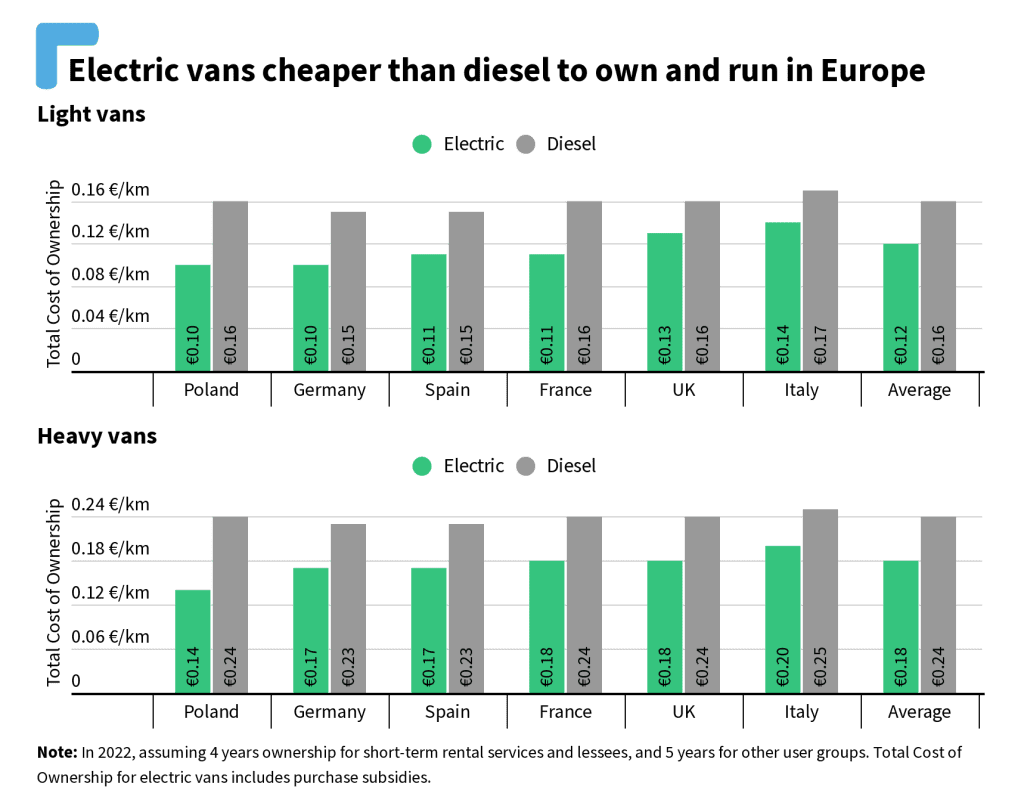
The results of the analysis showed that electric vans are already the cheapest option for all user groups considered in all six countries when purchase subsidies are included.
Specifically, the average EU electric van is 25% cheaper than the average diesel van, with a TCO of 0.15€/km for the electric van as compared to 0.20€/km for the diesel van.
Moreover, even if purchase subsidies are excluded, electric vans would still be cheaper on a TCO basis in five out of the six countries considered, and are cheaper in all countries and for all user groups by 2024 at the latest.
A survey of European van buyers published concurrently with the report also found that the European van market is ready to jump on board the electric revolution, with 36% of van fleets surveyed already boasting at least one electric van, while another 32% plan to buy an electric van this year.
The survey, of 745 fleets across Europe by Dataforce for T&E, also found that 16% are considering buying an e-van in the next five years.
But, unfortunately, the supply of electric van models is lacking, explaining why – despite the interest – electric vans only account for 3% of sales, lagging well behind battery electric vehicles (BEVs) at 9%.
Further, T&E expect that the supply of electric vans will continue to fall short for the rest of the decade unless a significant and immediate increase is made to the European Union’s proposed van CO2 targets – which were left untouched in the 2020s and do not require manufacturers to increase sales of electric vans above a 10% share before the end of the decade.
“An electric van beats a diesel on cost and van buyers know it,” said James Nix, freight manager at T&E. “But there’s nowhere near enough supply of e-vans. EU lawmakers can change this at a stroke by increasing the CO2 targets which will require vanmakers to sell more zero-emissions vehicles.”
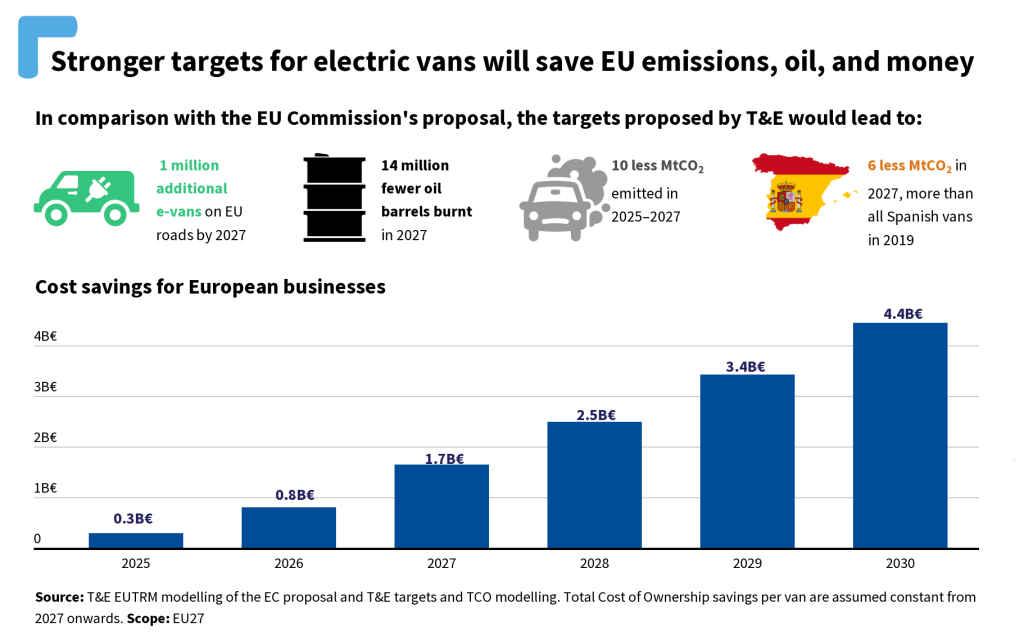
According to T&E, tightening the EU’s draft CO2 targets during this decade would result in the addition of 1 million extra electric vans to European roads within five years, would save 5.6-megatonnes of CO2 emissions in 2027, and reduce the annual oil consumption of European vans by 7% in 2027.
This last is of particular relevance, as the annual reduction of oil consumption would end dependence on Russian imports. Similarly, even more ambitious targets would save European businesses €13.1 billion over 2025–2030 due to the lower costs of running e-vans.
“Electric vans will help cut our oil dependence and save European businesses billions of euros already in this decade. But the drip feed of electric vans on to the market has to end,” said James Nix.
“Member states and MEPs can open the tap and put far more e-vans on the market by ramping up the EU van CO2 targets.”
In particular, T&E is calling on European Union lawmakers to tighten the proposed van CO2 targets to require a 25% reduction in average van CO2 emissions in 2025, along with a new intermediate target of a 45% reduction by 2027 and an 80% reduction by 2030.
Thankfully, T&E’s report will hopefully be seen by the right eyes, as the EU Parliament and environment ministers are set to decide their positions in the coming months ahead of an agreement on final targets due in the Northern Summer.

Joshua S. Hill is a Melbourne-based journalist who has been writing about climate change, clean technology, and electric vehicles for over 15 years. He has been reporting on electric vehicles and clean technologies for Renew Economy and The Driven since 2012. His preferred mode of transport is his feet.