
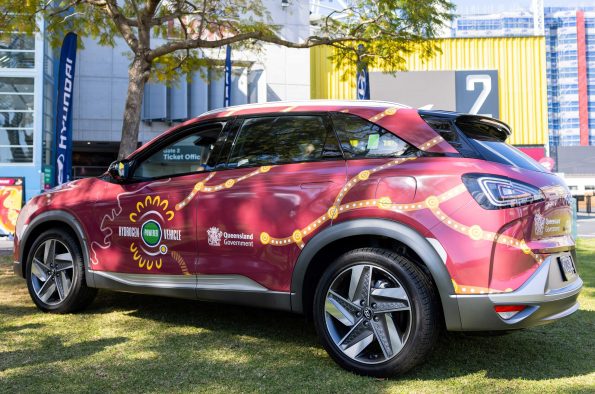
South Korean automaker Hyundai has deployed five of its Nexo hydrogen fuel-cell electric vehicles (EV) into the Queensland Government’s fleet, adding to the 20 Nexo fuel cell EVs already deployed in the ACT.
The Nexo SUV, along with Toyota’s Mirai is one of two hydrogen-powered cars now available in Australia (although only to fleet owners) and boasts a devilish range of 666-kilometres (WLTP).
The Nexo is also Hyundai’s second-generation production fuel-cell vehicle and serves as the company’s technological flagship of this technology, although refuelling remains an issue with single stations available in Brisbane, Sydney, Canberra and Melbourne with limited capacity on the number of vehicles that can be served.
The addition of the Nexos atakes the total Queensland government fleet of electric vehicles to more than 100, with the aim of lifting this total to 144 by the end of 2021 and double that by the end of 2022. QFleet, as the Queensland Government’s fleet of electric vehicles is called, is available to frontline health staff, educators, and community workers.
“These head-turning vehicles will be fuelled with home-grown Queensland hydrogen as they are tested in on-road conditions over the next three years,” said Mick de Brenni, Queensland’s Minister for Energy, Renewables and Hydrogen.
“Leasing them as part of our trial of fuel cell electric vehicle technology highlights the fact that QFleet – the government’s fleet manager – continues to drive Queensland’s renewable transport options,” he said.
“This trial aims to accelerate the uptake of hydrogen technology and support Queensland’s push to position itself as a global hydrogen superpower. It will demonstrate the effectiveness and efficiency of hydrogen for passenger vehicles and possibly lead the way for hydrogen’s roll-out to trucks, trains and marine applications.”
Jun Heo, Hyundai Australia’s CEO said the Nexo is a “cornerstone” of its green vehicle line-up, and joins hybrid, plug-in hybrid and pure electric models to “underscore our leadership in eco-mobility and our commitment to developing sustainable motoring solutions.”
There is intense debate about the chances of FCEV’s to be able to compete against battery electric vehicles (BEVs) in the passenger sector, but hydrogen is expected to play a greater role in industrial transport options – across heavy-duty long-haul transport, as well as potential as a marine transport fuel.
As Australia continues to build its hydrogen strategy and considers the development of massive green hydrogen hubs, ground-level demonstration of FCEVs as in Queensland’s QFleet and the ACT will help to support continued growth and development of hydrogen across Australia.
“This, in turn, helps grow our local hydrogen supply chain and that means more jobs for Queenslanders in this emerging sector,” de Brenni said in his statement.
“It means jobs sourcing raw materials for renewable hydrogen production and manufacturing state-of-the-art technology, right through to exporting this renewable energy to an increasingly hydrogen-hungry world market.”
“The Queensland Government has set a target of zero nett emissions by 2050 and the transition to low and zero-emission electric vehicles will be a significant driver of this target being met,” he said.

Joshua S. Hill is a Melbourne-based journalist who has been writing about climate change, clean technology, and electric vehicles for over 15 years. He has been reporting on electric vehicles and clean technologies for Renew Economy and The Driven since 2012. His preferred mode of transport is his feet.