Source: Tesla
Tesla has reduced the advertised driving range of all its vehicles on its Australian website – but it’s for a very good reason.
The new driving range of the Long Range Model 3, for example, is now 580km, whereas previously it was 657km. The Standard Range Plus, which was previously 508km, now says it can only drive 448km, and the Performance now says 567km where it once said 628km.
That’s a 12% drop, but there has been no corresponding change in battery size or operational parameters. While Tesla occasionally pushes out software updates that alter driving range, they are always efficiency improvements resulting in minor increases.
So what gives?
The devil in the detail of course is that Tesla has (finally!) decided to use Worldwide Harmonised Light Vehicle Test Procedure (WLTP) ratings, which have been in use since 2017 and are used to measure carbon emissions and energy consumption of vehicles.
Previously, Tesla stated range figures developed using requirements developed under the Australian Design Rule 81/02 — Fuel Consumption Labelling for Light Vehicles), which was developed in line with the New European Driving Cycle (NEDC) rating, before the WLTP was introduced.
The New European Driving Cycle (NEDC) rating is known for delivering higher results than actual real-world driving range and copped considerable criticism because its procedures were too theoretical, and carmakers were accused of doing things to get better results.
NEDC driving range figures can be as much as 30% higher than range achieved driving under real-world conditions, and earned itself another interpretation of the NEDC acronym – “not even damn close”. For more information see Bryce Gaton’s article on the matter here.
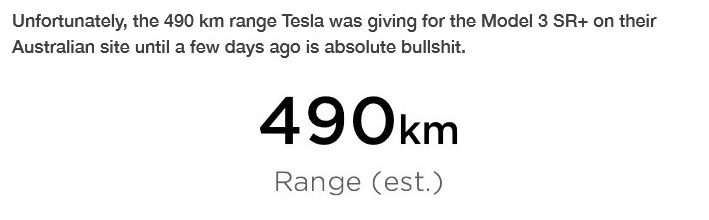
When stating NEDC range on its website, Tesla also attracted criticism from some quarters, such as this Model 3 reviewer (noting the range from before an efficiency improvement that brought the NEDC rating to 508km):
Other carmakers in Australia that import electric vehicles, such as Hyundai (eg the Kona EV with 64kWh battery with 484km range), have been using WLTP for some time so it is good to see Tesla move in line with this.
You can still choose to see the NEDC range on the Tesla website (although really, who would you?) by clicking the small WLTP link on the vehicle’s design page, then “learn more”.
There, you’ll see a message that says: “Range figures shown are based on the WLTP standard which may be useful in comparing ranges among electric vehicles. Your actual vehicle range will vary depending on the vehicle configuration, battery age and condition, driving style and operating, environmental and climate conditions.”
But if you really want to get a proper idea of driving range, we’d also suggest heading over to our EV Models pages, which state what you can expect to get in real-world driving conditions as well as WLTP ratings.
Bridie Schmidt is associate editor for The Driven, sister site of Renew Economy. She has been writing about electric vehicles since 2018, and has a keen interest in the role that zero-emissions transport has to play in sustainability. She has participated in podcasts such as Download This Show with Marc Fennell and Shirtloads of Science with Karl Kruszelnicki and is co-organiser of the Northern Rivers Electric Vehicle Forum. Bridie also owns a Tesla Model Y and has it available for hire on evee.com.au.
Geely throws in finance offer and a free home charger for its already popular EX5…
Kia offers deals on its EV3 and its EV5 to help move MY25 stock as…
Like its stablemate, the newly released Musso electric ute, the KGM Torres EVX electric SUV…
Volvo cuts prices on its existing EX30 and EX40 electric offerings in preparation of the…
What sort of EV can you buy for less than $30,000, or less than $40,000?…
Chinese automotive group Chery unveils its next generation ‘Rhino’ battery which boasts ultra-fast charging and…