Electric vehicles (EVs) consume just a fraction of the materials needed to produce and drive an internal combustion engine (ICE) vehicle, and will use less and less as battery technology evolves, a new study from European clean transport lobby Transport & Environment has found.
The new study released on Sunday outlines that just 30 kilograms of raw materials are lost in the production and use of an electric car after 70% is recycled at end-of-life, compared with 17,000 litres of fuel burnt by ICE cars.
It’s an enormous amount, made all the more conspicuous by a comparison of a football to a 25-storey building from Lucien Mathieu, transport and e-mobility analyst at T&E who co-authored the report.
“When it comes to raw materials there is simply no comparison,” Mathieu said in a statement.
“Over its lifetime, an average fossil-fuel car burns the equivalent of a stack of oil barrels, 25 storeys high. If you take into account the recycling of battery materials, only around 30kg of metals would be lost – roughly the size of a football.
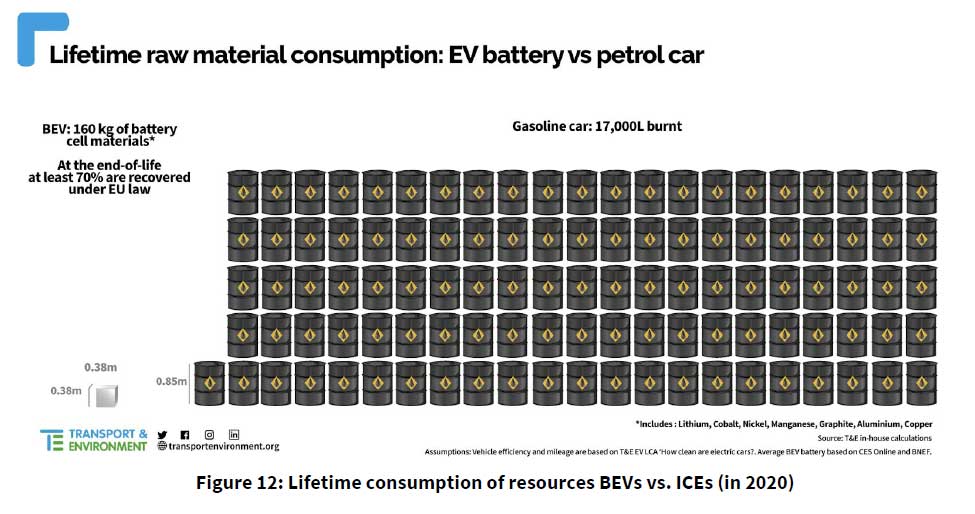
The findings underline how a transition to electric mobility can have a major impact on reducing dependency on crude oil, because the majority of material lost in an ICE vehicle is in its fuel use and the production and distribution of that fuel.
ICE cars are mostly burners
As T&E points out, 77% of the lifecycle energy consumption of an ICE vehicle is in the burning of fuel. Another 18% is used in the refining, extraction, production and transportation of that fuel. The remainder is in production of the vehicle.
Combined, the making and burning of fuel accounts for 95% of the energy consumption of an ICE vehicle. Once it is burned, there is no way of recovering it, unless you count the development of e-fuels by carbon capture which is an entirely different conversation.
By comparison, the use of electricity to recharge a battery-electric vehicle (BEV) accounts for 60% of its lifecycle energy consumption, while battery production accounts for 23%, and production of the vehicle itself accounts for 11%.
This assumes that the remaining 7% is the lifecycle energy consumption of wind and solar if the EV is powered solely by renewables – which grid mixes are increasingly moving towards.

Widening the ICE vs EV gap
T&E also note that the gap between material and energy usage is tipped to widen as battery technology improves, and if recycling targets now being proposed by the European Commission are achieved.
This is because technological advancements will see the amount of raw materials needed to make batteries reduced significantly over the next decade.
Specifically, T&E says it expects the demand for lithium per kilowatt-hour of battery to reduce by half, cobalt by three-quarters and nickel – which is key to making high energy density batteries – by a fifth.
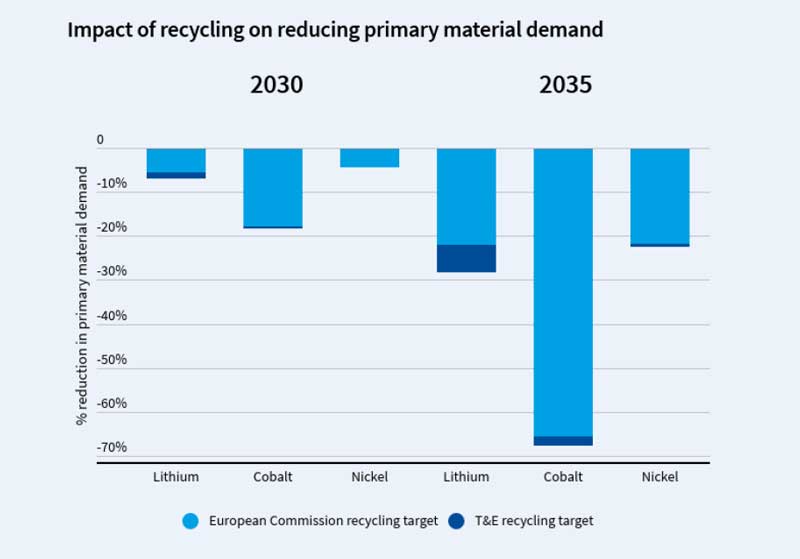
By recycling battery materials, T&E also says that further reductions in raw material demand can be achieved, by sourcing 20% of lithium and nickel and 65% cobalt from recycled batteries by 2035.
“This is a far cry from the current situation where Europe’s car fleet is almost entirely dependent on crude oil imports,” says Mathieu.
“Increased battery efficiency and recycling will leave the EU significantly less dependent on imports for raw materials than it is for oil.”
Citation: Transport & Environment (2021), From dirty oil to clean batteries