Supplied
Electric vehicles owners Peter and Robyn Tuft have been pushing the boundaries of off-grid living, powering not only their home in pristine southern Tasmania but also their EVs from the sun and their own seasonal creek.
The two retired nature-lovers took the plunge into off-grid living around five years ago.
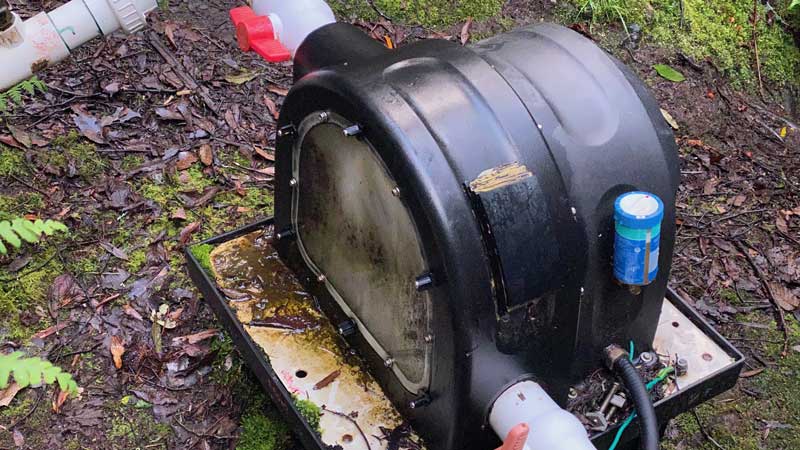
Their award-winning house uses a very small amount of energy – about 5-7kWh a day, powered by a 4kW solar system and a mini-hydro that generates up to 800W of power when the creek is running.
“We’re keen to minimise our personal CO2 impact,” says Peter Tuft, and says while the home is very energy efficient, it has not meant a compromise.
“It’s very comfortable …. but after we’d been here for a little we while thought, we have some surplus power,” he says.
So the couple added not just one, but two electric vehicles to their household. The first purchase was a secondhand Mitsubishi i-Miev in 2016 (now 10 years old) and a brand new Long Range (LR) Model 3 in 2019.
Tuft says the LR Model 3, which has a 75kWh battery, is pushing the limits of their off-grid setup, but says the couple haven’t looked back and are now thrilled they can proudly say that both their home and vehicles emit no carbon.
“We had the opportunity in 2016 to buy the 2nd-hand 2010 i-Miev, which when new had a nameplate range of 130km – when we got it it would do about 80km, and it’s now down to 70km,” says Tuft.
“We used it for short trips, but couldn’t do long trips in it.
“We wanted to get a proper EV one day so we took the plunge and bought a Tesla Model 3 Long Range.”
“We’re pushing the boundaries a bit but it works,” says Tuft.
Although the retired couple typically drive no more than 20km to the nearest town for supplies, they do take the occasional trip around Tasmania to go bush walking.
While this gives them the opportunity to take advantage of the many 50kW public chargers now popping up around the island state, they’ve tweaked their home energy storage system to account for the extra demand of the Model 3.
To ensure they had enough energy storage to keep both cars charged without draining the home battery, they secured 16kWh of batteries through a deal with an Australian Electric Vehicle Association member.
“What it means is that with those additional batteries … we are not at risk of running down the house batteries,” says Tuft.
“When the house batteries are virtually full but power is still incoming, the power gets diverted to separate lithium-ion battery bank.
This is supplemented by the mini-hydro system which can generate up to 20kWh per day when the creek is running at full capacity (typically in winter and spring, which more than offsets the losses in winter from the solar system).
“Because we’re in southern Tasmania, days are short and the sun doesn’t get very high,” says Tuft.
“We are fortunate to have small creek – it’s not a big flow but it is steep terrain – with a 45 metre drop, and at a flow of 4 litres a second, the generator puts out 800W.”
Tuft says the hydro generator, which is a commercial product from New Zealand company PowerSpout, is very economical in terms of cost, and even though the pipes and cables cost a lot more than the generator itself, he thinks the set up was worth it.
All up he estimates the entire off grid system including solar panels, lead acid battery, and hydro cost around $40,000. He suspects this would have been comparable or cheaper than getting the house connected to the grid, which would have required 1.5km worth of underground pipes and cables.
He adds that while the sticker price may seem high for some, the cost of off-grid setups are highly dependent on what you’re trying to achieve and where your home is located.
“You can make this transition to zero carbon without it being all that difficult,” says Tuft.
A previous version of this article incorrectly stated the Long Range Model 3 has a 100kWh battery. We wish!
Bridie Schmidt is associate editor for The Driven, sister site of Renew Economy. She has been writing about electric vehicles since 2018, and has a keen interest in the role that zero-emissions transport has to play in sustainability. She has participated in podcasts such as Download This Show with Marc Fennell and Shirtloads of Science with Karl Kruszelnicki and is co-organiser of the Northern Rivers Electric Vehicle Forum. Bridie also owns a Tesla Model Y and has it available for hire on evee.com.au.
We spent a week with Jaecoo’s affordable J5 EV to see how this practical electric…
Tesla’s seven-seat Model Y arrives in Europe as part of its sales push, but is…
The Geely EX5 Extended gains special finance and a free home charger offer as competition…
Canberra apartment hunters can now check which buildings actually support EV charging, after AEVA launched…
Tesla is set to lift Cybertruck pricing just days after unveiling its new sub-$A85,000 entry…
Jaecoo’s sharp $36,990 driveaway launch price has helped the J5 EV surpass 1,000 orders within…