Source: Pixabay
World first “plug and charge” technology for electric vehicles introduced by Australia’s Tritium could see cars transform into more than just a mode of transport.
First introduced in May, Tritium’s potentially revolutionary EV plug and charge could upturn the EV industry just as “plug and play” technology did to computers and gaming.
A new white paper released by the Brisbane-based company, which produces and sells high-powered EV charging units in more than 30 continues, describes a vision that could see the technology do more than change the way we charge.
It says this could improve the in-car charging experience to allow an electric car to become a payment device synonymous with today’s “tap and go” smartphone technology, or be bundled as a service with charging, insurance and other fees all included.
While the concept of paying for a product as a service is a trend that we’re starting to see in many industries (such as software-as-a-service, or S-A-A-S), its the first time we’ve heard of cars being proposed as a payment device.
According to Tritium’s head of market strategy, and the author of the white paper, Nathan Dunlop, Tritium’s plug and charge technology is ideal for this because it has already been designed for the utmost security and to, well, pay for charging.
“As it is secure and utilises advanced cryptographic techniques, we believe the vehicle will follow a similar technology roadmap to the smartphone which is no longer just a phone, but a tap-and-go payment method and an essential device beyond its ability to simply make calls,” he said.
“The technology behind Plug and Charge will lead to Automakers, Charge Point Operators and Utilities innovating new offerings and re-defining how the EV is used – it won’t be seen simply as a method from getting from A to B, but a way to interact with and/or pay for C.”
Imagine driving through parcel pickup and not needing to pull out the wallet, or forgetting your smartphone and paying with your car.
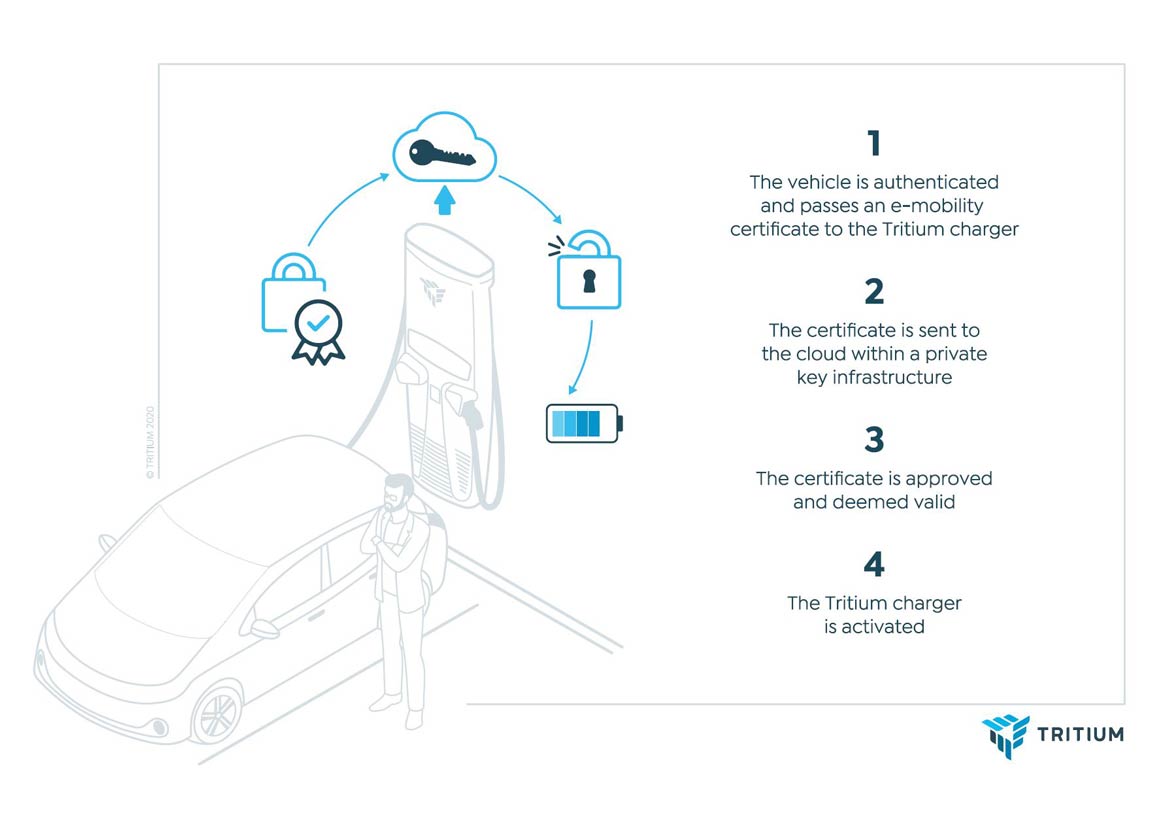
The Tritium plug and charge technology utilises the ISO 15118 communications protocol to enable an electric vehicle to authenticate, authorise and bill customers in much the way a credit card does, but via the charging cable.
This negates the need for an electric vehicle owner to carry an RFID card, for which past security issues have been ironed out but which still carry the risk of theft via cloning.
But Dunlop sees more scope than just paying for electric vehicle charging using the plug and charge system.
He breaks this down in the whitepaper into three broad opportunities: improving customer experience, providing EVs-as-a-service, and most interestingly enabling a “car as credit card” function.
The first of these would allow for a more streamlined experience for customer, says Dunlop.
“First, you’ll see the charging interaction move into an in-vehicle experience, with the ability to set charge speeds and cost limit preferences all from the comfort of the vehicle,” he said in a statement about the white paper.
He likens the opportunity to that which electric vehicle pioneer Tesla uses today, where car owners can control facets fo charging such as charge rates and limits from within the car interface.
“Secondly, we see a ‘Vehicle as a Service’ bundles emerging, in which charging fees, and ongoing vehicle loan finance being bundled into a convenient payment plan,” says Dunlop.
He says that this could be further extended by integrating such a package with home energy usage.
“Vehicle manufacturers will soon differentiate on the in-vehicle payment experience and application offerings,” he says.
“Ordering could be managed through in-vehicle applications, or voice commands. Identification, authentication, and payment can then be centralised into a monthly vehicle spend.”
If done well, it would ensure loyalty for charge point operators (CPOs) from customers, says Dunlop.
“CPOs could differentiate quickly from ones which don’t offer an interoperable charging experience, and it opens up a new revenue stream by offering easy charging solutions to drivers without a membership to their network – in some instances they could charge a small fee in the way some banks offer use of their ATMs in exchange for a small access fee.
“And utilities could offer solutions such as bulk billing or bundling at the end of a month or even subscription services, thus securing customer loyalty across offerings in the same way Telcos bundle home internet and mobile phone usage.”
But it is the last item – using an electric vehicle to pay for goods and services – that could spark the most broad offerings, says Dunlop.
“Finally, yet perhaps most interestingly, is the idea of the vehicle as a credit card payment device, a ‘tap and go’ on wheels. If the vehicle itself is a validated payment mechanism the vehicle effectively becomes a rolling payment medium via the stored cryptographic information in the vehicle.
“As the ecosystem around the vehicle evolves, the use cases of the vehicle as a payment medium extend far further than solely charging services. For example, a drive-thru restaurant payment may become touch free, with limited human interaction.
“Ordering could be managed through in-vehicle applications, or voice commands. Identification, authentication, and payment can then be centralised into a monthly vehicle spend.”
Bridie Schmidt is associate editor for The Driven, sister site of Renew Economy. She has been writing about electric vehicles since 2018, and has a keen interest in the role that zero-emissions transport has to play in sustainability. She has participated in podcasts such as Download This Show with Marc Fennell and Shirtloads of Science with Karl Kruszelnicki and is co-organiser of the Northern Rivers Electric Vehicle Forum. Bridie also owns a Tesla Model Y and has it available for hire on evee.com.au.
Tim Eden and Riz Akhtar join to help review the year that was in EVs,…
The Zeekr 7X arrives in Australia with a sort of self-assurance usually reserved for brands…
Deliveries of Tesla's fastest electric SUV to date begin in Australia, with some owners celebrating…
Jaecoo J5 EV packs modern family SUV looks, great build quality that's ready for adventure…
BYD continues its rapid global expansion after reaching its 15 million NEV production milestone.
Tesla opens up almost 50 new Supercharger stalls ahead of the holiday rush, meaning EV…