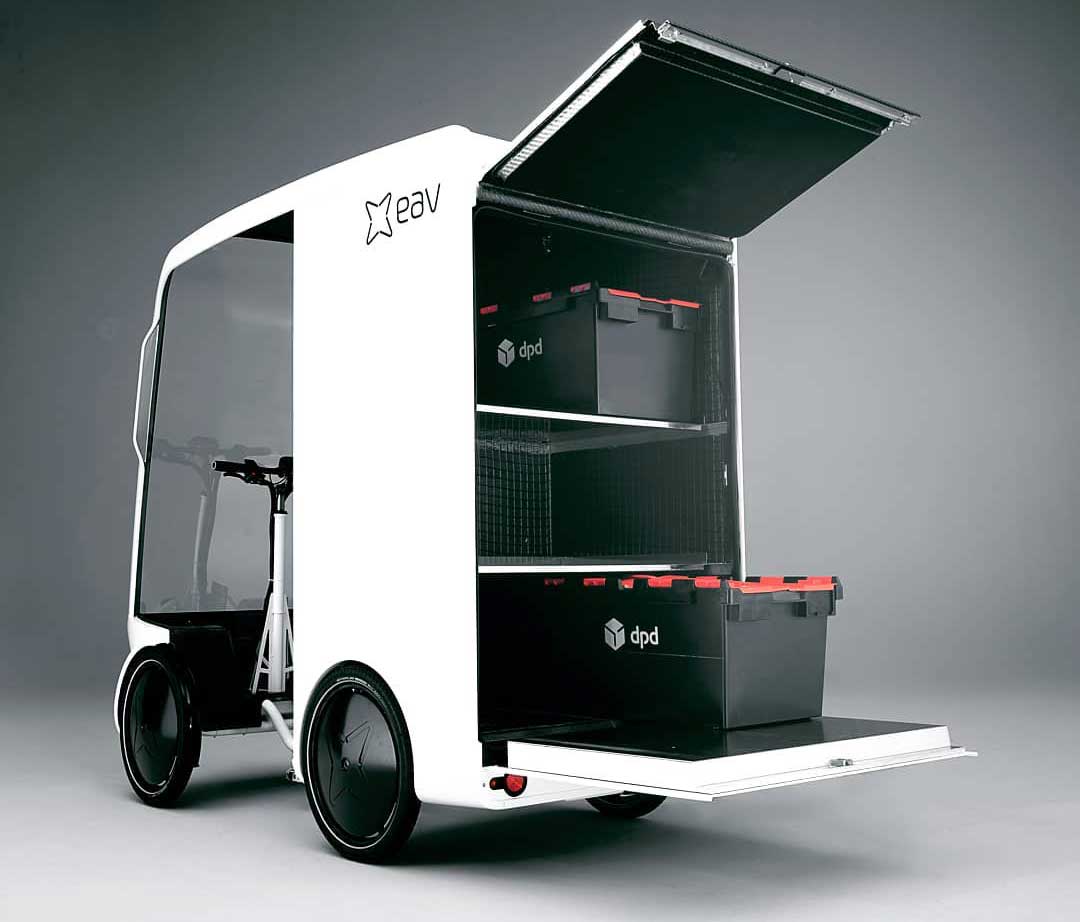
Source: eavCargo/Facebook
Oxfordshire start-up Electric Assisted Vehicles Limited (EAV) has launched a new electric carbon carrying solution at the Oxford EV Summit, the EAVan – an eCargo bike engineered from a van “down” rather than from an eBike “up”.
EAV rightly concludes that, in addition to “indisputable evidence of climate change … “Cars, vans and trucks, especially in towns and cities, are considered as one of the main contributary causes of air pollution”.
The EAVan, therefore, is an effort to provide an “immediate solution” to improving air quality as well as reducing overall traffic congestion.
However, rather than trying to ad-hoc their way to create an eBike that is able to carry more than a bag or two of groceries, EAV have worked “down” from a traditional van.
The resulting EAVan nevertheless requires what EAV is describing as a “culture-of-use” change as people begin to wrap their minds around trading in their traditional Light Commercial Vehicles or petrol and diesel “vans”.
“We wanted the EAVan to be as usable as possible by anyone,” said Adam Barmby, Technical Director and Founder of EAV.
“Getting people out of vans and onto eCargo bikes isn’t easy if they think it’s going to be an awful experience. Being exposed to the elements or being low to traffic isn’t going to appeal to anyone. So, we started with the idea of the outer body of a light commercial van and we added the electric pedal-assist propulsion system.
“We’ve used all the electric assistance which the regulations permit including a thumb throttle, which we call an ‘e-nertia’ switch, which accelerates the EAVan up to about 3/mph,” Barmby continued.
“After that, simply turning the pedals provides enough power to move up to 120 kgs of payload in the cargo area up to a maximum assisted speed of 25/kmh”
The amount of assistance can be adjusted, and we have our own gearbox so using the EAVan is very easy indeed. We regenerate power into the batteries under braking and free-wheeling to maximise the efficiency of the EAVan which has a range of up to 60 miles or further if you piggyback more batteries.
“It’s simple, yet elegant and really enjoyable to use. And infrastructure is not an issue. We use a standard household plug to charge our interchangeable batteries so the EAVan is an immediate solution and incredibly cost effective.”
The EAVan is built on a unique “Cloudframe” chassis design which helps the eCargo bike to be fully modular, allowing it to fulfil a wide array of uses – from delivery van or pick-up to paramedic or security patrol vehicle.
The EAVan can also be evolved into both longer and wider “EAVehicles” providing a potential platform for larger vans and Personal Transport Vehicles (PTVs) including everything from taxies and minibuses down to personal vehicles.
“We travel far more slowly than we think, especially in towns and cities,” explained Nigel Gordon- Stewart, Chairman and Executive Director of EAV.
“If we can reduce the mass of traffic, both in terms of actual weight and sheer volume, as well as remove all toxic emissions using bio-mechanical EAVans and EAVehicles, we’d have a cleaner, safer and much more enjoyable environment in which to live and work. And there’s no impact on business efficiency using EAVans.
They’re highly efficient so it’s mainly a culture change that’s needed and EAVans and EAVehicles are really fun to use and a much healthier solution for people as a whole.”
EAV has applied for a patent for its EAVan and will now also be working on the production of a range of new EAVehicles – including new features such as doors, an undertray floor, and in-vehicle heating and ventilation.
“We believe we have a very strong solution for urban transport immediately and for the future with both EAVans and EAVehicles,” Gordon-Stewart concluded.
“We see the streets of towns and cities around the world being populated with these lightweight, efficient and safe vehicles all moving smoothly within a much less impacted infrastructure.
“We can save on road damage, tyre and brake particulate pollution as well as operating under completely zero emissions which will unquestionably help with the enormous issue of climate change.
“Our cities and towns will also be a quieter place to be and there’d be no impact on businesses in terms of efficiency. In fact, a cleaner environment and healthier population would provide for more efficient lives and businesses for the future.
“We already have a healthy order book and EAVan deliveries for trials start in September. Dealing with pollution and congestion in towns and cities is genuinely in sight.”
Joshua S. Hill is a Melbourne-based journalist who has been writing about climate change, clean technology, and electric vehicles for over 15 years. He has been reporting on electric vehicles and clean technologies for Renew Economy and The Driven since 2012. His preferred mode of transport is his feet.
The Elexio SUV generally scored well by Australian vehicle safety standards, except for the threat…
Polestar’s head office in Sweden has released more detailed plans regarding the arrival of four…
New data shows Tesla's FSD Supervised usage now exceeds 13 billion km ahead of rapid…
It can and has been done, but vehicle manufacturers are notoriously bad at offering upgrades…
Chinese EV manufacturer and Tesla FSD rival Xpeng has showcased its Advanced Driver Assistance Systems…
First performance report from New Vehicle Efficiency Standard Regulator has bad news for some of…