AC EVlink and DC Tritium chargers form part of the QESH at Hamilton in Brisbane. Credit: Bridie Schmidt
We are encouraging questions from readers about electric vehicles, and charging, and whatever else you want to learn. So please send them through and we will get our experts to respond, and invite other people to contribute through the comments section.
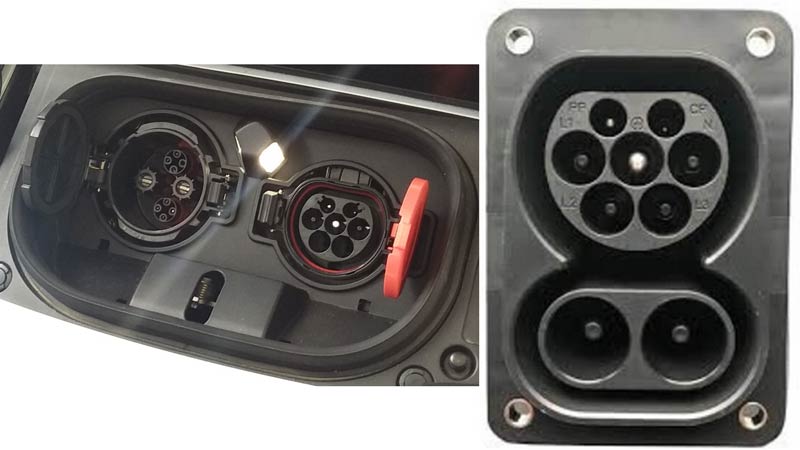
I realise that a CCS2 plug will not fit the socket on my Renault ZOE due to there being no space for the DC part of the plug. Would it be possible to use the Type 2 cable that came with the car to connect the AC part of the CCS2 plug to the Zoe’s Type2 socket, or is there some other incompatibility that would stop this working?
Peter Y
Hi Peter – would you like the short or the long answer?
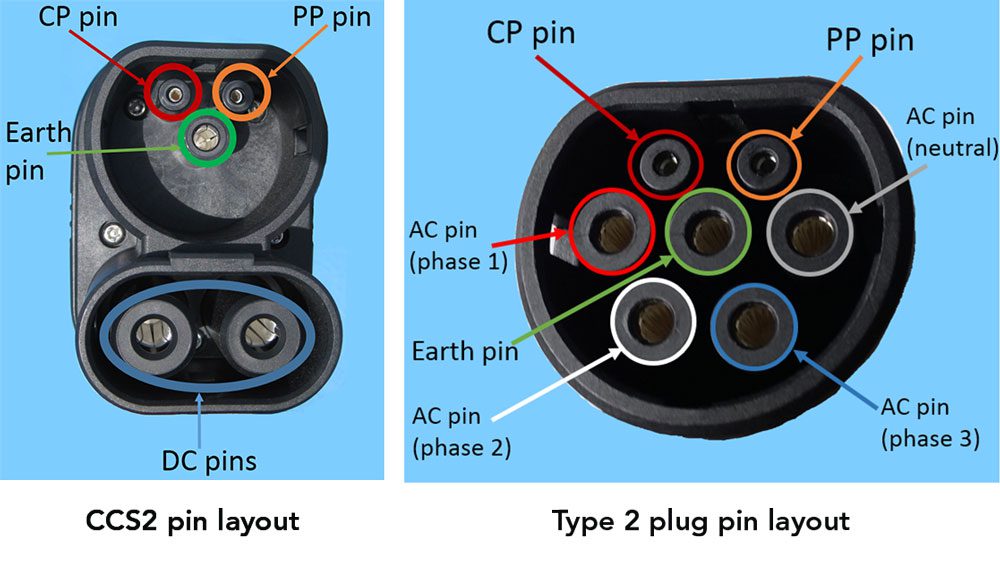
The short answer is that a DC charger uses the two bottom pins of the CCS2 socket and only the earth and communications pins in the Type 2 section (see Pic 3).
The other 4 are simply not connected when DC charging(See Pic 3). Consequently, when DC charging there is no AC available to the car via the plug.
Therefore a CCS2 DC charger is useless to an AC-only electric vehicle (EV) like a Zoe or Kangoo ZE1.
The longer answer involves explaining the precise usage of each pin in the Type 2 and CCS plugs.
In CCS charging, the AC connectors use the same system for ‘talking’ to the car and the charger2 as is used for the DC charging communications.
One communications signal (via the ‘PP’ pin) tells the EVSE that an EV is plugged in. A second communications signal (via the ‘CP’ pin) tells the car exactly what current the EVSE can supply.
Commonly, for AC EVSEs, the charge rate for one phase is 3.6 or 7.2kW, or three phase at 11 or 22kW – but many other options are possible depending on the EVSE settings3.
The trick with CCS DC charging is (as mentioned above) it uses the same communications system as the AC charging system.
As shown in Pic 3, this means that for DC charging the manufacturer only needs to add and connect two more pins for DC below the Type 2 inlet socket – thereby creating the CCS2 socket – and talk to the car and EVSE via the same pins as before. (Unless you are Tesla – but that is a longer story told elsewhere. See here.)
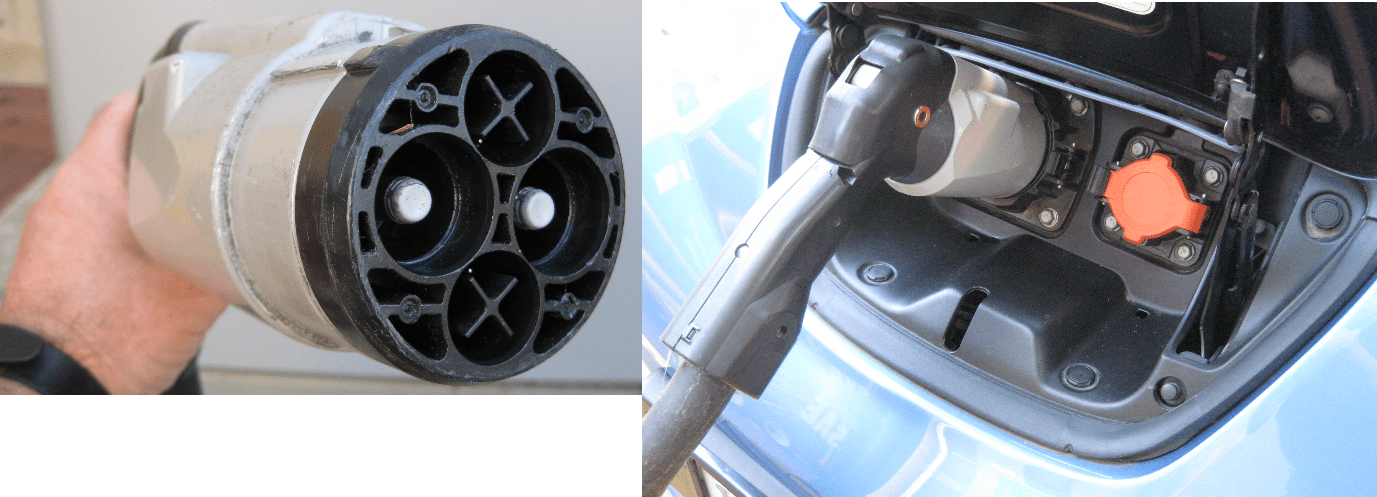
This is also why the CCS system allows for a much smaller plug that the older separate CHAdeMO and AC sockets – CHAdeMO uses a totally different communications system to Type 1 or 2 AC charging – in fact it uses many more pins to do the same thing – hence the large size of the CHAdeMO plug/socket combination plus the need for a separate AC socket.
Notes:
Bryce Gaton is an expert on electric vehicles and contributor for The Driven and Renew Economy. He has been working in the EV sector since 2008 and is currently working as EV electrical safety trainer/supervisor for the University of Melbourne. He also provides support for the EV Transition to business, government and the public through his EV Transition consultancy EVchoice.
The roll out of electric buses to two additional routes - including the busiest in…
Analysis of EV registrations show massive growth in March as surging fuel prices and fears…
We got behind the wheel of GAC’s new electric hatchback to see what $31,990 gets…
Renault is offering a drive-away price of $49,990 for its battery electric Megane E-Tech hatchback…
After almost 3 years since the trials on the Toyota BEV ute started, the company…
Australia's green bank is committing $100 million to help VW Group offer discounted loans for…