
Electric car maker Tesla has reported a big slump in electric vehicle deliveries in the first quarter, prompting a revised annual target at the low end of expectations as it grapples with rapid expansion into Europe and China.
The company released its quarterly production and delivery figures this week, saying it produced 62,950 Model 3s and 14,250 Model S and Xs in the first quarter of 2019, but only managed to deliver 50,900 Model 3s and 12,100 Model S and Xs.
In terms of deliveries, this is an 8% drop in deliveries for the Model 3 from the prior quarter, and a hefty43% drop in deliveries for the Model S and X.
“Due to a massive increase in deliveries in Europe and China, which at times exceeded 5x that of prior peak delivery levels, and many challenges encountered for the first time, we had only delivered half of the entire quarter’s numbers by March 21, ten days before end of quarter,” the company said.
“This caused a large number of vehicle deliveries to shift to the second quarter. At the end of the first quarter, approximately 10,600 vehicles were in transit to customers globally.”
Tesla said it still expects to reach the lower end of its 350,000-500,000 annual delivery goal as stated by Musk at the quarter four earnings call, but is now aiming for 360,000 to 400,000 deliveries.
The announcement sparked an 8.2 per cent drop in the Tesla share price in trade on Thursday, as investors and analysts grappled with yet another piece of news that took them by surprise.
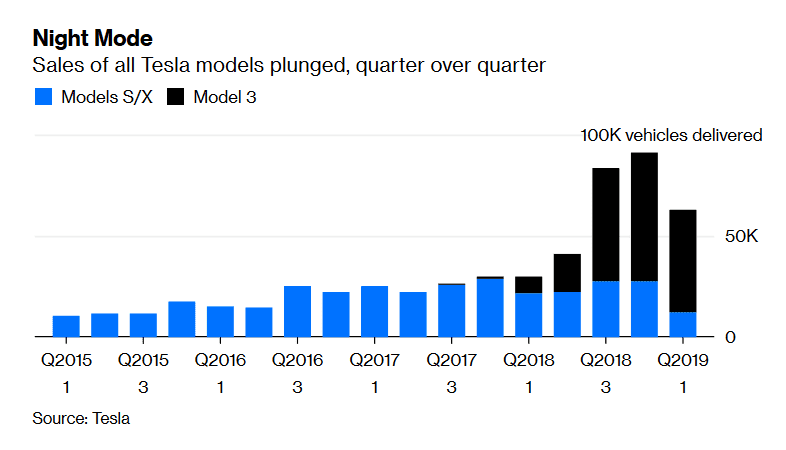
The drop to 77,200 cars made and 63,000 delivered is well below what many analysts predicted (which range wildly from 60,000 as predicted by Seeking Alpha’s Anton Wahlmann to as high as 105,000 as predicted by Cleantechnica’s Maarten Vinkhuyzen – who did put his hand up for a massively incorrect forecast).
Musings about the reason for the drop in production and sales are many, but the figures may at least help make sense of a “series of bizarre moves” made by the carmaker in recent months, from price drops to price rises, store closures and re-openings as it shored up costs to bring to market the Standard Range Model 3.
“The various moves aimed at slashing costs and boosting sales volume make sense in the context of such a drop-off. Likewise the tight rein on capex, especially with that convertible bond payment factored in,” said Liam Denning at Bloomberg, pointing to Tesla’s note on Wednesday evening that it now has “sufficient cash on hand”.
Australian customers will be hoping that it won’t impact timing of the long-awaited deliveries of the Model 3s to Australia, which are scheduled for this winter, according to a tweet from Musk.

Bridie Schmidt is associate editor for The Driven, sister site of Renew Economy. She has been writing about electric vehicles since 2018, and has a keen interest in the role that zero-emissions transport has to play in sustainability. She has participated in podcasts such as Download This Show with Marc Fennell and Shirtloads of Science with Karl Kruszelnicki and is co-organiser of the Northern Rivers Electric Vehicle Forum. Bridie also owns a Tesla Model Y and has it available for hire on evee.com.au.