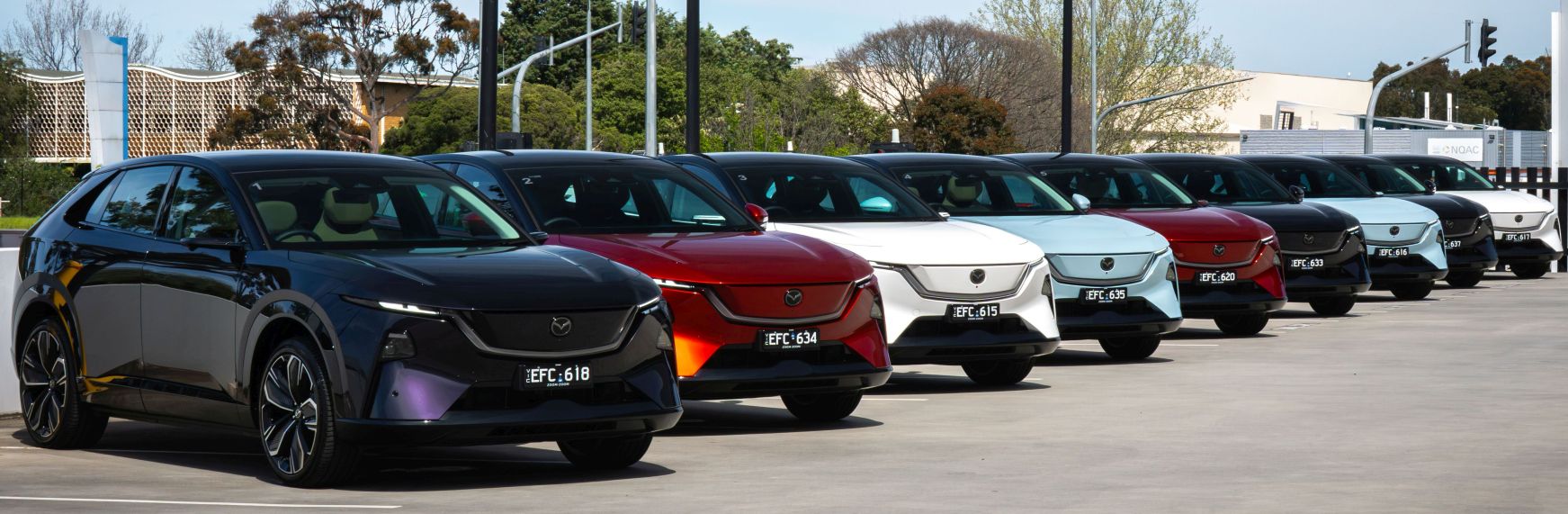
Mazda have just launched the all-electric CX-6e medium SUV onto the Australian market. Effectively an electric equivalent to Mazda’s petrol CX-60 medium SUV, it follows hot on the heels of the recently launched Mazda 6e medium passenger sedan.
The CX-6e is technically classified here as a ‘medium SUV’: with its swooping rear roofline and hatch, in looks it could also be described as a ‘crossover’.
Available in two variants, the ‘GT’ and ‘Azami’, in reality little differentiates the two apart from tyre/wheel size and mirrors. (The GT uses 235/55 tyres on 19-inch rims with standard mirror-based mirrors whilst the Azami has 255/40 tyres on 21-inch rims and camera-based digital interior and exterior mirrors).
The GT is currently priced from $56,990 on the road (in Victoria), with the Azumi priced at an extra $3,000 at $59,990 on-the-road (in Victoria).
Interestingly, neither the CX-6e or the 6e are ‘Made in Japan’ – rather they are built in China as a product of the now 20 year-old Changen Mazda joint venture.
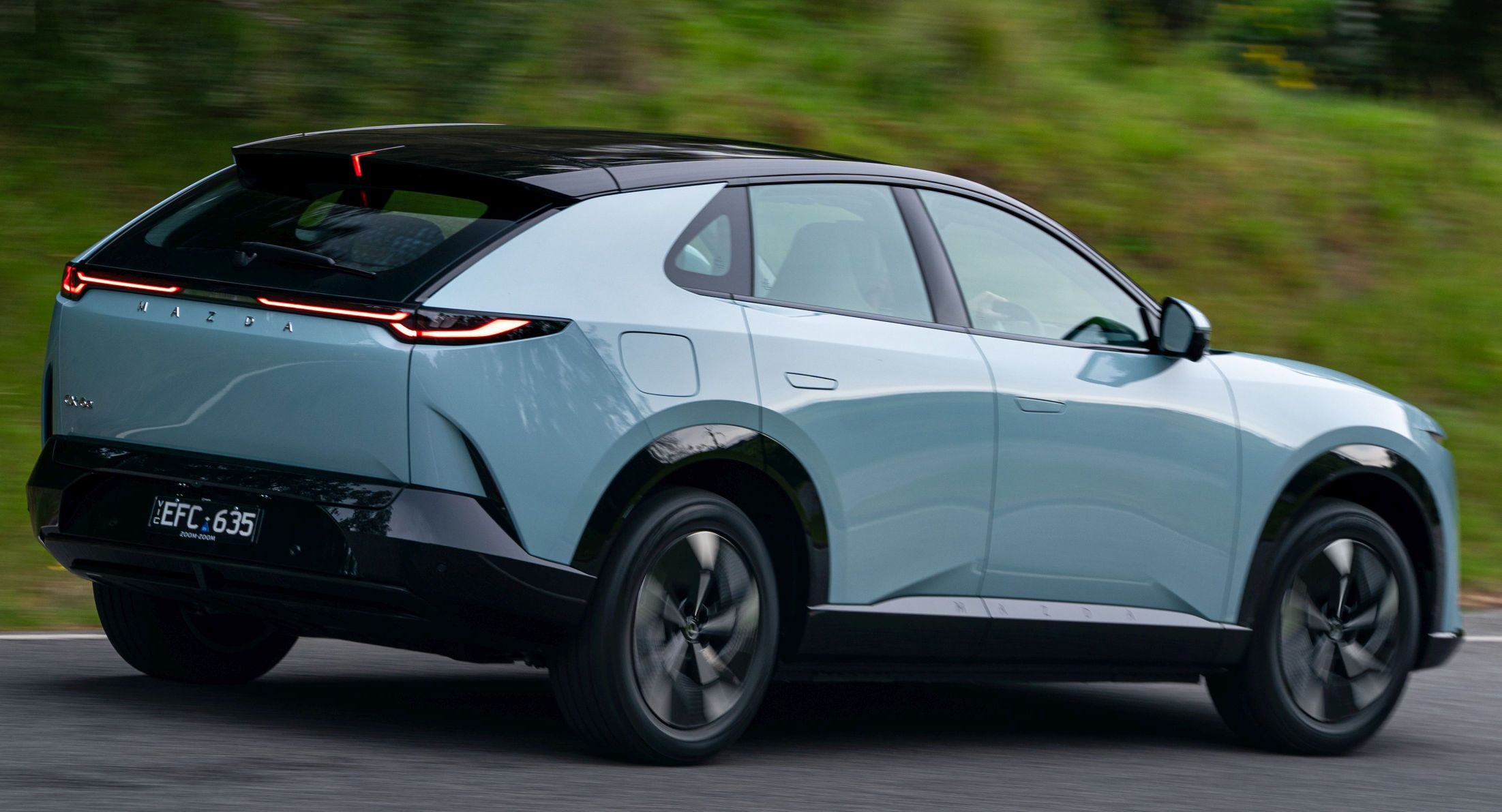
As such, the CX-6e (like the 6e) is based on the same platform as the latest Deepal S07. Mazda are however keen to emphasise it is in no way a rebadged S07 – rather it is built in a separate factory under Mazda control with completely different exterior sheet metal and interior, along with Mazda specific suspension tuning.
Having now spent around 5 hours on varying road conditions in both versions, it definitely comes across as ‘not a Deepal S07’, although the question then arises: ‘but is it a Mazda?’.
At the launch event, Mazda were at pains to emphasise the body and interior design were done by Mazda’s in-house design team, led by Eiji Kimoto. As a result, the exterior exemplifies Mazda’s current design language, along with most of the interior. No surprises there.
However, the dash layout differs markedly from the more traditional layout of the 6e. There is no driver’s display, instead the basic details of speed, speed limit and indicator use are provided by a Head-Up-Display (HUD) reflected on the lower windscreen.
As HUDs go, it works well and is easy to read – although I do get reports from people with polarised sunglasses that they filter out some HUD displays. If you do have polarised lenses, I’d recommend taking your pair on a test drive.
The biggest surprise though is in the infotainment screen. At 67 cm wide, it starts next to the driver and stretches all the way across the passenger side. This makes a good half of it inaccessible to the driver, meaning it’s there purely for the passenger’s benefit.
As a passenger for some of my time in during the launch event, the extended screen proved to be of little interest beyond the first 5 min of trying to find some form of use for it.
All-in-all, the ultra-wide screen of the CX-6e feels both superfluous and a potential source of distraction to the driver. On the other hand, the section within reach of the driver worked well with little to no lag and, being 5K, was clear and easy to read.
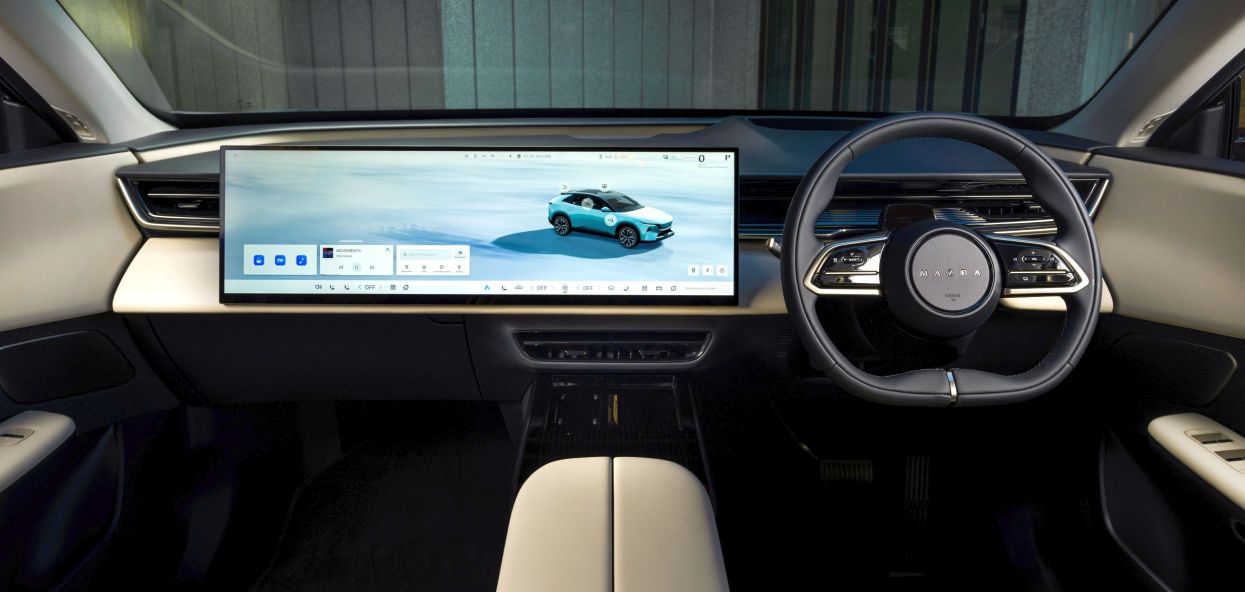
However, sadly (like many modern cars – particularly Chinese manufactured ones), there is still an over emphasis on App control via the infotainment screen rather than physical buttons and dials.
Trying to find a spot on the screen to operate things like the ventilation system is to my mind dangerous as it requires you to look away from the road to find the correct spots on-screen, versus a ‘braille’ system of buttons and knobs. It will be interesting to see how many make their way back under the incoming rule changes in Europe and China mandating analogue controls for a car’s basic functions.
Another disappointment was the camera-based digital mirrors in the Azami – especially where the exterior mirror views were displayed on small screens on the inside door trims. Looking in and down rather than to the side did not feel like an ‘improvement’ to driver safety. To put it bluntly: some things really don’t need to be reinvented.
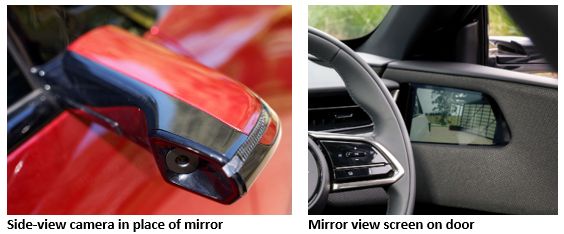
Mind-you, digital side mirrors in particular are already feeling like a passing fad (like 3D TV), given Hyundai deleted the option in their latest update to the Ioniq 5.
Thankfully, as someone who wears glasses, the central interior mirror could at least be switched between digital or old-fashioned reflective mirror. (Digital central rear-vision mirrors, being so close to the driver, can be all but impossible to focus on if wearing single-vision lenses).
Driving
Whilst the CX-6e has the same 78kWh battery and drive train as the 6e, it seems aerodynamics are not an SUV’s friend: the CX-6e has a WLTP driving range of 468 km, versus 560 km in the 6e.
Still, 468 km is plenty for most people and going by the 6e, the CX-6e is likely to achieve better numbers if driven mainly at suburban speeds. Also, in comparison to many new BEVs, it may not appear ‘lightning fast’ off the line.
However, at 7.9 and 8.1 seconds 0-100km/hr (GT/Azami) the CX-6e is no slouch and accelerates briskly, providing more than enough for passing situations. Handling, in my short time with it, was also quite neutral and sure-footed. If pushed hard, it went into a gentle understeer … although you did have to try hard to provoke that reaction.
As for any differences between the GT and Azami: the Azami does ride slightly more firmly on its 21-inch, lower profile tyres, but that was about it. Both handled minor bumps and potholes well.
Steering feel is adjustable (although anything but ‘Sport’ seemed a bit vague) along with 4 selectable levels of regenerative braking. It is worth noting here that adjusting the regen level was not easy: rather than using steering mounted paddles like many manufacturers now do, it could only be adjusted in the CX-6e by diving deep into a series of menus.
Seating adjustment is 8 way electric for the driver (4 way for the front passenger) with tilt and reach steering wheel adjustment. At first-blush the seats and driving position didn’t feel entirely comfortable, although I found it hard to put my finger on why. But, as they say, ‘the proof is in the pudding’ and after multiple 45 minute to one-hour stints in both driver’s and passenger seats, I felt no stiffness or tiredness at the end of each session.
The rear seats offer massive amounts of head and legroom, as well as (for the outer two) quite comfortable seating positions. The middle seat was somewhat less comfortable though with a humped base and flat back (due to the fold-down armrest) and all-in-all felt to be a bit of an afterthought.
As a result, the middle position would be fine for short trips, but could quickly get uncomfortable on an extended journey. A general ‘open and airy’ feel for rear-seat passengers was also helped by a full panoramic glass roof with retractable shade.
Summing up:
First impressions were of a competently handling, comfortable family car. Much what you would expect from a Mazda: which answers the question I posed earlier re ‘but is it a Mazda?’
On the other hand, its Chinese associations do come through in places – such as having a left-hand indicator, as well as a some slightly annoying pieces of unnecessary ‘bling’, such as the widescreen infotainment screen and the Azami’s digital mirrors.
For the price – I would at the very least shortlist it for inspection, and Mazda diehards would not be disappointed if keeping to the same brand for their BEV update. But my tip is that, if buying the CX-6e, I’d opt for the GT and pocket the $3k difference.
Specifications
Seating: 5
Boot volumes in litres (1 litre = 10 x 10 x 10 cm)
- Boot under parcel shelf: 363
- Rear seat folded: 956/1,434 (to shelf/to roof)
- Froot (Front Boot): 83
Dimensions:
- Overall length: 4,850 mm
- Overall height: 1,620 mm
- Ground clearance: 158 mm
- Overall width (edge of doors): 1,948 mm
- Overall width (edge of mirrors): 2,098 mm
Battery: 78 kWh
Energy consumption: (WLTP)
- 18.9 kWh/100 km (GT)
- 19.4 kWh/100km (Azami)
Kerb weight:
- 2,130 kg
Charging:
- 1 phase AC: 7 kW max.
- 3 phase AC: 11 kW max.
- DC: 194 kW max.
Charge port location:
Right-hand rear (above rear wheel arch)
Vehicle to Load connection (position and power):
Adaptor for use with charge port, 3-5kW at 220V
Drive configuration: Rear-wheel drive (RWD)
Turning circle: 12 m
Towing: 1000/1500 kg (unbraked/braked)
Spare tyre: No.
Platform: Changan EPA1 platform (shared with Deepal)
Warranty:
- Battery: 8 yrs/160,000 km
- General: 5 years/unlimited km
Performance:

Fuller specifications of the Mazda CX-6e can be found in TheDriven’s new models page, as well as the AEVA Fact Sheets page.
Full Disclosure:
Accommodation, food and drink were all provided by Mazda for the 2-day launch event.