
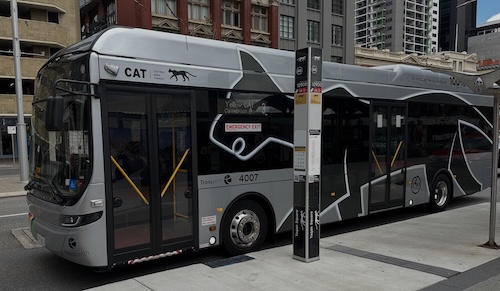
The wheels on the electric bus go round and round. But, how does that work? Trialling electric buses has long seemed like trialling the wheel.
Transperth’s largest EV bus depot is now complete: 56 dual chargers, 112 plugs, and a state and federal government lined up to be photographed in front of it. And so they should. It’s a great outcome. But there are lessons to study.
The electrical infrastructure that made it possible raises questions about how such electrification could better fit into the whole-of-government and its net zero transition plans.
Karrinyup in Perth is the third depot converted, after Elizabeth Quay and Malaga, and it followed the same basic playbook: substation upgrades, high-voltage reticulation, CCTV, yard reconstruction, and refurbished staff facilities, delivered by Jet Charge.
Bayswater and Jandakot North are now going through the same process, sized for 130 and 82 buses respectively, and Welshpool, Joondalup and Claisebrook are next in the planning queue.
Each site effectively repeats the same retrofit: assess the existing grid connection, upgrade the substation, install chargers, rebuild the yard around them.
Credit is due for how that retrofit is being managed. Jet Charge co-founder Tim Washington has explained that Karrinyup’s 112 charging bays use energy management software that deliberately charges the whole fleet slowly and simultaneously overnight — around four hours for roughly 300km of range — rather than fast-charging buses individually, specifically to avoid straining the local network.
That’s a genuinely smart way to manage demand within a fixed connection.
But it is still a site-level software fix for what is, at its core, a network-level constraint. Clever load management at Karrinyup doesn’t substitute for planning the electrical capacity of the next ten depots before they’re built.
The pattern demonstrated is efficient in the short term but raises a longer-term question on transport, density and precincts that we’ve outlined previously can enable the grid to perform better in its transition to renewables.
Our argument is that future electrification demand – EV charging, bus depots, freight, logistics – should be planned now for precinct scale before growth arrives, not retrofitted site by site after the fact. Karrinyup, Malaga and Elizabeth Quay are each a case of the latter: real infrastructure, delivered well, but planned depot-by-depot rather than as part of an integrated network-wide electrical strategy.
There’s a telling detail in how that unevenness is playing out. Malaga’s upgrade included solar panels and battery storage to ease pressure on its grid connection.
Karrinyup – despite being newer, larger, and the flagship of the program – has none. The state’s biggest depot has less energy resilience built in than the one it superseded. That’s not a minor oversight; it’s a sign the rollout is still being planned connection by connection rather than against a consistent, forward-looking standard.
We also point out that Perth has been clothed disproportionately in “automobile fabric” – car-dependent, low-density suburban growth – compared with older transit-oriented areas.
That matters here because most of the depots being converted – Karrinyup, Bayswater, Jandakot – sit in exactly that fabric: built for a diesel-era transit and transport network, now being asked to carry far higher electrical loads than they were ever designed for, but are ideal for the next energy system that government is guiding us into, especially when solar incentiives are supersized and will more positively fit into these precincts.
Malaga’s inclusion of solar panels and battery storage in its upgrade was a partial answer to that problem, easing pressure on its grid connection rather than relying purely on substation capacity.
None of this diminishes what’s been delivered.
WA transport minister Rita Saffioti’s point that 11 new electric buses are entering service each month, with depot capacity being built ahead of that demand, is a genuinely disciplined way to run a fleet transition, and it reflects lessons learned from the years when small-scale trials outpaced the charging infrastructure needed to support them – and the purchase orders needed to deliver a fleet.
We’ve pushed for exactly this kind of scaled deployment since 2018 — repeatedly contrasting Perth’s early caution with Shenzhen’s full bus-fleet conversion and Norway’s decade-old electric ferry network —this shift is “a breath of fresh air” after years of advocacy.
The parallel rollout of Perth’s electric ferry network follows the same infrastructure logic – and the same advocacy arc.
Five battery-electric ferries are under construction at Henderson’s Echo Marine Group as part of a $107 million METRONET on Swan project. The planned Matilda Bay terminal will include its own onshore high-voltage charging infrastructure, approved through a standard environmental and planning referral, alongside new berthing capacity at Barrack Square Jetty.
Like the bus depots, each terminal needs its own shore power and charging capacity built in, and each is being approached as an individual site rather than a networked energy plan – the same retrofit pattern, on water instead of land.
The practical test for Transperth now is whether the next wave of depot conversions – Welshpool, Joondalup’s further upgrade, Claisebrook – moves beyond straightforward substation retrofits toward the kind of anticipatory, precinct-level electrical planning, now being recognised globally as the best scale for optimising renewable power.
Getting individual depots charged and running has clearly been achievable, but now lets see if we can make precincts that are largely self-sufficient.
The harder question is whether Perth’s broader grid and precinct planning can get ahead of demand – not just for buses and ferries, but for the freight and truck electrification that will follow the same depots, the same substations, and the same choice: plan the network now for precinct-scale renewables, or retrofit it again, site by site, when the next fleet needs power.