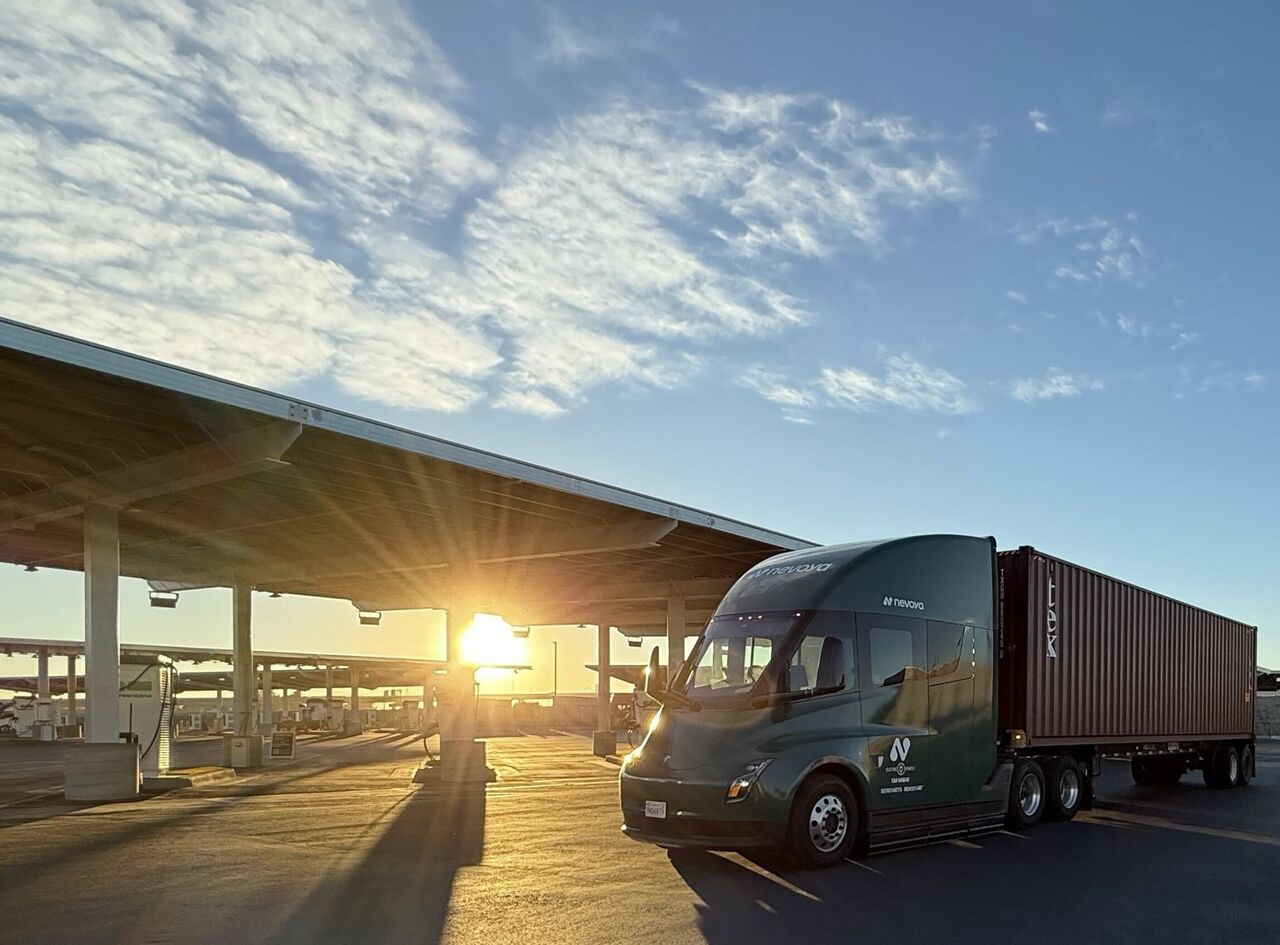
Social media giant and technology conglomerate Meta, the parent company behind Facebook, Instagram, and WhatsApp, has signed a multi-year deal with US freight operator Nevoya to support the deployment of 25 Class 8 battery-electric trucks between San Bernardino, California, and Phoenix, Arizona.
Meta will buy environmental attribute certificates tied to Nevoya’s electric freight service. Under a system known as “book and claim”, companies can buy the emissions benefits of lower-emissions freight separately from the transport service itself.
Nevoya expects the trucks to start operating on Interstate 10 in 2027 and travel about 4 million miles (6.4 million km) a year. The deal also supports new charging infrastructure, and Nevoya says the fleet’s electricity use will be matched with renewable energy certificates.
The I-10 is the major high-capacity east-west corridor across the southern United States and links the ports of Los Angeles and Long Beach to Phoenix, El Paso, Houston and the Gulf.
The multi-year agreement will see Meta purchase zero-emission trucking environmental attributes certifications (EACs), carbon credits that represent the environmental attributes of Nevoya’s battery-electric freight service.
This is Meta’s second partnership with Nevoya” to “This is Meta’s first standalone deal with Nevoya, following its participation in a group purchase of freight certificates in January.
Meta was one of several high-profile buyers whose collective EAC purchases would support the deployment of approximately 40 battery-electric-trucks in Texas.
In addition to Meta, companies signing on to the GMA agreement included Amazon, eBay, and Etsy. The agreement was further expanded in September when Google also signed on, expanding the number of battery electric trucks to be deployed to 63.
“Coming back to Nevoya for a second corridor reflects what we look for in our value chain work: partners that can scale, and agreements we can repeat,” said Devon Lake, Head of Net Zero Strategy, Meta.
“Freight is part of the emissions footprint of building and operating our data centres, and multi-year commitments like this help address our scope 3 emissions and make electric trucking available and competitive on the routes that serve the regions where we build.”
The Center for Green Market Activation explained in January that, while many shippers are committed to decarbonisation, the actual availability of zero-emission services is rare, with electric trucks accounting for less than 1 per cent of new heavy-duty vehicles in the United States.
“With this pilot procurement, GMA Trucking has shown how to translate market demand for zero-emission trucking services into scalable deployments,” said Kim Carnahan, CEO at GMA, speaking in January.
“Through a competitive procurement process and advance purchase commitments from leading corporations, we’ve proven a replicable model to get urgently needed zero-emission trucks on the road. With contracts signed, we’re already planning for our next, even bigger procurement.”
The next test for book and claim is whether it can help electric freight expand beyond a handful of routes backed by some of the world’s biggest companies.