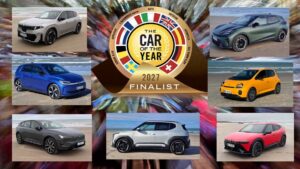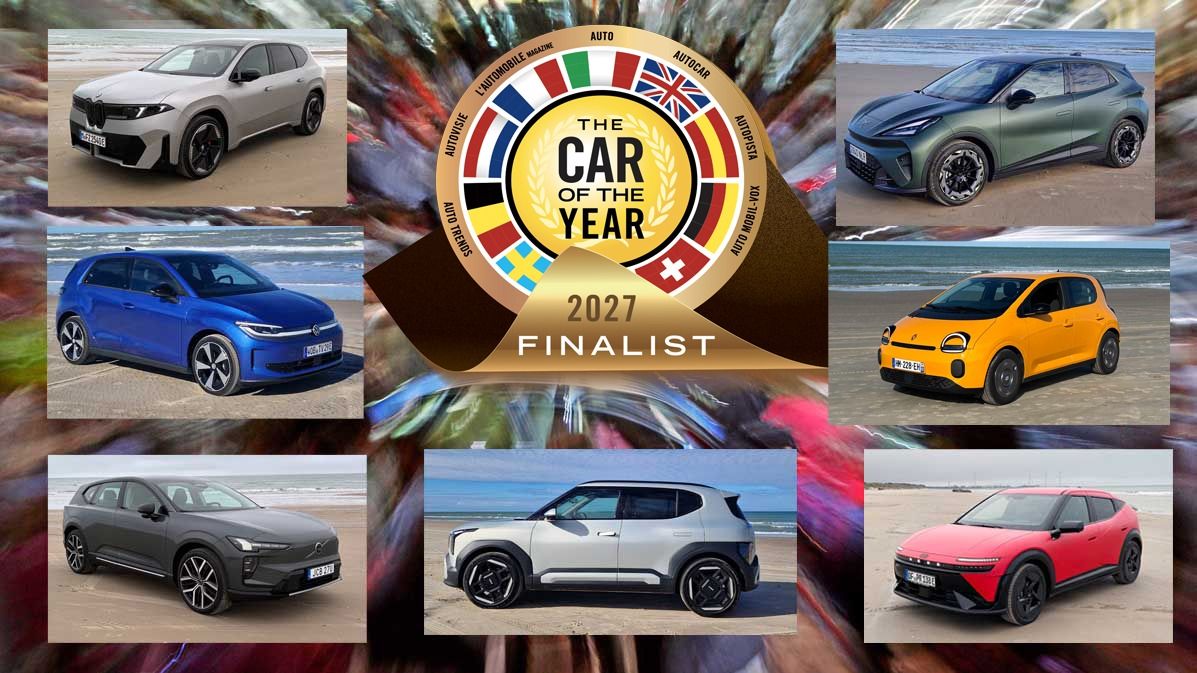
If you ever needed proof that the EV transition is closing in on the point of ‘happened’ rather than ‘happening’, you need only look at the finalists for the prestigious 2027 European Car of the Year award. All seven finalists are full-battery electric vehicles (BEVs).
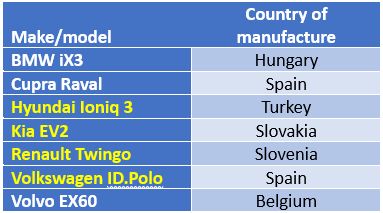
In alphabetical order, they are:
As a bit of background – the award is specifically intended as an independent selection of one winner (with two runners-up), judged as the most outstanding new car to go on sale in the 12 months before the date of the award. (There are no categories, sub-divisions or classes).
Judged by a broad panel of sixty-five senior motoring writers representing 25 countries across Europe and the UK, the award is run by a non-profit institution, independent of the motor industry.
Running since 1964, the first BEV to win Car of the Year was the Nissan Leaf back in 2011. 2022 was then the first time the top three positions were taken up by BEVs, and this year is the first time the full short-list of seven contenders contains nothing but BEVs. As such, it surely must be sending shivers down the spines of those manufacturers still focussing on internal combustion-based technology.
One sad fact though of this list is the four shown in yellow. These are either definitely, (or in the case of the ID.Polo, probably) NOT coming to Australia. Worse still, last year’s winner (the Renault 5 E-Tech) is also definitely not coming here. In addition, whilst many larger cars were in the long-list, only one was judged to be of sufficient merit for short-listing: the Volvo EX60.
All the rest are small to light cars. Surely if these extremely popular, strong-selling smaller BEVs can also be judged as the best BEVs available there – it must be ringing some alarm bells somewhere with Australian BEV importers that they are missing an opportunity? With the sorts of positive reviews they are receiving (and now major awards), half the sales job here has already been done.
Another point of note is no Chinese manufacturers or manufactured BEVs appear in this year’s short-list, although quite a number were evaluated in the initial long-list. Perhaps their arrival into a future short-list (which is inevitable) will be the marker of more than a few shivers down the spines of the exclusively European-built cars in this year’s list?
Update: I did forget to add, as another one of those “signs of things to come”: whilst Renault is a European company and the Twingo is built in Europe, the Twingo’s R&D process was done in China ... in a mere 21 months - something that will more than likely send a few more shivers down the spines of Europe’s BEV makers, should it take out the top prize.